give answer in 2 step with explanation at the end of each step and final answer at the end:
4. Copper Oxide Layers The common building blocks for most high temperature (high Tc) su perconductors are copper oxide layers as shown in the figure below.
Assume the distance between the copper atoms (dark circles) is a. For simplicity assume that in the third dimension these CuO2 layers are simply stacked ( copper above copper, oxygen above oxygen) with spacing c, and there are no other atoms in the crystal structure. In first approximation, the layers have four -fold symmetry; the crystal is tetragonal. 0.0.0.0 0.0. 0.0. (i) tetragonal (ii) orthorhombic (a) Sketch the Bravais lattice and indicate a possible set of primitive lattice vectors. What is the unit cell, and what is the basis? (b) In La2CuO4 one discovers at closer inspection, that the CuO2 lattice is actually not flat; but that the oxygen atoms are moved out of the plane ( up or down) in an alternating fashion (see the figure above where + means up and means down. What is the primitive cell and lattice spacing for this crystal ?
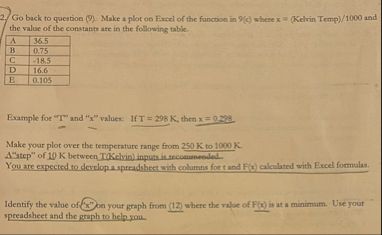
What is the reciprocal lattice ?Go nko giv 6) Mok loc Ec fe fc 4 wb Gn Tem) 1012
(hh Bos he re
fms)
[for —]
he
[Tuite
Fane oT and he UT DAK hems
Sake pone plo ree hermes ge bm 50K MEO K.
A 10K vr cp mmr
‘Yous expscid 0 develop. suede wih come oe sed Ff) caelind wih Excel foun
iyo ott oe gf 1 we eof P ms mm U5
Question:
give answer in 2 step with explanation at the end of each step and final answer at the end:
4. Copper Oxide Layers The common building blocks for most high temperature (high Tc) su perconductors are copper oxide layers as shown in the figure below.
Assume the distance between the copper atoms (dark circles) is a. For simplicity assume that in the third dimension these CuO2 layers are simply stacked ( copper above copper, oxygen above oxygen) with spacing c, and there are no other atoms in the crystal structure. In first approximation, the layers have four -fold symmetry; the crystal is tetragonal. 0.0.0.0 0.0. 0.0. (i) tetragonal (ii) orthorhombic (a) Sketch the Bravais lattice and indicate a possible set of primitive lattice vectors. What is the unit cell, and what is the basis? (b) In La2CuO4 one discovers at closer inspection, that the CuO2 lattice is actually not flat; but that the oxygen atoms are moved out of the plane ( up or down) in an alternating fashion (see the figure above where + means up and means down. What is the primitive cell and lattice spacing for this crystal ?
What is the reciprocal lattice ?Go nko giv 6) Mok loc Ec fe fc 4 wb Gn Tem) 1012
(hh Bos he re
fms)
[for —]
he
[Tuite
Fane oT and he UT DAK hems
Sake pone plo ree hermes ge bm 50K MEO K.
A 10K vr cp mmr
‘Yous expscid 0 develop. suede wih come oe sed Ff) caelind wih Excel foun
iyo ott oe gf 1 we eof P ms mm U5
This is AI generated Response.
Asked by: Rahulkumar
Created at: 2025-09-02 05:27:06
Final Answer:
RenderedRaw Text
Did you like this answer?
Let's break down your **Copper Oxide Layers** question into two steps as requested:
---
### (a) **Bravais Lattice, Primitive Vectors, Unit Cell, and Basis**
**Step 1: Sketching the Bravais lattice and primitive vectors (Tetragonal case)**
- **Bravais lattice:**
The copper oxide layers (CuO₂) have a **tetragonal lattice** in the simplest approximation. This means the lattice has four-fold symmetry in the plane and is stacked identically in the third dimension.
- **Primitive lattice vectors:**
If the distance between copper atoms is **a** and the stacking distance is **c**, the primitive vectors are:
- **a₁ = a x̂**
- **a₂ = a ŷ**
- **a₃ = c ẑ**
- **Unit Cell:**
The unit cell is a rectangular prism (a × a × c).
- **Basis:**
For the CuO₂ layer, the **basis** consists of:
- 1 Cu atom at (0, 0, 0)
- 2 O atoms at (½, 0, 0) and (0, ½, 0) (in units of a)
**Explanation:**
In the tetragonal approximation, the Cu atoms sit at the corners of the square lattice, and the O atoms are centered on the edges between Cu atoms, forming the CuO₂ layer.
---
### (b) **La₂CuO₄ - Distorted Structure, Primitive Cell, and Reciprocal Lattice**
**Step 2: Distorted structure (Orthorhombic-like), primitive cell, and reciprocal lattice**
- **Distorted structure:**
In La₂CuO₄, the O atoms are displaced **alternately up and down** out of the CuO₂ plane, so the lattice is **no longer perfectly tetragonal**; it becomes **orthorhombic** (unit cell parameters: a ≠ b ≠ c).
- **Primitive cell:**
The primitive cell must now be **doubled along one direction** to account for the up/down alternation of O atoms. So, the primitive cell size becomes **a × a × 2c** if the alternation is along the c-axis.
- **Lattice spacing:**
The spacing between repeating units along c is now **2c** because of the up/down alternation.
- **Basis:**
The basis now includes:
- 1 Cu atom at (0, 0, 0)
- 2 O atoms at (½, 0, δ) and (0, ½, –δ) where δ is the displacement above and below the plane.
- **Reciprocal lattice:**
For the tetragonal cell, the reciprocal lattice vectors are:
- **b₁ = (2π/a) x̂**
- **b₂ = (2π/a) ŷ**
- **b₃ = (2π/c) ẑ**
For the doubled cell (along c), the z-component becomes:
- **b₃' = (2π)/(2c) = π/c**
**Explanation:**
The doubling of the unit cell along c due to oxygen displacement halves the periodicity in reciprocal space along z, so the Brillouin zone is smaller in that direction.
---
## **Final Answer:**
1. **(a) In the simple tetragonal CuO₂ structure, the primitive lattice vectors are a₁ = a x̂, a₂ = a ŷ, a₃ = c ẑ; the unit cell is a × a × c, and the basis is 1 Cu at (0,0,0), and 2 O at (½,0,0), (0,½,0).**
2. **(b) In La₂CuO₄, with alternating O displacement, the primitive cell is doubled along c (a × a × 2c), the basis includes displaced O atoms at (½,0,δ) and (0,½,–δ), and the reciprocal lattice vectors are (2π/a, 2π/a, π/c).**
Question:
Solve 2
This is AI generated Response.
Asked by: Rahulkumar
Created at: 2025-09-02 06:47:59
Final Answer:
RenderedRaw Text
Did you like this answer?
Let's proceed step-by-step to understand the effects of oxygen atom displacement in La₂CuO₄ on its lattice and reciprocal lattice.
---
### **Step 1: Understanding the Structural Distortion**
**Explanation:**
In the ideal CuO₂ layer, oxygen atoms lie perfectly in the plane, resulting in a simple tetragonal lattice with lattice vectors:
- **Primitive vectors:**
\[
\mathbf{a}_1 = a \hat{\mathbf{x}}, \quad \mathbf{a}_2 = a \hat{\mathbf{y}}, \quad \mathbf{a}_3 = c \hat{\mathbf{z}}
\]
- **Basis:**
- Cu at \((0, 0, 0)\)
- O at \((\frac{1}{2}, 0, 0)\) and \((0, \frac{1}{2}, 0)\) (fractional coordinates relative to the lattice)
In La₂CuO₄, the oxygen atoms are displaced **alternately up and down** along the z-axis (out of the plane). This **breaks the perfect tetragonal symmetry**, leading to a **doubling of the unit cell** along the c-axis to accommodate the alternating displacement pattern.
---
### **Step 2: Primitive Cell and Lattice Spacing**
**Explanation:**
- The **original** unit cell has size \(a \times a \times c\).
- Due to the **alternating up/down** displacement of oxygen atoms, the **primitive cell** must now contain **two layers** along the c-axis to include both oxygen positions.
**Result:**
- The **new primitive cell** in the **distorted structure** has:
\[
\boxed{
\text{Size}: \quad a \times a \times 2c
}
\]
- The **lattice points** are now separated by **\(2c\)** along the z-direction, because the pattern repeats every two layers.
**Basis positions:**
- Cu at \((0,0,0)\)
- Oxygen atoms at \(\left(\frac{1}{2}, 0, \delta\right)\) and \(\left(0, \frac{1}{2}, -\delta\right)\), where \(\delta\) is the displacement magnitude along z (up or down).
This **doubling** captures the **alternation of oxygen positions**.
---
### **Final Summary:**
- The **primitive cell** in La₂CuO₄, accounting for oxygen displacement, is **doubled along the c-axis**:
\[
\boxed{
\text{Primitive cell dimensions}: \quad a \times a \times 2c
}
\]
- The **basis atoms** include Cu at \((0,0,0)\) and O atoms at \(\left(\frac{1}{2}, 0, \pm \delta\right)\), \(\left(0, \frac{1}{2}, \pm \delta\right)\).
- The **reciprocal lattice vectors** for this **doubled cell** are:
\[
\mathbf{b}_1 = \frac{2\pi}{a} \hat{\mathbf{x}}, \quad \mathbf{b}_2 = \frac{2\pi}{a} \hat{\mathbf{y}}, \quad \mathbf{b}_3 = \frac{\pi}{c} \hat{\mathbf{z}}
\]
This reduction in the Brillouin zone along the z-direction reflects the physical doubling of the real-space periodicity due to oxygen displacement.
---
**In brief:**
- **Primitive cell in La₂CuO₄:** \(a \times a \times 2c\)
- **Lattice spacing:** doubled along c
- **Reciprocal lattice vectors:** \(\mathbf{b}_1 = \frac{2\pi}{a} \hat{\mathbf{x}}\), \(\mathbf{b}_2 = \frac{2\pi}{a} \hat{\mathbf{y}}\), \(\mathbf{b}_3 = \frac{\pi}{c} \hat{\mathbf{z}}\)
---
If you need further details or clarification, feel free to ask!
VIPSolutions focuses on clear, step‑by‑step explanations so you can learn quickly. Whether you need an AI‑generated walkthrough or a short hint to get unstuck, each solution is organized for fast reading and easy review later.
Search similar questions, compare approaches, and bookmark the best answers for revision. Our goal is simple: quick, reliable study help that feels natural—not noisy.
 VIPSolutions
 Go nko giv 6) Mok loc Ec fe fc 4 wb Gn Tem) 1012
(hh Bos he re
fms)
[for —]
he
[Tuite
Fane oT and he UT DAK hems
Sake pone plo ree hermes ge bm 50K MEO K.
A 10K vr cp mmr
‘Yous expscid 0 develop. suede wih come oe sed Ff) caelind wih Excel foun
iyo ott oe gf 1 we eof P ms mm U5