This is AI generated Response.
Asked by: Pagal
Created at: 2025-08-31 05:59:34
Final Answer:
RenderedRaw Text
Did you like this answer?
Let's break it down step-by-step as requested:
---
### **2(a) Cartesian Equation for the Plane**
**Step 1: Find a point and two direction vectors in the plane.**
- **Point on \( L_1 \):**
\( L_1: \frac{x-1}{2} = \frac{y-2}{3} = \frac{z-1}{1} = t \)
So, a point on \( L_1 \) (when \( t=0 \)):
\( (x,y,z) = (1,2,1) \).
- **Direction vector of \( L_1 \):**
From the denominators: \( \vec{d_1} = (2,3,1) \).
- **Direction vector of \( L_2 \):**
\( L_2: \frac{x-2}{1} = \frac{y+1}{-2} = \frac{z-4}{-2} \)
Direction vector: \( \vec{d_2} = (1,-2,-2) \).
- **The plane contains \( L_1 \) (so it contains \( (1,2,1) \) and direction \( (2,3,1) \)), and is parallel to \( L_2 \) (so direction \( (1,-2,-2) \) is also in the plane).**
**Step 1 Explanation:**
We need a plane containing a given point and two direction vectors (one from \( L_1 \), one from \( L_2 \)), because the plane must contain \( L_1 \) and be parallel to \( L_2 \).
---
**Step 2: Find the normal vector and write the equation.**
- Two direction vectors in the plane: \( \vec{d_1} = (2,3,1) \), \( \vec{d_2} = (1,-2,-2) \).
- Normal vector \( \vec{n} = \vec{d_1} \times \vec{d_2} \):
\[
\vec{n} =
\begin{vmatrix}
\mathbf{i} & \mathbf{j} & \mathbf{k} \\
2 & 3 & 1 \\
1 & -2 & -2 \\
\end{vmatrix}
= \mathbf{i}(3 \cdot -2 - 1 \cdot -2) - \mathbf{j}(2 \cdot -2 - 1 \cdot 1) + \mathbf{k}(2 \cdot -2 - 3 \cdot 1)
\]
\[
= \mathbf{i}(-6 + 2) - \mathbf{j}(-4 - 1) + \mathbf{k}(-4 - 3)
= \mathbf{i}(-4) - \mathbf{j}(-5) + \mathbf{k}(-7)
= (-4, 5, -7)
\]
- Equation of the plane through \( (1,2,1) \) with normal \( (-4,5,-7) \):
\[
-4(x-1) + 5(y-2) - 7(z-1) = 0
\]
or
\[
-4x + 5y - 7z + 4 - 10 + 7 = 0
\]
\[
-4x + 5y - 7z + 1 = 0
\]
**Step 2 Explanation:**
The normal vector is found using the cross product of the two direction vectors. The Cartesian equation is derived from the point-normal form of a plane.
---
**Final Answer for 2(a):**
\[
\boxed{-4x + 5y - 7z + 1 = 0}
\]
---
## **2(b) True/False Statements**
### i. For \( a, b, c \in \mathbb{R}^n \), if \( a-b=0 \) and \( a-c=0 \), then \( b-c=0 \).
**Step 1:**
If \( a-b=0 \Rightarrow a = b \) and \( a-c=0 \Rightarrow a = c \).
**Step 1 Explanation:**
Both \( b \) and \( c \) are equal to \( a \).
**Step 2:**
Since \( b = c \), \( b-c = 0 \).
**Step 2 Explanation:**
Subtracting equal vectors gives the zero vector.
**Final Answer for (i):**
**True.**
---
### ii. For two planes in \( \mathbb{R}^3 \) with normals \( n_1, n_2 \) that intersect in a line with direction vector \( d \), \( d \) is always parallel to \( n_1 \times n_2 \).
**Step 1:**
The direction vector \( d \) of the intersection line of two planes is given by the cross product of their normals: \( d = n_1 \times n_2 \).
**Step 1 Explanation:**
The intersection line is perpendicular to both normal vectors, and the cross product gives such a direction.
**Step 2:**
Therefore, \( d \) is always parallel to \( n_1 \times n_2 \).
**Step 2 Explanation:**
This is a standard result in 3D analytic geometry.
**Final Answer for (ii):**
**True.**
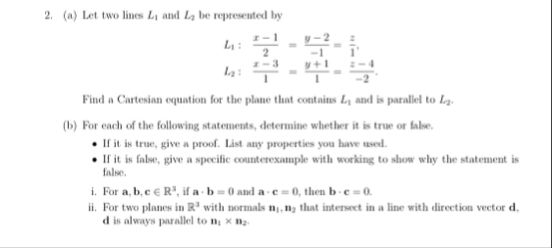
Question:
2
.
(
a
)
Let two lines
L
1
and
L
2
be represented by
L
1
:
x
-
1
2
=
y
-
2
-
1
=
z
1
L
2
:
x
-
3
1
=
y
1
1
=
z
-
4
-
2
Find a Cartesian equation for the plane that contains
L
1
and is parallel to
L
2
.
(
b
)
For each of the following statements, determine whether it is true or false.
If it is true, give a proof. List any properties you have used.
If it is false, give a specific counterexample with working to show why the statement is false.
i
.
For
a
,
b
,
c
i
n
R
3
,
if
a
*
b
=
0
and
a
*
c
=
0
,
then
b
*
c
=
0
.
ii
.
For two planes in
R
3
with normals
n
1
,
n
2
that intersect in a line with direction vector
d
,
d
is always parallel to
n
1
×
n
2
.
This is AI generated Response.
Asked by: Pagal
Created at: 2025-08-31 06:02:11
Final Answer:
RenderedRaw Text
Did you like this answer?
Let's carefully solve each part step-by-step.
---
## **2(a) Cartesian Equation of the Plane**
### **Step 1: Identify a point and direction vectors**
Given lines:
\[
L_1: \frac{x - 1}{2} = \frac{y - 2}{-1} = \frac{z - 1}{1}
\]
- **Point on \( L_1 \):**
When the parameter \( t=0 \):
\[
x=1, \quad y=2, \quad z=1
\]
- **Direction vector of \( L_1 \):**
From the denominators:
\[
\vec{d}_1 = (2, -1, 1)
\]
---
Given lines:
\[
L_2: \frac{x - 3}{1} = \frac{y - 1}{1} = \frac{z - 4}{-2}
\]
- **Direction vector of \( L_2 \):**
\[
\vec{d}_2 = (1, 1, -2)
\]
---
### **Step 2: Find the plane containing \( L_1 \) and parallel to \( L_2 \)**
- The plane **must contain** \( L_1 \), so it contains point \( P=(1,2,1) \).
- The plane is **parallel** to \( L_2 \), meaning the direction vector \( \vec{d}_2 \) is **parallel to** the plane (but not necessarily in the plane).
**Key insight:**
The plane contains \( L_1 \), so it contains \( \vec{d}_1 \).
It is **parallel** to \( L_2 \), so the vector \( \vec{d}_2 \) is **parallel** to the plane (but not necessarily in it).
This implies the plane contains \( \vec{d}_1 \) and is **parallel** to \( \vec{d}_2 \).
- The **normal vector** \( \vec{n} \) of the plane should be perpendicular to both \( \vec{d}_1 \) and \( \vec{d}_2 \).
### **Step 3: Calculate the normal vector**
\[
\vec{n} = \vec{d}_1 \times \vec{d}_2
\]
\[
\vec{n} =
\begin{vmatrix}
\mathbf{i} & \mathbf{j} & \mathbf{k} \\
2 & -1 & 1 \\
1 & 1 & -2 \\
\end{vmatrix}
\]
Calculate the cross product:
\[
\vec{n} = \mathbf{i}((-1)\times(-2) - 1 \times 1) - \mathbf{j}(2 \times (-2) - 1 \times 1) + \mathbf{k}(2 \times 1 - (-1) \times 1)
\]
\[
= \mathbf{i} (2 - 1) - \mathbf{j} (-4 - 1) + \mathbf{k} (2 + 1)
\]
\[
= \mathbf{i} (1) - \mathbf{j} (-5) + \mathbf{k} (3)
\]
\[
\Rightarrow \vec{n} = (1, 5, 3)
\]
### **Step 4: Write the Cartesian equation**
Using point \( (1, 2, 1) \):
\[
1(x - 1) + 5(y - 2) + 3(z - 1) = 0
\]
\[
(x - 1) + 5(y - 2) + 3(z - 1) = 0
\]
Expand:
\[
x - 1 + 5y - 10 + 3z - 3 = 0
\]
\[
x + 5y + 3z - 14 = 0
\]
---
## **Final answer for 2(a):**
\[
\boxed{x + 5y + 3z = 14}
\]
---
## **2(b) True/False Statements**
### **i. If \( a, b, c \in \mathbb{R}^3 \) and \( a \times b = 0 \) and \( a \times c = 0 \), then \( b \times c = 0 \).**
**Step 1:**
Recall that \( a \times b = 0 \) implies \( a \) and \( b \) are **parallel** (or one is zero). Similarly, \( a \times c = 0 \) implies \( a \) and \( c \) are **parallel** (or one is zero).
- So, \( b \) and \( c \) are both parallel to \( a \) (or \( a \) is zero).
**Step 2:**
- If \( a \neq 0 \), then \( b = \lambda a \) and \( c = \mu a \):
\[
b \times c = (\lambda a) \times (\mu a) = \lambda \mu (a \times a) = 0
\]
since the cross product of any vector with itself is zero.
- If \( a=0 \), then \( a \times b=0 \) and \( a \times c=0 \) hold trivially, and \( b, c \) can be arbitrary. In that case, \( b \) and \( c \) are not necessarily parallel, so \( b \times c \) may **not** be zero.
**Counterexample:**
Let \( a=0 \), \( b=(1,0,0) \), \( c=(0,1,0) \):
\[
a \times b = 0, \quad a \times c = 0, \quad \text{but} \quad b \times c = (0,0,1) \neq 0
\]
Thus, the statement is **false**.
---
### **ii. For two planes in \( \mathbb{R}^3 \) with normals \( n_1, n_2 \), if they intersect in a line with direction vector \( d \), then \( d \) is always parallel to \( n_1 \times n_2 \).**
**Step 1:**
The line of intersection of two planes is perpendicular to both normals, so its direction vector is proportional to the cross product:
\[
d \parallel n_1 \times n_2
\]
**Step 2:**
Since the cross product gives a vector perpendicular to both \( n_1 \) and \( n_2 \), \( d \) must be parallel to \( n_1 \times n_2 \).
**Final conclusion:**
The statement is **true**.
---
## **Summary:**
### **Final answers:**
**2(a):**
\[
\boxed{x + 5y + 3z = 14}
\]
**2(b):**
- (i) **False** (counterexample: \( a=0 \), \( b=(1,0,0) \), \( c=(0,1,0) \))
- (ii) **True**
VIPSolutions focuses on clear, step‑by‑step explanations so you can learn quickly. Whether you need an AI‑generated walkthrough or a short hint to get unstuck, each solution is organized for fast reading and easy review later.
Search similar questions, compare approaches, and bookmark the best answers for revision. Our goal is simple: quick, reliable study help that feels natural—not noisy.
 VIPSolutions
 2. (a) Lot two lies Ly and Ly be represented by
Lg =
= 2s 2h 5 .
£23 _ per im
hi =p = Sep
Find n Cotesia equation fo the ple ths conte £, sd in paralie 0 L
(1b) For each of the following statements, determine whether it is trae of fake.
o 1011 tre, give pro. Lint any propetin ou have wd
© IF it bs fab, give n specific counterexample with working to show why the statement is
abe
i Fura be eR ifn b=Oanda-c=0,thenb-c=0.
i. For two planes in 2? with normal wy, that intersect in ie with dieetion vetoed,
lo abvayn parle ot %