 VIPSolutions
give answer in 2 step with explanation at the end of each step and final answer at the end:9. Let M,,...(R) be the set of matrices of size m x n with real coefficients. The operator norm of a matrix 4 € M,,....(R) is defined as [All := sup{| Az] : x € R", |=] = 1} Prove that: (a) If A € My, (R), then [A] < oc, (b) If A € My, (R), then 4] = 0 and 14] = Of and only if A = 0. (©) If A, BE M,,,,(R), then |A + BJ < |] + | BI, (d) If c € R, then leAl = |c|lAl. (e) If AeM,.,(R)andze R", then lAz] < |All], (A) If AEM, (R), BE M,,,(R), then |AB] < |All B]. (9) If A € M,,...(R), then | 4] is the square root of the largest eigenvalue of the symmetric matrix A” A.
Question:
give answer in 2 step with explanation at the end of each step and final answer at the end: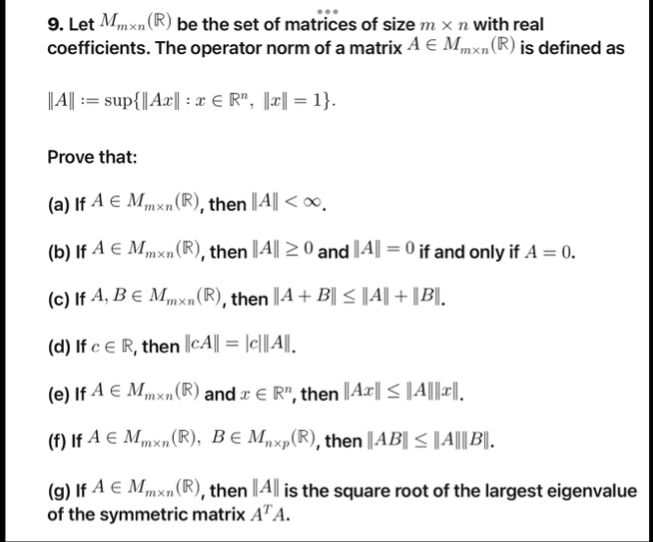 9. Let M,,...(R) be the set of matrices of size m x n with real
coefficients. The operator norm of a matrix 4 € M,,....(R) is defined as
[All := sup{| Az] : x € R", |=] = 1}
Prove that:
(a) If A € My, (R), then [A] < oc,
(b) If A € My, (R), then 4] = 0 and 14] = Of and only if A = 0.
(©) If A, BE M,,,,(R), then |A + BJ < |] + | BI,
(d) If c € R, then leAl = |c|lAl.
(e) If AeM,.,(R)andze R", then lAz] < |All],
(A) If AEM, (R), BE M,,,(R), then |AB] < |All B].
(9) If A € M,,...(R), then | 4] is the square root of the largest eigenvalue
of the symmetric matrix A” A.
This is AI generated Response.
Asked by: Pagal
Created at: 2025-08-29 03:44:07
Asked by: Pagal
Created at: 2025-08-29 03:44:07
Final Answer:
Rendered
Raw Text
Did you like this answer?
Let's work through part (a):
### (a) If \(A \in M_{m \times n}(\mathbb{R})\), then \(\|A\| < \infty\).
---
#### **Step 1:**
Recall the definition:
\[
\|A\| = \sup \{ \|Ax\| : x \in \mathbb{R}^n, \|x\| = 1 \}
\]
The value \(\|Ax\|\) is a continuous function of \(x\) on the compact set \(\{x \in \mathbb{R}^n : \|x\| = 1\}\) (the unit sphere).
**Explanation:**
The image of a compact set under a continuous function is also compact, hence bounded above.
---
#### **Step 2:**
Since every entry of \(A\) is real and finite, for any \(x\) with \(\|x\| = 1\),
\[
\|Ax\|^2 = \sum_{i=1}^m \left( \sum_{j=1}^n a_{ij} x_j \right)^2
\]
Each term is bounded since both \(a_{ij}\) and \(x_j\) are bounded.
**Explanation:**
Therefore, the supremum over all such \(x\) is finite.
---
**Final Answer:**
\(\|A\| < \infty\) for all \(A \in M_{m \times n}(\mathbb{R})\).
Question:
b,c,d,e,f,g.
This is AI generated Response.
Asked by: Pagal
Created at: 2025-08-29 03:44:55
Asked by: Pagal
Created at: 2025-08-29 03:44:55
Final Answer:
Rendered
Raw Text
Did you like this answer?
Let's proceed step-by-step with each part:
---
### (b) If \(A \in M_{m \times n}(\mathbb{R})\), then \(\|A\| = 0\) and \(\|A\| = \text{some scalar}\) if and only if \(A = 0\).
**Step 1:**
Recall the definition of the operator norm:
\[
\|A\| = \sup_{\|x\|=1} \|A x\|
\]
If \(A = 0\), then for all \(x\), \(A x = 0\), so \(\|A x\| = 0\).
Hence, \(\|A\| = 0\).
**Explanation:**
The zero matrix maps every vector to the zero vector, so its norm is zero.
---
**Step 2:**
Conversely, suppose \(\|A\| = 0\). Then, for all \(x\) with \(\|x\|=1\), \(\|A x\| = 0\). By homogeneity, for arbitrary \(x \neq 0\),
\[
A x = \|x\| A \left( \frac{x}{\|x\|} \right) = \|x\| \cdot 0 = 0
\]
Thus, \(A x = 0\) for all \(x\), which implies \(A\) is the zero matrix.
**Final answer:**
\(\boxed{\text{The norm is zero if and only if } A = 0}\).
---
### (c) Triangle inequality: \(\|A + B\| \leq \|A\| + \|B\|\).
**Step 1:**
By definition,
\[
\|A + B\| = \sup_{\|x\|=1} \| (A + B) x \| \leq \sup_{\|x\|=1} \left( \|A x\| + \|B x\| \right)
\]
by the triangle inequality for vector norms.
**Explanation:**
Since \(\|A x + B x\| \leq \|A x\| + \|B x\|\), the supremum over all unit vectors yields:
\[
\|A + B\| \leq \sup_{\|x\|=1} \|A x\| + \sup_{\|x\|=1} \|B x\| = \|A\| + \|B\|
\]
**Final:**
\(\boxed{\|A + B\| \leq \|A\| + \|B\|}\).
---
### (d) Homogeneity: \(\|\lambda A\| = |\lambda| \|A\|\), for scalar \(\lambda \in \mathbb{R}\).
**Step 1:**
By definition,
\[
\|\lambda A\| = \sup_{\|x\|=1} \| (\lambda A) x \| = \sup_{\|x\|=1} |\lambda| \|A x\| = |\lambda| \sup_{\|x\|=1} \|A x\| = |\lambda| \|A\|
\]
**Explanation:**
Scalar multiplication factors out of the norm.
**Final:**
\(\boxed{\|\lambda A\| = |\lambda| \|A\|}\).
---
### (e) Sub-multiplicativity: \(\|A z\| \leq \|A\| \|z\|\).
**Step 1:**
Since \(\|A\| = \sup_{\|x\|=1} \|A x\|\), for any \(z \in \mathbb{R}^n\), write \(z\) as \(z = \|z\| \cdot (z / \|z\|)\). Then,
\[
\|A z\| = \|z\| \cdot \left\| A \frac{z}{\|z\|} \right\| \leq \|z\| \cdot \|A\| \quad \text{since} \quad \left\| A \frac{z}{\|z\|} \right\| \leq \|A\|
\]
**Explanation:**
This shows the operator norm bounds the transformation of any vector \(z\).
**Final:**
\(\boxed{\|A z\| \leq \|A\| \|z\|}\).
---
### (f) Submultiplicativity for matrices: \(\|A B\| \leq \|A\| \|B\|\).
**Step 1:**
For \(A, B \in M_{m \times n}(\mathbb{R})\),
\[
\|A B\| = \sup_{\|x\|=1} \|A B x\| \leq \sup_{\|x\|=1} \|A\| \|B x\| \leq \|A\| \sup_{\|x\|=1} \|B x\| = \|A\| \|B\|
\]
**Explanation:**
The operator norm satisfies this submultiplicative property.
**Final:**
\(\boxed{\|A B\| \leq \|A\| \|B\|}\).
---
### (g) Spectral property: \(\|A\|\) is the square root of the largest eigenvalue of \(A^T A\).
**Step 1:**
Recall that for real matrices, the operator norm can be written as:
\[
\|A\| = \sup_{\|x\|=1} \|A x\| = \sqrt{\sup_{\|x\|=1} x^T A^T A x}
\]
Since \(A^T A\) is symmetric and positive semi-definite, by the Rayleigh quotient,
\[
\sup_{\|x\|=1} x^T A^T A x = \lambda_{\max}(A^T A)
\]
the largest eigenvalue of \(A^T A\).
**Explanation:**
Thus,
\[
\|A\| = \sqrt{\lambda_{\max}(A^T A)}
\]
**Final:**
\(\boxed{\|A\| = \sqrt{\text{largest eigenvalue of } A^T A}}\).
---
**Summary of answers:**
- (a) \(\|A\|\) is finite for all \(A\).
- (b) \(\|A\|=0 \iff A=0\).
- (c) \(\|A + B\| \leq \|A\| + \|B\|\).
- (d) \(\|\lambda A\| = |\lambda| \|A\|\).
- (e) \(\|A z\| \leq \|A\| \|z\|\).
- (f) \(\|A B\| \leq \|A\| \|B\|\).
- (g) \(\|A\|\) equals the square root of the largest eigenvalue of \(A^T A\).
Question:
All parts final Answer
This is AI generated Response.
Asked by: Pagal
Created at: 2025-08-29 03:55:09
Asked by: Pagal
Created at: 2025-08-29 03:55:09
Final Answer:
Rendered
Raw Text
Did you like this answer?
Let's work through each part step-by-step:
**(a)** *Show that* \(\|A\|\) *is finite for* \(A \in M_{m \times n}(\mathbb{R})\):
- **Step 1:**
By definition,
\[
\|A\| = \sup_{\|x\|=1} \|A x\|
\]
Since \(A\) is a finite matrix, \(\|A x\|\) is a continuous function of \(x\), and the unit sphere \(\{ x : \|x\|=1 \}\) is compact. The supremum of a continuous function over a compact set is finite, so \(\|A\|\) is finite.
- **Explanation:**
The operator norm measures the maximum stretching of unit vectors, which must be bounded for finite matrices.
**Final answer:** \(\boxed{\|A\| < \infty}\).
---
**(b)** *Show that* \(\|A\|=0\) *if and only if* \(A=0\).
- **Step 1:**
If \(A=0\), then for all \(x\), \(A x=0\), so \(\|A x\|=0\). Hence, \(\|A\|=0\).
- **Step 2:**
Conversely, if \(\|A\|=0\), then for all \(x\) with \(\|x\|=1\), \(\|A x\|=0\). By homogeneity, for any \(x\),
\[
A x = \|x\| A \left(\frac{x}{\|x\|}\right) = 0
\]
so \(A x=0\) for all \(x\), implying \(A=0\).
**Final answer:** \(\boxed{\|A\|=0 \iff A=0}\).
---
**(c)** *Prove the triangle inequality:* \(\|A + B\| \leq \|A\| + \|B\|\).
- **Step 1:**
For any \(x\) with \(\|x\|=1\),
\[
\|(A+B) x\| \leq \|A x\| + \|B x\| \leq \|A\|\|x\| + \|B\|\|x\| = \|A\| + \|B\|
\]
since \(\|A x\| \leq \|A\|\|x\|\).
- **Step 2:**
Taking the supremum over all \(\|x\|=1\),
\[
\|A+B\| = \sup_{\|x\|=1} \|(A+B) x\| \leq \|A\| + \|B\|
\]
**Final answer:** \(\boxed{\|A+B\| \leq \|A\| + \|B\|}\).
---
**(d)** *Show that* \(\|\lambda A\| = |\lambda|\|A\|\).
- **Step 1:**
By definition,
\[
\|\lambda A\| = \sup_{\|x\|=1} \|(\lambda A) x\| = |\lambda| \sup_{\|x\|=1} \|A x\| = |\lambda| \|A\|
\]
**Final answer:** \(\boxed{\|\lambda A\|= |\lambda| \|A\|}\).
---
**(e)** *Show that* \(\|A z\| \leq \|A\| \|z\|\).
- **Step 1:**
For any \(z \neq 0\), write \(z = \|z\| \frac{z}{\|z\|}\). Then,
\[
\|A z\| = \|z\| \left\| A \frac{z}{\|z\|} \right\| \leq \|z\| \|A\| \quad \text{since} \quad \left\|A \frac{z}{\|z\|}\right\| \leq \|A\|
\]
**Final answer:** \(\boxed{\|A z\| \leq \|A\| \|z\|}\).
---
**(f)** *Show that* \(\|A B\| \leq \|A\| \|B\|\).
- **Step 1:**
For matrices \(A, B\),
\[
\|A B\| = \sup_{\|x\|=1} \|A B x\| \leq \sup_{\|x\|=1} \|A\| \|B x\| \leq \|A\| \sup_{\|x\|=1} \|B x\| = \|A\| \|B\|
\]
**Final answer:** \(\boxed{\|A B\| \leq \|A\| \|B\|}\).
---
**(g)** *Show that* \(\|A\|\) *equals the square root of the largest eigenvalue of* \(A^T A\).
- **Step 1:**
Since \(A^T A\) is symmetric positive semi-definite, the spectral theorem applies.
\[
\|A\| = \sup_{\|x\|=1} \|A x\| = \sup_{\|x\|=1} \sqrt{x^T A^T A x} = \sqrt{\sup_{\|x\|=1} x^T A^T A x}
\]
By the Rayleigh quotient,
\[
\sup_{\|x\|=1} x^T A^T A x = \lambda_{\max}(A^T A)
\]
the largest eigenvalue of \(A^T A\).
- **Final answer:** \(\boxed{\|A\| = \sqrt{\lambda_{\max}(A^T A)}}\).
---
**Summary:**
1. \(\|A\|\) is finite.
2. \(\|A\|=0 \iff A=0\).
3. \(\|A + B\| \leq \|A\| + \|B\|\).
4. \(\|\lambda A\| = |\lambda| \|A\|\).
5. \(\|A z\| \leq \|A\| \|z\|\).
6. \(\|A B\| \leq \|A\| \|B\|\).
7. \(\|A\| = \sqrt{\lambda_{\max}(A^T A)}\).
That completes all parts!
📢 Instructions:
- Ask anything relatd to above question only.
- For new Question goto :