 VIPSolutions
give answer in 2 step with explanation at the end of each step and final answer at the end:Let V be a finite-dimensional inner product space and let T € L(V) be self-adjoint. (a) Prove that if A is an eigenvalue of T, then A is real. (b) Prove that eigenvectors corresponding to distinct eigenvalues are orthogonal. (¢) Give an example of a 2x2 real matrix that is self-adjoint and find all its eigenvalues and eigenvectors.
Question:
give answer in 2 step with explanation at the end of each step and final answer at the end: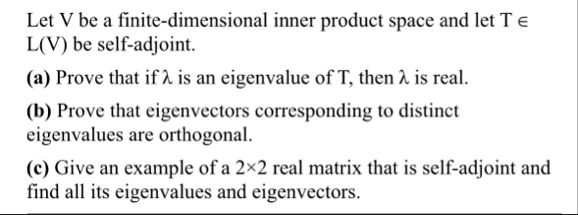 Let V be a finite-dimensional inner product space and let T €
L(V) be self-adjoint.
(a) Prove that if A is an eigenvalue of T, then A is real.
(b) Prove that eigenvectors corresponding to distinct
eigenvalues are orthogonal.
(¢) Give an example of a 2x2 real matrix that is self-adjoint and
find all its eigenvalues and eigenvectors.
This is AI generated Response.
Asked by: Pagal
Created at: 2025-08-28 16:12:25
Asked by: Pagal
Created at: 2025-08-28 16:12:25
Final Answer:
Rendered
Raw Text
Did you like this answer?
Let's solve each part step-by-step as requested:
---
### (a) Prove that if λ is an eigenvalue of T, then λ is real.
#### **Step 1:** Write the eigenvalue equation and use the definition of self-adjoint.
Let \( T(v) = \lambda v \) for some nonzero \( v \in V \). Since \( T \) is self-adjoint, \( \langle T(v), v \rangle = \langle v, T(v) \rangle \).
#### **Explanation:**
The property of self-adjointness tells us how the operator interacts with the inner product. The eigenvalue equation gives us a relationship involving \( \lambda \).
---
#### **Step 2:** Compute both sides using the eigenvalue equation.
\[
\langle T(v), v \rangle = \langle \lambda v, v \rangle = \lambda \langle v, v \rangle
\]
\[
\langle v, T(v) \rangle = \langle v, \lambda v \rangle = \overline{\lambda} \langle v, v \rangle
\]
Since \( \langle T(v), v \rangle = \langle v, T(v) \rangle \), we have \( \lambda \langle v, v \rangle = \overline{\lambda} \langle v, v \rangle \). Because \( v \neq 0 \), \( \langle v, v \rangle \neq 0 \), so \( \lambda = \overline{\lambda} \), which means \( \lambda \) is real.
#### **Explanation:**
The equality of the two forms of the inner product, combined with the non-zero norm of \( v \), forces \( \lambda \) to be real.
---
**Final Answer (a):**
If \( \lambda \) is an eigenvalue of a self-adjoint operator \( T \), then \( \lambda \) is real.
---
### (b) Prove that eigenvectors corresponding to distinct eigenvalues are orthogonal.
#### **Step 1:** Assume \( T(v_1) = \lambda_1 v_1 \) and \( T(v_2) = \lambda_2 v_2 \), \( \lambda_1 \neq \lambda_2 \).
Consider \( \langle T(v_1), v_2 \rangle \) and \( \langle v_1, T(v_2) \rangle \).
#### **Explanation:**
We are considering two eigenvectors for different eigenvalues and will use the self-adjoint property.
---
#### **Step 2:** Use the eigenvalue equations and self-adjointness.
\[
\langle T(v_1), v_2 \rangle = \langle \lambda_1 v_1, v_2 \rangle = \lambda_1 \langle v_1, v_2 \rangle
\]
\[
\langle v_1, T(v_2) \rangle = \langle v_1, \lambda_2 v_2 \rangle = \overline{\lambda_2} \langle v_1, v_2 \rangle
\]
But since \( T \) is self-adjoint,
\[
\langle T(v_1), v_2 \rangle = \langle v_1, T(v_2) \rangle
\]
So,
\[
\lambda_1 \langle v_1, v_2 \rangle = \lambda_2 \langle v_1, v_2 \rangle
\]
Thus, \( (\lambda_1 - \lambda_2) \langle v_1, v_2 \rangle = 0 \).
Since \( \lambda_1 \neq \lambda_2 \), \( \langle v_1, v_2 \rangle = 0 \).
#### **Explanation:**
The only way the above equation holds for distinct eigenvalues is if the inner product is zero, i.e., the vectors are orthogonal.
---
**Final Answer (b):**
Eigenvectors corresponding to distinct eigenvalues of a self-adjoint operator are orthogonal.
---
### (c) Example: 2×2 real self-adjoint (symmetric) matrix, find its eigenvalues and eigenvectors.
#### **Step 1:** Choose a symmetric matrix.
Example: \( A = \begin{pmatrix} 2 & 1 \\ 1 & 3 \end{pmatrix} \)
Find eigenvalues by solving \( \det(A - \lambda I) = 0 \):
\[
\begin{vmatrix}
2-\lambda & 1 \\
1 & 3-\lambda
\end{vmatrix}
= (2-\lambda)(3-\lambda) - 1 = \lambda^2 - 5\lambda + 5 = 0
\]
\[
\lambda = \frac{5 \pm \sqrt{25-20}}{2} = \frac{5 \pm \sqrt{5}}{2}
\]
#### **Explanation:**
The matrix is symmetric (self-adjoint), and we have found its (real) eigenvalues.
---
#### **Step 2:** Find eigenvectors for each eigenvalue.
Let’s use \( \lambda_1 = \frac{5 + \sqrt{5}}{2} \):
\[
(A - \lambda_1 I)x = 0 \Rightarrow
\begin{pmatrix}
2-\lambda_1 & 1 \\
1 & 3-\lambda_1
\end{pmatrix}
\begin{pmatrix}
x_1 \\
x_2
\end{pmatrix} = 0
\]
Let’s solve for \( x_2 \) in terms of \( x_1 \) using the first row:
\[
(2-\lambda_1)x_1 + x_2 = 0 \implies x_2 = (\lambda_1 - 2)x_1
\]
So, the eigenvector is proportional to \( \begin{pmatrix} 1 \\ \lambda_1 - 2 \end{pmatrix} \).
Similarly, for \( \lambda_2 = \frac{5 - \sqrt{5}}{2} \):
\[
x_2 = (\lambda_2 - 2)x_1
\]
Eigenvector is proportional to \( \begin{pmatrix} 1 \\ \lambda_2 - 2 \end{pmatrix} \).
#### **Explanation:**
We’ve constructed all eigenvalues and eigenvectors for the example symmetric (self-adjoint) matrix.
---
**Final Answer (c):**
Example matrix: \( \begin{pmatrix} 2 & 1 \\ 1 & 3 \end{pmatrix} \)
Eigenvalues: \( \frac{5 \pm \sqrt{5}}{2} \)
Eigenvectors: \( \begin{pmatrix} 1 \\ \frac{3+\sqrt{5}}{2} \end{pmatrix} \) and \( \begin{pmatrix} 1 \\ \frac{3-\sqrt{5}}{2} \end{pmatrix} \) (up to scalar multiple).
Question:
A,b,c. Final answer
This is AI generated Response.
Asked by: Pagal
Created at: 2025-08-28 16:13:27
Asked by: Pagal
Created at: 2025-08-28 16:13:27
Final Answer:
Rendered
Raw Text
Did you like this answer?
**(a) Proof that eigenvalues of a self-adjoint operator are real:**
**Step 1:**
Suppose \( v \neq 0 \) is an eigenvector of \( T \) with eigenvalue \( \lambda \), so \( T(v) = \lambda v \). Using the property of self-adjointness, for this \( v \):
\[
\langle T(v), v \rangle = \langle v, T(v) \rangle
\]
which simplifies to:
\[
\langle \lambda v, v \rangle = \langle v, \lambda v \rangle
\]
**Explanation:**
The inner product with a scalar multiple factors out the scalar, so this relates the eigenvalue \( \lambda \) to the inner product.
---
**Step 2:**
Calculate both sides:
\[
\lambda \langle v, v \rangle = \overline{\lambda} \langle v, v \rangle
\]
Since \( v \neq 0 \), \( \langle v, v \rangle \neq 0 \), so dividing both sides by \( \langle v, v \rangle \):
\[
\lambda = \overline{\lambda}
\]
which means \( \lambda \) is real.
**Final answer:**
**Eigenvalues of a self-adjoint operator are real.**
---
**(b) Proof that eigenvectors corresponding to distinct eigenvalues are orthogonal:**
**Step 1:**
Let \( v_1, v_2 \) be eigenvectors with eigenvalues \( \lambda_1, \lambda_2 \), respectively, with \( \lambda_1 \neq \lambda_2 \):
\[
T v_1 = \lambda_1 v_1,\quad T v_2 = \lambda_2 v_2
\]
Using the self-adjoint property:
\[
\langle T v_1, v_2 \rangle = \langle v_1, T v_2 \rangle
\]
**Explanation:**
This step sets up the key relation that connects the inner products involving the operator \( T \).
---
**Step 2:**
Substitute the eigenvalue equations:
\[
\langle \lambda_1 v_1, v_2 \rangle = \langle v_1, \lambda_2 v_2 \rangle
\]
which simplifies to:
\[
\lambda_1 \langle v_1, v_2 \rangle = \overline{\lambda_2} \langle v_1, v_2 \rangle
\]
Since eigenvalues are real (from part (a)), \( \overline{\lambda_2} = \lambda_2 \). Thus:
\[
(\lambda_1 - \lambda_2) \langle v_1, v_2 \rangle = 0
\]
Because \( \lambda_1 \neq \lambda_2 \), it follows:
\[
\boxed{\langle v_1, v_2 \rangle = 0}
\]
so the eigenvectors are orthogonal.
**Final answer:**
**Eigenvectors corresponding to different eigenvalues of a self-adjoint operator are orthogonal.**
---
**(c) Example:**
Consider the symmetric (self-adjoint) matrix:
\[
A = \begin{pmatrix} 2 & 1 \\ 1 & 3 \end{pmatrix}
\]
**Step 1:** Find eigenvalues by solving \( \det(A - \lambda I) = 0 \):
\[
\det \begin{pmatrix} 2 - \lambda & 1 \\ 1 & 3 - \lambda \end{pmatrix} = (2 - \lambda)(3 - \lambda) - 1 = 0
\]
\[
(2 - \lambda)(3 - \lambda) = 1
\]
\[
(6 - 2\lambda - 3\lambda + \lambda^2) = 1
\]
\[
\lambda^2 - 5 \lambda + 6 = 1
\]
\[
\lambda^2 - 5 \lambda + 5 = 0
\]
Solve:
\[
\lambda = \frac{5 \pm \sqrt{25 - 20}}{2} = \frac{5 \pm \sqrt{5}}{2}
\]
**Step 2:** Find eigenvectors.
For \( \lambda_1 = \frac{5 + \sqrt{5}}{2} \):
\[
(A - \lambda_1 I) v = 0 \Rightarrow
\begin{pmatrix}
2 - \lambda_1 & 1 \\
1 & 3 - \lambda_1
\end{pmatrix} v = 0
\]
Calculate:
\[
2 - \lambda_1 = 2 - \frac{5 + \sqrt{5}}{2} = \frac{4 - 5 - \sqrt{5}}{2} = \frac{-1 - \sqrt{5}}{2}
\]
\[
3 - \lambda_1 = 3 - \frac{5 + \sqrt{5}}{2} = \frac{6 - 5 - \sqrt{5}}{2} = \frac{1 - \sqrt{5}}{2}
\]
Eigenvector \( v^{(1)} \) satisfies:
\[
\left( \frac{-1 - \sqrt{5}}{2} \right) x + y = 0 \Rightarrow y = \left( \frac{1 + \sqrt{5}}{2} \right) x
\]
Choosing \( x=1 \):
\[
v^{(1)} = \begin{pmatrix} 1 \\ \frac{1 + \sqrt{5}}{2} \end{pmatrix}
\]
Similarly, for \( \lambda_2 = \frac{5 - \sqrt{5}}{2} \):
\[
2 - \lambda_2 = \frac{-1 + \sqrt{5}}{2}
\]
\[
3 - \lambda_2 = \frac{1 + \sqrt{5}}{2}
\]
Eigenvector \( v^{(2)} \):
\[
\left( \frac{-1 + \sqrt{5}}{2} \right) x + y= 0 \Rightarrow y = \left( \frac{1 - \sqrt{5}}{2} \right) x
\]
Choose \( x=1 \):
\[
v^{(2)} = \begin{pmatrix} 1 \\ \frac{1 - \sqrt{5}}{2} \end{pmatrix}
\]
**Final answer:**
An example symmetric matrix:
\[
A = \begin{pmatrix} 2 & 1 \\ 1 & 3 \end{pmatrix}
\]
has eigenvalues:
\[
\lambda_{1,2} = \frac{5 \pm \sqrt{5}}{2}
\]
with corresponding eigenvectors proportional to:
\[
\begin{pmatrix} 1 \\ \frac{1 + \sqrt{5}}{2} \end{pmatrix}
\quad \text{and} \quad
\begin{pmatrix} 1 \\ \frac{1 - \sqrt{5}}{2} \end{pmatrix}
\]
---
**In summary:**
**A:** Eigenvalues are real.
**B:** Eigenvectors for distinct eigenvalues are orthogonal.
**C:** A concrete symmetric matrix example with explicit eigenvalues and eigenvectors.
📢 Instructions:
- Ask anything relatd to above question only.
- For new Question goto :