 VIPSolutions
give answer in 2 step with explanation at the end of each step and final answer at the end:5.3 Use the adjoint method to determine the inverse of the coefficient matrix given by 2 3 1 Aso 4 1 [u] 3 -3 2
Question:
give answer in 2 step with explanation at the end of each step and final answer at the end: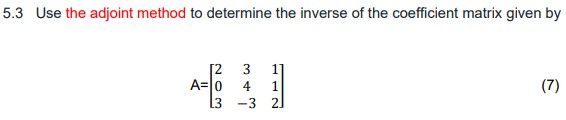 5.3 Use the adjoint method to determine the inverse of the coefficient matrix given by
2 3 1
Aso 4 1 [u]
3 -3 2
This is AI generated Response.
Asked by: Pagal
Created at: 2025-08-28 16:05:32
Asked by: Pagal
Created at: 2025-08-28 16:05:32
Final Answer:
Rendered
Raw Text
Did you like this answer?
Let's use the **adjoint method** to find the inverse of the matrix \( A \):
\[
A = \begin{bmatrix}
2 & 3 & 1 \\
0 & 4 & 1 \\
3 & -3 & 2
\end{bmatrix}
\]
### **Step 1: Find the Determinant of \( A \) and the Matrix of Cofactors**
#### **Determinant of \( A \):**
\[
|A| = 2 \begin{vmatrix} 4 & 1 \\ -3 & 2 \end{vmatrix} - 3 \begin{vmatrix} 0 & 1 \\ 3 & 2 \end{vmatrix} + 1 \begin{vmatrix} 0 & 4 \\ 3 & -3 \end{vmatrix}
\]
Calculate each minor:
- \( \begin{vmatrix} 4 & 1 \\ -3 & 2 \end{vmatrix} = (4)(2) - (1)(-3) = 8 + 3 = 11 \)
- \( \begin{vmatrix} 0 & 1 \\ 3 & 2 \end{vmatrix} = (0)(2) - (1)(3) = 0 - 3 = -3 \)
- \( \begin{vmatrix} 0 & 4 \\ 3 & -3 \end{vmatrix} = (0)(-3) - (4)(3) = 0 - 12 = -12 \)
Plug them back in:
\[
|A| = 2(11) - 3(-3) + 1(-12) = 22 + 9 - 12 = 19
\]
**Explanation:**
The determinant is necessary because the formula for the inverse is \(\frac{1}{|A|} \text{adj}(A)\). If \(|A| = 0\), the matrix is not invertible.
---
### **Step 2: Find the Adjoint of \( A \) and Then the Inverse**
#### **Cofactor Matrix:**
Let's calculate each cofactor:
- \(C_{11} = +\begin{vmatrix} 4 & 1 \\ -3 & 2 \end{vmatrix} = 11\)
- \(C_{12} = -\begin{vmatrix} 0 & 1 \\ 3 & 2 \end{vmatrix} = -(-3) = 3\)
- \(C_{13} = +\begin{vmatrix} 0 & 4 \\ 3 & -3 \end{vmatrix} = -12\)
- \(C_{21} = -\begin{vmatrix} 3 & 1 \\ -3 & 2 \end{vmatrix} = -[(3)(2) - (1)(-3)] = -[6 + 3] = -9\)
- \(C_{22} = +\begin{vmatrix} 2 & 1 \\ 3 & 2 \end{vmatrix} = (2)(2) - (1)(3) = 4 - 3 = 1\)
- \(C_{23} = -\begin{vmatrix} 2 & 3 \\ 3 & -3 \end{vmatrix} = -[(2)(-3) - (3)(3)] = -[-6 - 9] = 15\)
- \(C_{31} = +\begin{vmatrix} 3 & 1 \\ 4 & 1 \end{vmatrix} = (3)(1) - (1)(4) = 3 - 4 = -1\)
- \(C_{32} = -\begin{vmatrix} 2 & 1 \\ 0 & 1 \end{vmatrix} = -[(2)(1) - (1)(0)] = -[2 - 0] = -2\)
- \(C_{33} = +\begin{vmatrix} 2 & 3 \\ 0 & 4 \end{vmatrix} = (2)(4) - (3)(0) = 8 - 0 = 8\)
So the cofactor matrix is:
\[
\begin{bmatrix}
11 & 3 & -12 \\
-9 & 1 & 15 \\
-1 & -2 & 8
\end{bmatrix}
\]
Take its transpose (adjugate/adjoint matrix):
\[
\text{adj}(A) =
\begin{bmatrix}
11 & -9 & -1 \\
3 & 1 & -2 \\
-12 & 15 & 8
\end{bmatrix}
\]
**Explanation:**
The adjoint (or adjugate) matrix is the transpose of the matrix of cofactors.
---
### **Final Answer: Inverse of \( A \)**
\[
A^{-1} = \frac{1}{|A|} \text{adj}(A) = \frac{1}{19}
\begin{bmatrix}
11 & -9 & -1 \\
3 & 1 & -2 \\
-12 & 15 & 8
\end{bmatrix}
\]
Or explicitly:
\[
A^{-1} =
\begin{bmatrix}
\frac{11}{19} & \frac{-9}{19} & \frac{-1}{19} \\
\frac{3}{19} & \frac{1}{19} & \frac{-2}{19} \\
\frac{-12}{19} & \frac{15}{19} & \frac{8}{19}
\end{bmatrix}
\]
📢 Instructions:
- Ask anything relatd to above question only.
- For new Question goto :