 VIPSolutions
give answer in 2 step with explanation at the end of each step and final answer at the end:Ad. Consider the one-dimensional equation ‘ iy x' = x"4 Jax + 24° l where a is a real constant, | | \ #) Find the equilibrium points of the equation. 13) b) The equation has qualitative different phase portraits depending on a. shetch the phase portraits for the equation when a < 0, when a = 0, and whena>0. [HRY | 19] i SIPS | BETA CYA HAY | )
Question:
give answer in 2 step with explanation at the end of each step and final answer at the end: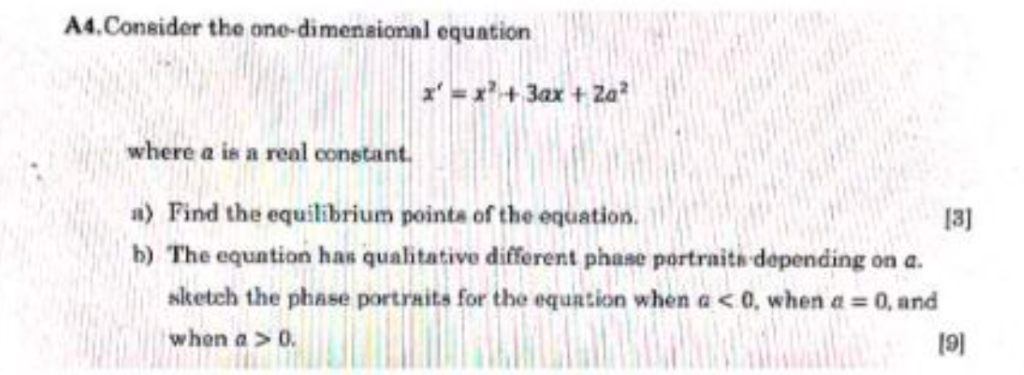 Ad. Consider the one-dimensional equation ‘
iy x' = x"4 Jax + 24°
l where a is a real constant, | | \
#) Find the equilibrium points of the equation. 13)
b) The equation has qualitative different phase portraits depending on a.
shetch the phase portraits for the equation when a < 0, when a = 0, and
whena>0. [HRY | 19]
i SIPS | BETA CYA HAY | )
This is AI generated Response.
Asked by: Pagal
Created at: 2025-08-27 21:01:37
Asked by: Pagal
Created at: 2025-08-27 21:01:37
Final Answer:
Rendered
Raw Text
Did you like this answer?
Let's solve the problem step by step as requested:
---
### **Step 1: Find the equilibrium points**
**Equation:**
\[ x' = x^2 - 3ax + 2a^2 \]
**Equilibrium points** occur where \( x' = 0 \):
\[
x^2 - 3ax + 2a^2 = 0
\]
This is a quadratic equation in \( x \):
\[
x = \frac{3a \pm \sqrt{(3a)^2 - 4 \cdot 1 \cdot 2a^2}}{2}
\]
Calculate the discriminant:
\[
(3a)^2 - 4 \cdot 1 \cdot 2a^2 = 9a^2 - 8a^2 = a^2
\]
So,
\[
x = \frac{3a \pm |a|}{2}
\]
This gives two solutions:
- \( x_1 = \frac{3a + |a|}{2} \)
- \( x_2 = \frac{3a - |a|}{2} \)
**Explanation:**
The equilibrium points are found by setting the right-hand side to zero and solving the resulting quadratic equation for \( x \).
---
### **Step 2: Sketch phase portraits for different values of \( a \)**
#### **Case 1: \( a > 0 \)**
- \( |a| = a \), so:
- \( x_1 = \frac{3a + a}{2} = 2a \)
- \( x_2 = \frac{3a - a}{2} = a \)
- So, equilibria: \( x = a \), \( x = 2a \)
#### **Case 2: \( a = 0 \)**
- Both equilibria collapse to zero:
- \( x_1 = x_2 = 0 \)
#### **Case 3: \( a < 0 \)**
- \( |a| = -a \), so:
- \( x_1 = \frac{3a + (-a)}{2} = \frac{2a}{2} = a \)
- \( x_2 = \frac{3a - (-a)}{2} = \frac{4a}{2} = 2a \)
- So, equilibria: \( x = a \), \( x = 2a \) (but both negative)
**Phase Portraits:**
- The sign of \( x' \) between and outside the equilibria determines the direction of flow.
- The equilibrium points will switch stability depending on the sign of \( a \).
**Summary Table:**
| \( a \) | Equilibria | Relative position |
|----------------|-------------------|------------------------|
| \( a > 0 \) | \( x = a, 2a \) | \( a < 2a \) |
| \( a = 0 \) | \( x = 0 \) | (double root) |
| \( a < 0 \) | \( x = 2a, a \) | \( 2a < a \) |
**Explanation:**
Depending on the value of \( a \), the nature and stability of equilibrium points change, and so do the phase portraits. For \( a > 0 \), the equilibria are both positive; for \( a < 0 \), they're both negative; for \( a = 0 \), there's a single degenerate equilibrium at 0.
---
## **Final Answer**
### (a) **The equilibrium points are:**
\[
x = \frac{3a \pm |a|}{2}
\]
### (b) **Phase portraits:**
- For \( a > 0 \): Two equilibria at \( x = a \) and \( x = 2a \) (both positive).
- For \( a = 0 \): One double equilibrium at \( x = 0 \).
- For \( a < 0 \): Two equilibria at \( x = 2a \) and \( x = a \) (both negative).
The stability and direction of flow between these points can be deduced by analyzing the sign of \( x' \) in each region.
📢 Instructions:
- Ask anything relatd to above question only.
- For new Question goto :