 VIPSolutions
give answer in 2 step with explanation at the end of each step and final answer at the end:6. Suppose we are formulating y = sin(z) for 0 < z < 27. But sin(z) is not linear, so we would approximate the sine function using a piecewise-linear function that samples the points at m equal intervals (m > 3). For example, with m = 8, the function looks like the following: Yy 7 A J 1) z J £2 ———— approximation Formulate this piecewise-linear function as the constraints of a mixed integer program for an arbitrary m.
Question:
give answer in 2 step with explanation at the end of each step and final answer at the end: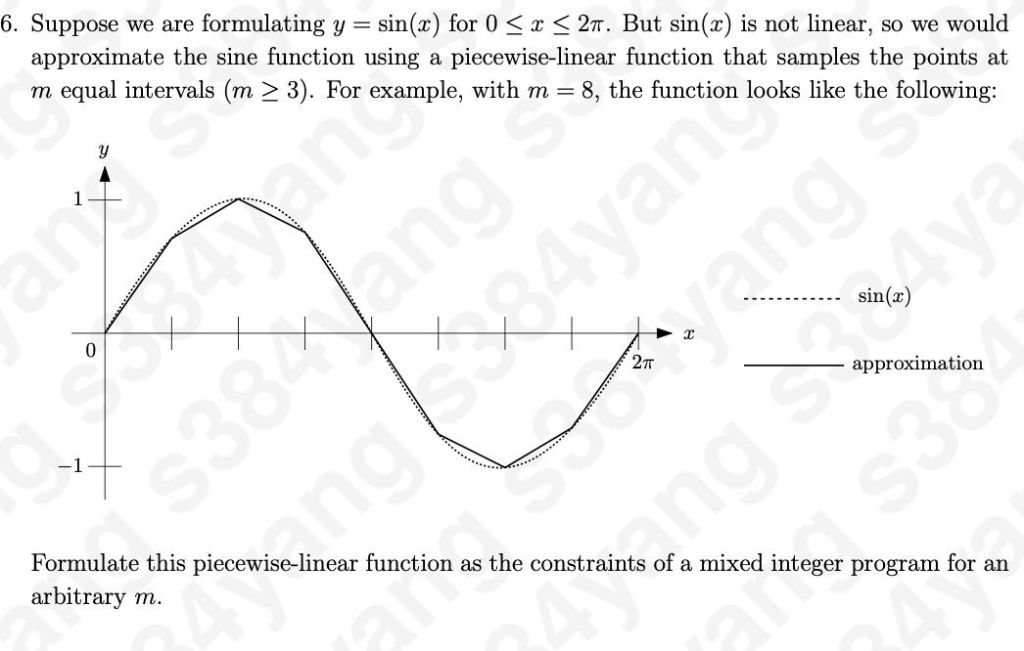 6. Suppose we are formulating y = sin(z) for 0 < z < 27. But sin(z) is not linear, so we would
approximate the sine function using a piecewise-linear function that samples the points at
m equal intervals (m > 3). For example, with m = 8, the function looks like the following:
Yy
7 A J 1)
z
J £2 ———— approximation
Formulate this piecewise-linear function as the constraints of a mixed integer program for an
arbitrary m.
This is AI generated Response.
Asked by: Pagal
Created at: 2025-08-27 15:48:44
Asked by: Pagal
Created at: 2025-08-27 15:48:44
Final Answer:
Rendered
Raw Text
Did you like this answer?
Let's break the solution into **2 steps** with explanations and then provide the final answer.
---
### **Step 1: Define the Breakpoints and Linear Segments**
Let’s define the breakpoints for the piecewise-linear approximation:
- Divide \( [0, 2\pi] \) into \( m \) equal intervals.
- The breakpoints are: \( x_k = \frac{2\pi k}{m} \) for \( k = 0, 1, ..., m \).
- The corresponding function values are: \( y_k = \sin(x_k) \).
**Explanation:**
We sample the sine function at \( m+1 \) equally spaced points. Each interval \( [x_k, x_{k+1}] \) will be approximated by a straight line connecting \( (x_k, y_k) \) and \( (x_{k+1}, y_{k+1}) \).
---
### **Step 2: Formulate the Piecewise-Linear Function Using Mixed Integer Constraints**
Introduce binary variables \( z_k \) for \( k = 0, 1, ..., m-1 \) to indicate which interval \( x \) belongs to. Only one \( z_k \) is active (equals 1) at any time:
- \( \sum_{k=0}^{m-1} z_k = 1 \), \( z_k \in \{0, 1\} \)
Let \( x \) be in \( [x_k, x_{k+1}] \) if \( z_k = 1 \). The linear approximation in this interval is:
\[
y = y_k + \frac{y_{k+1} - y_k}{x_{k+1} - x_k} (x - x_k)
\]
To enforce this, use the following constraints:
\[
x = \sum_{k=0}^{m-1} z_k \left( (x_k + (x_{k+1} - x_k) \lambda) \right)
\]
\[
y = \sum_{k=0}^{m-1} z_k \left( y_k + (y_{k+1} - y_k) \lambda \right)
\]
where \( \lambda \in [0, 1] \) for the active interval (so \( x = x_k + \lambda(x_{k+1} - x_k) \) when \( z_k = 1 \)), and \( \lambda \) is forced to be 0 otherwise.
Alternatively, **enforce bounds** using big-M constraints:
\[
x_k z_k \leq x \leq x_{k+1} z_k + (1-z_k)M \quad \forall k
\]
where \( M \) is a large constant.
**Explanation:**
The binary variables select which linear segment to use, and the constraints ensure \( x \) and \( y \) are linked according to the segment equation for the selected interval.
---
## **Final Answer**
**The piecewise-linear approximation of \( y = \sin(x) \) over \( [0, 2\pi] \) with \( m \) intervals can be formulated in a mixed integer program as:**
1. **Breakpoints:** \( x_k = \frac{2\pi k}{m} \), \( y_k = \sin(x_k) \) for \( k = 0, ..., m \).
2. **Binary variables:** \( z_k \in \{0, 1\} \) for \( k = 0, ..., m-1 \), with \( \sum_{k=0}^{m-1} z_k = 1 \).
3. **Piecewise-linear constraints:**
\[
x = \sum_{k=0}^{m-1} z_k (x_k + (x_{k+1} - x_k) \lambda_k)
\]
\[
y = \sum_{k=0}^{m-1} z_k (y_k + (y_{k+1} - y_k) \lambda_k)
\]
\[
0 \leq \lambda_k \leq 1 \quad \forall k
\]
(where only one \( \lambda_k \) is active; others are zero).
**This set of constraints models the piecewise-linear approximation of \( \sin(x) \) using \( m \) linear segments in a mixed integer program.**
📢 Instructions:
- Ask anything relatd to above question only.
- For new Question goto :