 VIPSolutions
give answer in 2 step with explanation at the end of each step and final answer at the end:6. The following argument contains a fundamental mistake in terms of the reasoning employed. Identify the mistake and correct the argument: For large values of R and for = on the curve C = {Re : t € [0,27]} |22—1/=~R* and |*+3/=R' Therefore. 2-1 Rr ola (B |[ S55] (fr) zenro
Question:
give answer in 2 step with explanation at the end of each step and final answer at the end: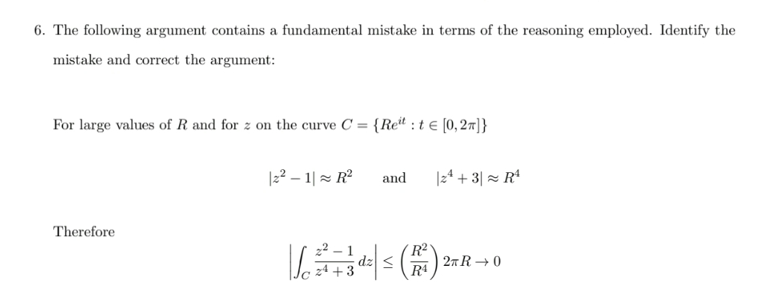 6. The following argument contains a fundamental mistake in terms of the reasoning employed. Identify the
mistake and correct the argument:
For large values of R and for = on the curve C = {Re : t € [0,27]}
|22—1/=~R* and |*+3/=R'
Therefore.
2-1 Rr
ola (B
|[ S55] (fr) zenro
This is AI generated Response.
Asked by: Pagal
Created at: 2025-08-25 09:37:53
Asked by: Pagal
Created at: 2025-08-25 09:37:53
Final Answer:
Rendered
Raw Text
Did you like this answer?
Let's break down the reasoning step by step, **explaining the mistake at each stage** and then **correct the argument**:
---
### **Step 1: Examine the Approximations**
The argument says for \(z\) on the curve \(C = \{Re^{it} : t \in [0,2\pi]\}\), and for large \(R\):
- \( |z^2 - 1| \approx R^2 \)
- \( |z^4 + 3| \approx R^4 \)
**Explanation:**
- For large \(R\), \(z = Re^{it}\), so \(z^2 = R^2 e^{i2t}\), and \(z^4 = R^4 e^{i4t}\).
- Then, \( |z^2 - 1| = |R^2 e^{i2t} - 1| \approx R^2 \) (since \(-1\) is negligible compared to \(R^2\)).
- Similarly, \( |z^4 + 3| = |R^4 e^{i4t} + 3| \approx R^4 \) (since \(+3\) is negligible compared to \(R^4\)).
**Mistake:**
These approximations are valid **only for large \(R\)** and **outside neighborhoods** where \(z^2 \approx 1\) or \(z^4 \approx -3\). For all \(t\), these approximations can fail near those exceptional points.
---
### **Step 2: Bound the Integral and Identify the Error**
The argument then proceeds:
\[
\left| \int_C \frac{z^2 - 1}{z^4 + 3} dz \right| \leq \left( \frac{R^2}{R^4} \right) 2\pi R \to 0
\]
**Explanation:**
- The bound uses the estimation lemma (ML inequality) in complex analysis:
\[
\left| \int_C f(z) dz \right| \leq \max_{z \in C} |f(z)| \cdot \text{(length of } C)
\]
- Here, \(\max_{z \in C} \left| \frac{z^2-1}{z^4+3} \right| \approx \frac{R^2}{R^4} = \frac{1}{R^2}\).
- The length of \(C\) is \(2\pi R\).
- Therefore, the bound is \(\frac{1}{R^2} \cdot 2\pi R = \frac{2\pi}{R} \to 0\) as \(R \to \infty\).
**Mistake:**
**The error is in using the maximum modulus of \(|z^2 - 1|\) and \(|z^4 + 3|\) uniformly for all \(z\) on \(C\).**
- For some \(z\) on \(C\), \(z^2\) could be close to 1 (when \(t = 0\) or \(t = \pi\)), making \(|z^2 - 1|\) close to 0, not \(R^2\).
- Similarly, \(z^4\) could be close to \(-3\), making \(|z^4 + 3|\) close to 0 for certain \(t\).
- **The maximum of the ratio is not necessarily the ratio of the maxima.** The function could be much larger than estimated if the denominator is small somewhere on the contour.
---
### **Correction and Final Answer**
**Corrected Argument:**
- For large \(R\), the dominant term in the numerator is \(z^2\) and in the denominator is \(z^4\), so:
\[
\frac{z^2-1}{z^4+3} \approx \frac{z^2}{z^4} = \frac{1}{z^2}
\]
- Therefore,
\[
\int_C \frac{z^2-1}{z^4+3} dz \approx \int_C \frac{1}{z^2} dz
\]
On the circle \(C: z = Re^{it}\), \(dz = iRe^{it} dt\), so:
\[
\int_C \frac{1}{z^2} dz = \int_0^{2\pi} \frac{1}{R^2 e^{i2t}} iRe^{it} dt = iR \int_0^{2\pi} \frac{e^{it}}{R^2 e^{i2t}} dt = \frac{i}{R} \int_0^{2\pi} e^{-it} dt = 0
\]
(since the integral of \(e^{-it}\) over \(0\) to \(2\pi\) is zero).
**Final Answer:**
**The mistake is in estimating the integral by taking the ratio of the maxima, which is not valid when the denominator can become small along the contour. The correct approach is to approximate the function for large \(R\) and show that the integral tends to zero by using the correct asymptotic behavior.**
📢 Instructions:
- Ask anything relatd to above question only.
- For new Question goto :