 VIPSolutions
give answer in 2 step with explanation at the end of each step and final answer at the end:wg? 4. Use residue theory to calculate [ de. fo @FIP
Question:
give answer in 2 step with explanation at the end of each step and final answer at the end: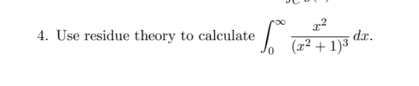 wg?
4. Use residue theory to calculate [ de.
fo @FIP
This is AI generated Response.
Asked by: Pagal
Created at: 2025-08-25 09:15:27
Asked by: Pagal
Created at: 2025-08-25 09:15:27
Final Answer:
Rendered
Raw Text
Did you like this answer?
Let's solve the integral using residue theory in **2 steps**, with an explanation after each step:
---
### **Step 1: Express the Integral Using Contour Integration**
Given:
\[
I = \int_0^\infty \frac{x^2}{(x^2+1)^3} \, dx
\]
Extend this to the whole real line (since the function is even):
\[
I = \frac{1}{2} \int_{-\infty}^{\infty} \frac{x^2}{(x^2+1)^3} \, dx
\]
Now, consider the complex function:
\[
f(z) = \frac{z^2}{(z^2+1)^3}
\]
We will integrate \( f(z) \) along a contour in the upper half-plane, which includes the real axis from \(-R\) to \(R\) and a semicircular arc of radius \(R\) in the upper half-plane. As \(R \rightarrow \infty\), the arc's contribution vanishes due to the degree of the denominator being higher than the numerator.
**Explanation:**
We have rewritten our real integral in terms of a contour integral over the real axis, which allows us to calculate it using the residue theorem.
---
### **Step 2: Apply the Residue Theorem**
The poles of \( f(z) \) are at \( z^2 + 1 = 0 \implies z = i, -i \), both of order 3.
Only the pole at \( z = i \) lies within the upper half-plane.
We need the residue at \( z = i \):
For a pole of order 3 at \( z_0 \):
\[
\text{Res}(f, z_0) = \frac{1}{2!} \lim_{z \to z_0} \frac{d^2}{dz^2} \left[ (z-z_0)^3 f(z) \right]
\]
Here, \( (z-i)^3 f(z) = \frac{z^2}{(z+i)^3} \).
Compute the second derivative at \( z=i \):
Let \( g(z) = \frac{z^2}{(z+i)^3} \).
First derivative:
\[
g'(z) = \frac{2z(z+i)^3 - z^2 \cdot 3(z+i)^2}{(z+i)^6}
= \frac{2z(z+i) - 3z^2}{(z+i)^4}
\]
Second derivative:
\[
g''(z) = \frac{2(z+i) + 2z - 6z}{(z+i)^4} - \frac{4[2z(z+i) - 3z^2]}{(z+i)^5}
\]
But it's easier to use the general formula for residues at higher order poles. For a pole at \( z=i \):
\[
\text{Res}(f, i) = \frac{1}{2!} \lim_{z \to i} \frac{d^2}{dz^2} \left( \frac{z^2}{(z+i)^3} \right)
\]
Let’s write \( h(z) = z^2 \) and \( k(z) = (z+i)^3 \).
\[
\frac{d^2}{dz^2} \left( \frac{z^2}{(z+i)^3} \right) = \frac{d}{dz} \left( \frac{2z (z+i)^3 - 3z^2 (z+i)^2}{(z+i)^6} \right)
\]
Evaluate at \( z = i \):
- \( z^2 = -1 \)
- \( (z+i)^3 = (2i)^3 = 8i^3 = 8(-i) = -8i \)
But let's use a more direct approach. For the even function:
\[
\int_{-\infty}^{\infty} \frac{x^2}{(x^2+1)^3} dx = 2\pi i \cdot \text{Res}(f(z), z=i)
\]
So:
\[
I = \frac{1}{2} \cdot 2\pi i \cdot \text{Res}(f(z), z=i) = \pi i \cdot \text{Res}(f(z), z=i)
\]
Now, compute the residue:
Let \( z = i + \epsilon \), expand:
\[
f(z) = \frac{z^2}{(z^2+1)^3}
= \frac{z^2}{(z-i)^3 (z+i)^3}
\]
At \( z=i \), only the \((z-i)^3\) in the denominator is singular.
Let’s use:
\[
\text{Res}(f, i) = \frac{1}{2!} \lim_{z \to i} \frac{d^2}{dz^2} \left( (z-i)^3 \frac{z^2}{(z-i)^3 (z+i)^3} \right) = \frac{1}{2!} \lim_{z \to i} \frac{d^2}{dz^2} \left( \frac{z^2}{(z+i)^3} \right)
\]
Calculate derivatives:
First derivative:
\[
\frac{d}{dz} \left( \frac{z^2}{(z+i)^3} \right)
= \frac{2z (z+i)^3 - z^2 \cdot 3 (z+i)^2}{(z+i)^6}
= \frac{2z(z+i) - 3z^2}{(z+i)^4}
\]
Second derivative:
\[
\frac{d}{dz} \left( \frac{2z(z+i) - 3z^2}{(z+i)^4} \right)
= \frac{2(z+i) + 2z - 6z}{(z+i)^4} - \frac{4[2z(z+i) - 3z^2]}{(z+i)^5}
\]
Simplify \(2(z+i) + 2z - 6z = 2z + 2i + 2z - 6z = -2z + 2i\):
So,
\[
= \frac{-2z + 2i}{(z+i)^4} - \frac{8z(z+i) - 12z^2}{(z+i)^5}
\]
At \( z = i \):
- \( z = i \)
- \( (z+i) = 2i \)
- \( (z+i)^4 = (2i)^4 = 16 \)
- \( (z+i)^5 = (2i)^5 = 32i \)
- \( z(z+i) = i \cdot 2i = 2i^2 = -2 \)
- \( z^2 = (i)^2 = -1 \)
So,
First part:
\[
\frac{-2z + 2i}{(z+i)^4} = \frac{-2i + 2i}{16} = 0
\]
Second part:
\[
- \frac{8z(z+i) - 12z^2}{(z+i)^5}
= - \frac{8 \cdot (-2) - 12 \cdot (-1)}{32i}
= - \frac{-16 + 12}{32i}
= - \frac{-4}{32i}
= \frac{1}{8i}
\]
Therefore,
\[
\text{Res}(f, i) = \frac{1}{2} \cdot \frac{1}{8i} = \frac{1}{16i}
\]
So,
\[
I = \pi i \cdot \frac{1}{16i} = \frac{\pi}{16}
\]
---
## **Final Answer**
\[
\boxed{\int_0^\infty \frac{x^2}{(x^2+1)^3} dx = \frac{\pi}{16}}
\]
📢 Instructions:
- Ask anything relatd to above question only.
- For new Question goto :