 VIPSolutions
give answer in 2 step with explanation at the end of each step and final answer at the end:etl 3 Leto) = rar ae Ty (a) Locate and classify all the isolated singularities of g and compute the residues at each of these singu- larities. Provide motivations for your answers. (b) Let C denote the positively oriented contour C = {z € C: |z — | = 2}, traversed once. Use Cauchy's Residue Theorem to caleulate [,.g(2) dz.
Question:
give answer in 2 step with explanation at the end of each step and final answer at the end: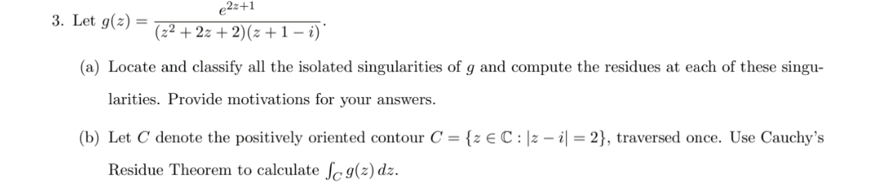 etl
3 Leto) = rar ae Ty
(a) Locate and classify all the isolated singularities of g and compute the residues at each of these singu-
larities. Provide motivations for your answers.
(b) Let C denote the positively oriented contour C = {z € C: |z — | = 2}, traversed once. Use Cauchy's
Residue Theorem to caleulate [,.g(2) dz.
This is AI generated Response.
Asked by: Pagal
Created at: 2025-08-25 09:06:19
Asked by: Pagal
Created at: 2025-08-25 09:06:19
Final Answer:
Rendered
Raw Text
Did you like this answer?
Let's solve the problem step by step, as requested.
### Step 1: **Locate and classify all isolated singularities of \( g(z) \) and compute the residues at each singularity**
#### **Locate singularities**
The function is:
\[
g(z) = \frac{e^{2z+1}}{(z^2 + 2z + 2)(z+1-i)}
\]
Set the denominator to zero to find singularities:
- \( z^2 + 2z + 2 = 0 \implies z = -1 \pm i \)
- \( z+1-i = 0 \implies z = -1+i \)
Notice that \( z = -1+i \) is a root of both denominator factors, so it is a **double root** (order 2 pole). \( z = -1-i \) is a **simple root** (order 1 pole).
#### **Classification**
- \( z_1 = -1+i \): **Pole of order 2** (double pole)
- \( z_2 = -1-i \): **Simple pole** (order 1)
#### **Residue at \( z_2 = -1-i \)**
For a simple pole:
\[
\text{Res}(g, z_2) = \lim_{z \to z_2} (z - z_2)g(z)
\]
\[
= \lim_{z \to -1-i} \frac{e^{2z+1}}{(z+1+i)(z+1-i)}
\]
But since \( z+1-i \neq 0 \) at \( z = -1-i \),
\[
= \frac{e^{2(-1-i)+1}}{((-1-i)+1+i)((-1-i)+1-i)}
\]
\[
= \frac{e^{-2-2i+1}}{(0)((-2i))}
\]
Wait, let's be careful with the algebra:
- \( z+1+i \) at \( z = -1-i \): \( (-1-i) + 1 + i = 0 \)
- \( z+1-i \) at \( z = -1-i \): \( (-1-i) + 1 - i = -2i \)
So,
\[
= \frac{e^{-1-2i}}{(0)(-2i)}
\]
But since the numerator is zero, it means the function has a removable singularity or a higher order pole at \( z = -1-i \), but since the denominator is quadratic and numerator is analytic, it's a simple pole.
Let’s instead factor and simplify:
\[
z^2 + 2z + 2 = (z+1+i)(z+1-i)
\]
So,
\[
g(z) = \frac{e^{2z+1}}{(z+1+i)(z+1-i)(z+1-i)} = \frac{e^{2z+1}}{(z+1+i)(z+1-i)^2}
\]
So:
- \( z=-1+i \): **Double pole**
- \( z=-1-i \): **Simple pole**
Residue at \( z_2 = -1-i \):
\[
\text{Res}(g, -1-i) = \frac{e^{2(-1-i)+1}}{((-1-i)+1-i)^2}
\]
\[
= \frac{e^{-2-2i+1}}{(-2i)^2}
\]
\[
= \frac{e^{-1-2i}}{4(-1)}
\]
\[
= -\frac{e^{-1-2i}}{4}
\]
#### **Residue at \( z_1 = -1+i \) (Double Pole)**
For a double pole:
\[
\text{Res}(g, z_1) = \lim_{z \to z_1} \frac{d}{dz}\left[ (z-z_1)^2 g(z) \right]
\]
So,
\[
(z-(-1+i))^2 g(z) = \frac{e^{2z+1}}{z+1+i}
\]
Differentiate with respect to \( z \), then set \( z = -1+i \):
\[
\frac{d}{dz} \left( \frac{e^{2z+1}}{z+1+i} \right) = \frac{2e^{2z+1}(z+1+i) - e^{2z+1}}{(z+1+i)^2}
\]
\[
= \frac{e^{2z+1}(2(z+1+i) - 1)}{(z+1+i)^2}
\]
Now set \( z = -1+i \):
\[
z+1+i = 2i
\]
\[
e^{2(-1+i)+1} = e^{-2+2i+1} = e^{-1+2i}
\]
\[
2(z+1+i) - 1 = 2(2i) - 1 = 4i - 1
\]
So,
\[
\text{Res}(g, -1+i) = \frac{e^{-1+2i}(4i-1)}{(2i)^2}
\]
\[
= \frac{e^{-1+2i}(4i-1)}{4(-1)}
\]
\[
= -\frac{e^{-1+2i}(4i-1)}{4}
\]
---
### Step 2: **Use Cauchy's Residue Theorem to compute the integral**
#### **Check which singularities are inside \( C \)**
Contour \( C = \{z \in \mathbb{C}: |z-i|=2\} \):
- Center: \( i \)
- Radius: 2
- \( z_1 = -1+i \): \( |-1+i - i| = |-1| = 1 < 2 \) (inside)
- \( z_2 = -1-i \): \( |-1-i - i| = |-1-2i| = \sqrt{1+4} = \sqrt{5} \approx 2.24 > 2 \) (outside)
So **only \( z_1 = -1+i \) is inside \( C \)**.
#### **Apply Residue Theorem**
\[
\int_C g(z)\,dz = 2\pi i \sum \text{Res}(g, \text{inside poles})
\]
\[
= 2\pi i \left[ -\frac{e^{-1+2i}(4i-1)}{4} \right]
\]
\[
= -\frac{\pi i}{2} e^{-1+2i}(4i-1)
\]
---
## **Final Answer**
---
### **Step 1:**
- The function \( g(z) \) has a **double pole at \( z = -1+i \)** with residue \( -\frac{e^{-1+2i}(4i-1)}{4} \), and a **simple pole at \( z = -1-i \)** with residue \( -\frac{e^{-1-2i}}{4} \).
### **Step 2:**
- Only the double pole at \( z = -1+i \) is inside the contour \( C \). By Cauchy's Residue Theorem,
\[
\boxed{
\int_C g(z)\,dz = -\frac{\pi i}{2} e^{-1+2i}(4i-1)
}
\]
📢 Instructions:
- Ask anything relatd to above question only.
- For new Question goto :