 VIPSolutions
give answer in 2 step with explanation at the end of each step and final answer at the end:1 L Let J) = Gos (a) What type of singularity is z = 0? Provide reasons for your answer. (b) What type of singularity is = = 11? Provide reasons for your answer.
Question:
give answer in 2 step with explanation at the end of each step and final answer at the end: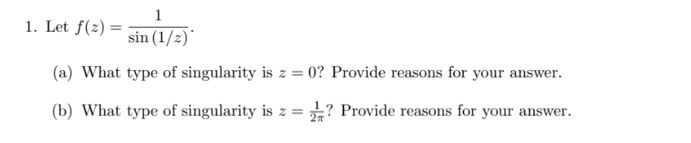 1
L Let J) = Gos
(a) What type of singularity is z = 0? Provide reasons for your answer.
(b) What type of singularity is = = 11? Provide reasons for your answer.
This is AI generated Response.
Asked by: Pagal
Created at: 2025-08-25 08:52:32
Asked by: Pagal
Created at: 2025-08-25 08:52:32
Final Answer:
Rendered
Raw Text
Did you like this answer?
Let's solve the problems step by step:
---
### (a) What type of singularity is \( z = 0 \)? Provide reasons for your answer.
#### **Step 1: Analyze the function near \( z = 0 \)**
- The function is \( f(z) = \frac{1}{\sin(1/z)} \).
- At \( z = 0 \), \( 1/z \) becomes unbounded (goes to infinity).
- The sine function, \(\sin(1/z)\), oscillates infinitely as \( z \to 0 \), and is not defined at \( z = 0 \).
**Explanation:** \( f(z) \) does not have a limit as \( z \to 0 \) because \(\sin(1/z)\) oscillates infinitely often between -1 and 1, so the denominator never settles to a value or zero in any regular way.
#### **Step 2: Classify the singularity**
- At \( z = 0 \), the function does not have a pole (since there is no finite order zero or pole at \( z = 0 \)).
- The function also cannot be made analytic by removing the point.
- The singularity is **essential**, as the behavior is highly oscillatory and not removable or a pole.
**Explanation:** A singularity is essential if the limit does not exist and the function exhibits extreme oscillatory behavior, as happens here due to \( \sin(1/z) \).
**Final answer for (a):**
> **The singularity at \( z = 0 \) is an essential singularity, because \( \sin(1/z) \) oscillates infinitely as \( z \to 0 \), making the function's behavior highly non-regular.**
---
### (b) What type of singularity is \( z = \frac{1}{2\pi} \)? Provide reasons for your answer.
#### **Step 1: Analyze the function at \( z = \frac{1}{2\pi} \)**
- Substitute \( z = \frac{1}{2\pi} \): \( 1/z = 2\pi \).
- \( \sin(2\pi) = 0 \), so the denominator becomes zero.
**Explanation:** At this value, the denominator is zero, which may indicate a pole if the numerator is nonzero.
#### **Step 2: Classify the singularity**
- Near \( z = \frac{1}{2\pi} \), set \( z = \frac{1}{2\pi} + \epsilon \).
- Then, \( 1/z \approx 2\pi - 2\pi^2 \epsilon \) (using Taylor expansion).
- \( \sin(1/z) \approx \sin(2\pi - 2\pi^2\epsilon) \approx -2\pi^2 \epsilon \) (since \( \sin(x) \approx x \) near 0).
- So, \( f(z) \approx \frac{1}{-2\pi^2 \epsilon} \), which diverges as \( \epsilon \to 0 \).
**Explanation:** This is the behavior of a simple pole.
**Final answer for (b):**
> **The singularity at \( z = \frac{1}{2\pi} \) is a simple pole, because the denominator vanishes linearly as \( z \to \frac{1}{2\pi} \), causing the function to diverge as \( 1/(z - \frac{1}{2\pi}) \).**
---
## **Summary of Answers**
- (a) \( z = 0 \) is an **essential singularity**.
- (b) \( z = \frac{1}{2\pi} \) is a **simple pole**.
📢 Instructions:
- Ask anything relatd to above question only.
- For new Question goto :