give answer in 2 step with explanation at the end of each step and final answer at the end:Problem 4
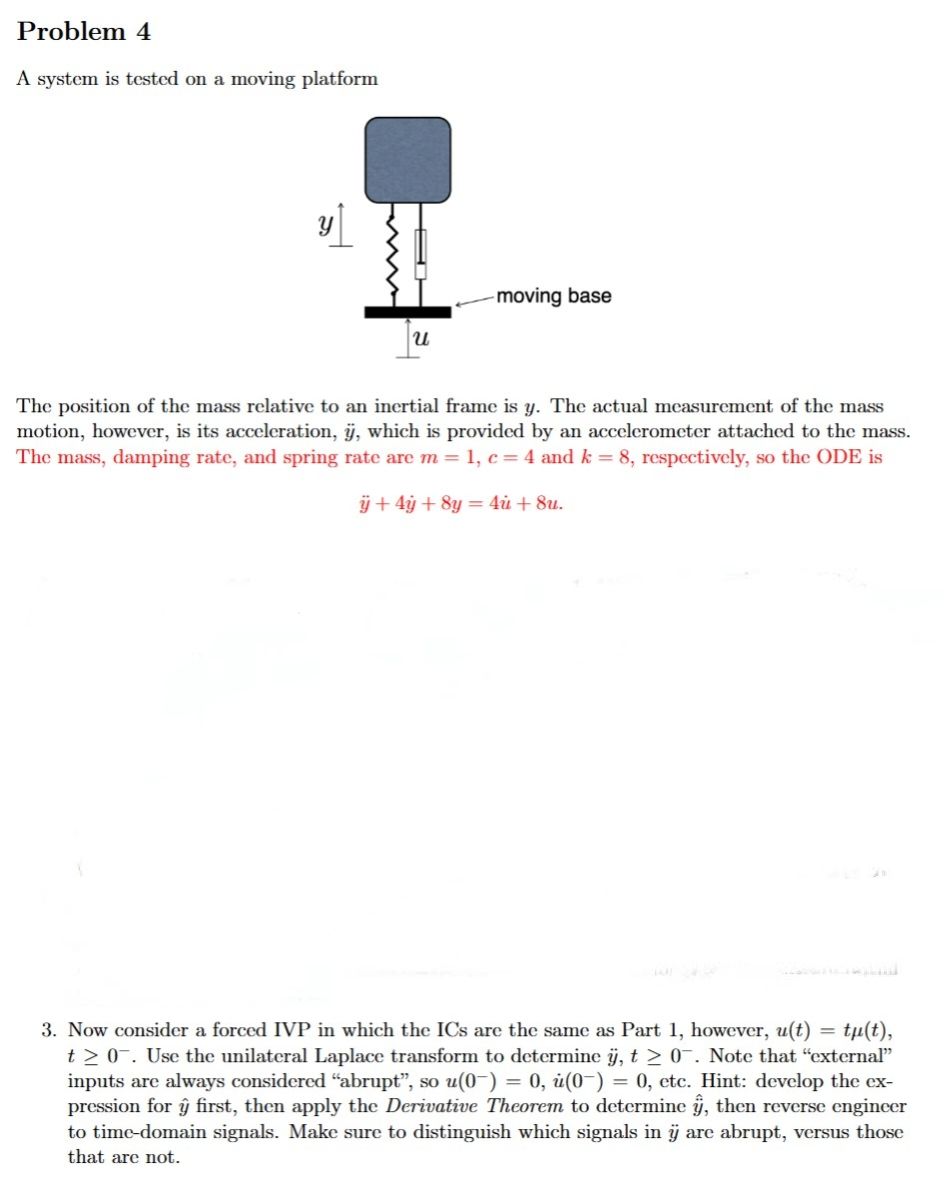
A system is tested on a moving platform
al
.—moving base
u
The position of the mass relative to an inertial frame is y. The actual measurement of the mass
motion, however, is its acceleration, §, which is provided by an accelerometer attached to the mass.
The mass, damping rate, and spring rate are m = 1, ¢ = 4 and k = 8, respectively, so the ODE is
ii + 45 + 8y = di + Su.
3. Now consider a forced IVP in which the ICs are the same as Part 1, however, u(t) = tu(t),
t > 07. Use the unilateral Laplace transform to determine §, ¢ > 07. Note that “external”
inputs arc always considered “abrupt”, so u(0~) = 0, #(0~) = 0, ctc. Hint: develop the ex-
pression for § first, then apply the Derivative Theorem to determine §, then reverse engineer
to time-domain signals. Make sure to distinguish which signals in ij are abrupt, versus those
that are not.
Question:
give answer in 2 step with explanation at the end of each step and final answer at the end:Problem 4
A system is tested on a moving platform
al
.—moving base
u
The position of the mass relative to an inertial frame is y. The actual measurement of the mass
motion, however, is its acceleration, §, which is provided by an accelerometer attached to the mass.
The mass, damping rate, and spring rate are m = 1, ¢ = 4 and k = 8, respectively, so the ODE is
ii + 45 + 8y = di + Su.
3. Now consider a forced IVP in which the ICs are the same as Part 1, however, u(t) = tu(t),
t > 07. Use the unilateral Laplace transform to determine §, ¢ > 07. Note that “external”
inputs arc always considered “abrupt”, so u(0~) = 0, #(0~) = 0, ctc. Hint: develop the ex-
pression for § first, then apply the Derivative Theorem to determine §, then reverse engineer
to time-domain signals. Make sure to distinguish which signals in ij are abrupt, versus those
that are not.
This is AI generated Response.
Asked by: Pagal
Created at: 2025-08-19 10:27:10
Final Answer:
RenderedRaw Text
Did you like this answer?
Let's solve the problem **step by step** as requested.
---
## **Step 1: Write the ODE and take the Laplace Transform**
Given ODE:
\[
\ddot{y} + 4\dot{y} + 8y = 4\dot{u} + 8u
\]
Given:
- \( u(t) = t\mu(t) \), where \( \mu(t) \) is the unit step function.
- Initial conditions (from Part 1, not shown, but typically \( y(0) = 0, \dot{y}(0) = 0 \) if not otherwise stated).
- External input: \( u(0) = 0, \dot{u}(0) = 0 \).
Taking the **Laplace Transform** (denote \( Y(s) = \mathcal{L}\{y(t)\} \), \( U(s) = \mathcal{L}\{u(t)\} \)):
\[
\mathcal{L}\{\ddot{y}\} = s^2 Y(s) - s y(0) - \dot{y}(0)
\]
\[
\mathcal{L}\{\dot{y}\} = s Y(s) - y(0)
\]
\[
\mathcal{L}\{\dot{u}\} = s U(s) - u(0)
\]
Substitute into the ODE, with all initial conditions set to zero:
\[
s^2 Y(s) + 4s Y(s) + 8 Y(s) = 4 (s U(s)) + 8 U(s)
\]
\[
(s^2 + 4s + 8)Y(s) = (4s + 8)U(s)
\]
\[
Y(s) = \frac{4s + 8}{s^2 + 4s + 8} U(s)
\]
**Explanation:**
We have rewritten the differential equation in the Laplace domain and expressed \( Y(s) \) in terms of \( U(s) \).
---
## **Step 2: Find \( \ddot{y}(t) \) (i.e., \( \mathcal{L}^{-1}\{s^2 Y(s)\} \))**
We need \( \ddot{y}(t) \), which in the Laplace domain is \( s^2 Y(s) \):
\[
s^2 Y(s) = s^2 \frac{4s + 8}{s^2 + 4s + 8} U(s)
\]
Since \( u(t) = t\mu(t) \), \( U(s) = \mathcal{L}\{t\} = \frac{1}{s^2} \):
\[
s^2 Y(s) = s^2 \frac{4s + 8}{s^2 + 4s + 8} \cdot \frac{1}{s^2} = \frac{4s + 8}{s^2 + 4s + 8}
\]
Thus,
\[
\ddot{y}(t) = \mathcal{L}^{-1}\left\{ \frac{4s+8}{s^2+4s+8} \right\}
\]
Let’s rewrite the denominator:
\[
s^2 + 4s + 8 = (s+2)^2 + 4
\]
So,
\[
\frac{4s+8}{(s+2)^2+4} = 4 \cdot \frac{s+2}{(s+2)^2+4}
\]
The Laplace inverse of \( \frac{s+a}{(s+a)^2 + b^2} \) is \( e^{-at} \cos(bt) \).
So:
\[
\mathcal{L}^{-1}\left\{ \frac{s+2}{(s+2)^2+2^2} \right\} = e^{-2t} \cos(2t)
\]
Therefore,
\[
\ddot{y}(t) = 4 e^{-2t} \cos(2t)
\]
**Explanation:**
We found the Laplace transform of \( \ddot{y}(t) \) and used the given input to find the explicit time-domain solution.
---
## **Final Answer:**
\[
\boxed{
\ddot{y}(t) = 4 e^{-2t} \cos(2t)
}
\]
- All signals in \( \ddot{y}(t) \) are continuous (not abrupt) because \( u(t) = t \) and the system is initially at rest.
- Any abrupt (impulse) terms would arise only if \( u(t) \) had abrupt changes at \( t = 0 \), which it does not in this case.
---
**Summary of Steps:**
1. **Laplace transform and solve for \( Y(s) \) in terms of \( U(s) \) (input Laplace transform).**
2. **Substitute the Laplace of the input, solve for \( \ddot{y}(t) \), and take the inverse Laplace to get the explicit answer.**
VIPSolutions focuses on clear, step‑by‑step explanations so you can learn quickly. Whether you need an AI‑generated walkthrough or a short hint to get unstuck, each solution is organized for fast reading and easy review later.
Search similar questions, compare approaches, and bookmark the best answers for revision. Our goal is simple: quick, reliable study help that feels natural—not noisy.
 VIPSolutions
 Problem 4
A system is tested on a moving platform
al
.—moving base
u
The position of the mass relative to an inertial frame is y. The actual measurement of the mass
motion, however, is its acceleration, §, which is provided by an accelerometer attached to the mass.
The mass, damping rate, and spring rate are m = 1, ¢ = 4 and k = 8, respectively, so the ODE is
ii + 45 + 8y = di + Su.
3. Now consider a forced IVP in which the ICs are the same as Part 1, however, u(t) = tu(t),
t > 07. Use the unilateral Laplace transform to determine §, ¢ > 07. Note that “external”
inputs arc always considered “abrupt”, so u(0~) = 0, #(0~) = 0, ctc. Hint: develop the ex-
pression for § first, then apply the Derivative Theorem to determine §, then reverse engineer
to time-domain signals. Make sure to distinguish which signals in ij are abrupt, versus those
that are not.