give answer in 2 step with explanation at the end of each step and final answer at the end:Problem 4
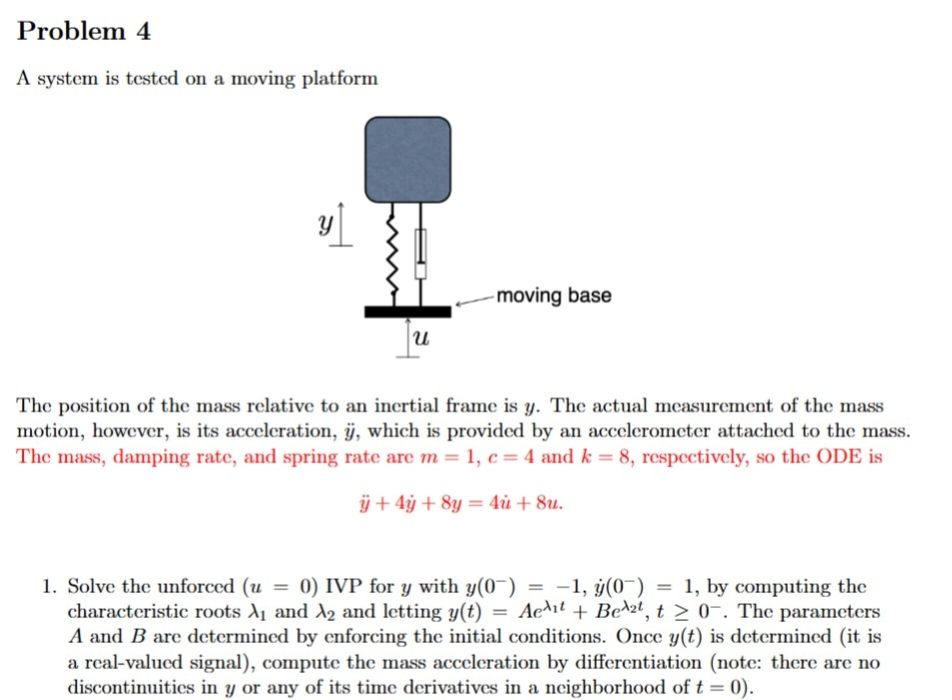
A system is tested on a moving platform
ul
moving base
u
The position of the mass relative to an inertial frame is y. The actual measurement of the mass
motion, however, is its acceleration, jj, which is provided by an accelerometer attached to the mass.
The mass, damping rate, and spring rate are m = 1, ¢ = 4 and k = 8, respectively, so the ODE is
9+ 4y + 8y = di + Su.
1. Solve the unforced (u = 0) IVP for y with y(0~) = —1,§(0") = 1, by computing the
characteristic roots A; and A; and letting y(t) = Ae’ + Be*2t, t > 0~. The parameters
A and B are determined by enforcing the initial conditions. Once y(t) is determined (it is
a real-valued signal), compute the mass acceleration by differentiation (note: there are no
discontinuities in y or any of its time derivatives in a neighborhood of t = 0).
Question:
give answer in 2 step with explanation at the end of each step and final answer at the end:Problem 4
A system is tested on a moving platform
ul
moving base
u
The position of the mass relative to an inertial frame is y. The actual measurement of the mass
motion, however, is its acceleration, jj, which is provided by an accelerometer attached to the mass.
The mass, damping rate, and spring rate are m = 1, ¢ = 4 and k = 8, respectively, so the ODE is
9+ 4y + 8y = di + Su.
1. Solve the unforced (u = 0) IVP for y with y(0~) = —1,§(0") = 1, by computing the
characteristic roots A; and A; and letting y(t) = Ae’ + Be*2t, t > 0~. The parameters
A and B are determined by enforcing the initial conditions. Once y(t) is determined (it is
a real-valued signal), compute the mass acceleration by differentiation (note: there are no
discontinuities in y or any of its time derivatives in a neighborhood of t = 0).
This is AI generated Response.
Asked by: Pagal
Created at: 2025-08-19 10:10:12
Final Answer:
RenderedRaw Text
Did you like this answer?
Let's solve the problem step by step as requested.
---
### **Step 1: Write the Unforced ODE and Find the Characteristic Roots**
Given the unforced system (\(u = 0\)), the ODE becomes:
\[
\ddot{y} + 4\dot{y} + 8y = 0
\]
This is a second-order linear homogeneous ODE.
Assume a solution of the form \( y(t) = e^{\lambda t} \):
\[
\lambda^2 e^{\lambda t} + 4\lambda e^{\lambda t} + 8 e^{\lambda t} = 0
\]
\[
e^{\lambda t} (\lambda^2 + 4\lambda + 8) = 0
\]
So, the **characteristic equation** is:
\[
\lambda^2 + 4\lambda + 8 = 0
\]
Solve for \(\lambda\):
\[
\lambda_{1,2} = \frac{-4 \pm \sqrt{16 - 32}}{2} = \frac{-4 \pm \sqrt{-16}}{2} = \frac{-4 \pm 4i}{2} = -2 \pm 2i
\]
**Explanation**: The characteristic roots are complex conjugates: \(\lambda_1 = -2 + 2i\), \(\lambda_2 = -2 - 2i\).
---
### **Step 2: Find the Solution Using Initial Conditions**
General solution:
\[
y(t) = A e^{(-2 + 2i)t} + B e^{(-2 - 2i)t}
\]
Or, using Euler's formula (\(e^{i\theta} = \cos\theta + i\sin\theta\)), rewrite as:
\[
y(t) = e^{-2t} \left[ C_1 \cos(2t) + C_2 \sin(2t) \right]
\]
Let's use the initial conditions:
- \(y(0^-) = -1\)
- \(\dot{y}(0^-) = 1\)
At \(t = 0\):
\[
y(0) = e^0 [C_1 \cdot 1 + C_2 \cdot 0] = C_1 = -1
\]
Compute the derivative:
\[
\dot{y}(t) = \frac{d}{dt} \left( e^{-2t} (C_1 \cos 2t + C_2 \sin 2t) \right)
\]
Apply product rule:
\[
\dot{y}(t) = -2 e^{-2t} (C_1 \cos 2t + C_2 \sin 2t)
+ e^{-2t} [ -2C_1 \sin 2t + 2C_2 \cos 2t ]
\]
At \(t=0\):
\[
\dot{y}(0) = -2 (C_1 \cdot 1 + C_2 \cdot 0) + [ -2C_1 \cdot 0 + 2C_2 \cdot 1 ]
= -2C_1 + 2C_2
\]
Set equal to initial condition:
\[
-2C_1 + 2C_2 = 1
\]
Recall \(C_1 = -1\):
\[
-2(-1) + 2C_2 = 1 \implies 2 + 2C_2 = 1 \implies 2C_2 = -1 \implies C_2 = -\frac{1}{2}
\]
So the solution is:
\[
\boxed{
y(t) = e^{-2t} \left[ -\cos(2t) - \frac{1}{2}\sin(2t) \right]
}
\]
---
### **Final Answer**
\[
\boxed{
y(t) = e^{-2t} \left[ -\cos(2t) - \frac{1}{2}\sin(2t) \right], \quad t \geq 0^-
}
\]
**Explanations after each step:**
- **Step 1:** Found the characteristic roots of the ODE, which are complex conjugates indicating a damped oscillatory response.
- **Step 2:** Used the initial conditions to solve for the constants in the general solution, resulting in the explicit solution above.
VIPSolutions focuses on clear, step‑by‑step explanations so you can learn quickly. Whether you need an AI‑generated walkthrough or a short hint to get unstuck, each solution is organized for fast reading and easy review later.
Search similar questions, compare approaches, and bookmark the best answers for revision. Our goal is simple: quick, reliable study help that feels natural—not noisy.
 VIPSolutions
 Problem 4
A system is tested on a moving platform
ul
moving base
u
The position of the mass relative to an inertial frame is y. The actual measurement of the mass
motion, however, is its acceleration, jj, which is provided by an accelerometer attached to the mass.
The mass, damping rate, and spring rate are m = 1, ¢ = 4 and k = 8, respectively, so the ODE is
9+ 4y + 8y = di + Su.
1. Solve the unforced (u = 0) IVP for y with y(0~) = —1,§(0") = 1, by computing the
characteristic roots A; and A; and letting y(t) = Ae’ + Be*2t, t > 0~. The parameters
A and B are determined by enforcing the initial conditions. Once y(t) is determined (it is
a real-valued signal), compute the mass acceleration by differentiation (note: there are no
discontinuities in y or any of its time derivatives in a neighborhood of t = 0).