 VIPSolutions
give answer in 2 step with explanation at the end of each step and final answer at the end:Ad Consider the one-dimensional equation x' =x? + 3ax + 20% I where a is a real constant. a) Find the equilibrium points of the equation. 31 b) The equation has qualitative different phase portraits depending on a. sketch the phase portraits for the equation when a < 0, when a = 0, and when a > 0. | [9]
Question:
give answer in 2 step with explanation at the end of each step and final answer at the end: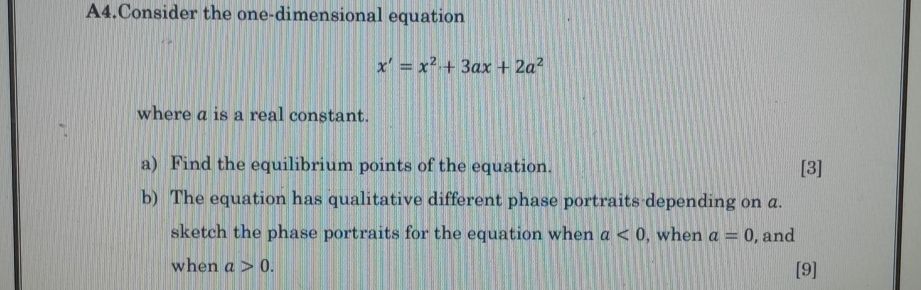 Ad Consider the one-dimensional equation
x' =x? + 3ax + 20%
I where a is a real constant.
a) Find the equilibrium points of the equation. 31
b) The equation has qualitative different phase portraits depending on a.
sketch the phase portraits for the equation when a < 0, when a = 0, and
when a > 0. | [9]
This is AI generated Response.
Asked by: Pagal
Created at: 2025-08-17 20:44:38
Asked by: Pagal
Created at: 2025-08-17 20:44:38
Final Answer:
Rendered
Raw Text
Did you like this answer?
Let's solve the given problem step by step:
---
### **Step 1: Find the equilibrium points of the equation**
The given equation is:
\[
\dot{x} = x^2 + 3a x + 2a^2
\]
**Equilibrium points** occur when \(\dot{x} = 0\):
\[
x^2 + 3a x + 2a^2 = 0
\]
This is a quadratic equation in \(x\):
\[
x^2 + 3a x + 2a^2 = 0
\]
Factoring:
\[
(x + 2a)(x + a) = 0
\]
So, the equilibrium points are:
\[
x = -2a \quad \text{and} \quad x = -a
\]
**Explanation**: We set \(\dot{x}\) to zero and solved the quadratic equation to find the equilibrium points.
---
### **Step 2: Sketch the phase portraits for different values of \(a\)**
#### **Case 1: \(a < 0\)**
- The equilibrium points, \(x_1 = -2a\) and \(x_2 = -a\), are both positive (since \(a < 0\)).
- The quadratic opens upwards (\(x^2\) term is positive).
#### **Case 2: \(a = 0\)**
- The equation becomes \(\dot{x} = x^2\).
- The only equilibrium point is \(x = 0\).
#### **Case 3: \(a > 0\)**
- The equilibrium points, \(x_1 = -2a\) and \(x_2 = -a\), are both negative (since \(a > 0\)).
- Again, the quadratic opens upwards.
#### **Phase Portraits Explanation**:
- For each case, determine the sign of \(\dot{x}\) in each interval between and outside the equilibrium points to sketch the arrows.
- **Stability**:
- At \(x = -2a\): If \(x < -2a\), \(\dot{x} > 0\); if \(x > -2a\) but \(x < -a\), \(\dot{x} < 0\).
- At \(x = -a\): If \(x > -a\), \(\dot{x} > 0\).
- So, \(x = -2a\) is a stable equilibrium; \(x = -a\) is unstable.
---
### **Final Answer:**
**a) Equilibrium points:**
\[
x = -2a \quad \text{and} \quad x = -a
\]
**b) Phase portrait sketches:**
- **For \(a < 0\):** Two positive equilibrium points (\(-2a < -a\)), with arrows pointing towards \(x = -2a\) (stable) and away from \(x = -a\) (unstable).
- **For \(a = 0\):** Single equilibrium at \(x = 0\); arrows point away from zero (unstable).
- **For \(a > 0\):** Two negative equilibrium points (\(-2a < -a\)), with similar stability as the \(a < 0\) case.
**Explanation**:
The qualitative behavior (stability and direction of flow) changes depending on the value of \(a\). The number and location of equilibrium points shift, and their stability can be deduced by the sign of \(\dot{x}\) in each region.
Question:
A 4 . Consider the one - dimensional equation � ' = � 2 + 3 � � + 2 � 2 where � is a real constant. a ) Find the equilibrium points of the equation. [ 3 ] b ) The equation has qualitative different phase portraits depending on � . sketch the phase portraits for the equation when � < 0 , when � = 0 , and when � > 0 .
This is AI generated Response.
Asked by: Pagal
Created at: 2025-08-17 20:46:11
Asked by: Pagal
Created at: 2025-08-17 20:46:11
Final Answer:
Rendered
Raw Text
Did you like this answer?
Let's solve the problem step by step:
---
### **Step 1: Find the equilibrium points of the equation**
Given differential equation:
\[
x' = x^2 + 3a x + 2a^2
\]
**To find equilibrium points**, set \(x' = 0\):
\[
x^2 + 3a x + 2a^2 = 0
\]
This is a quadratic in \(x\). Let's factor it:
\[
x^2 + 3a x + 2a^2 = (x + 2a)(x + a) = 0
\]
**Solutions:**
\[
x = -2a \quad \text{and} \quad x = -a
\]
**Explanation:** Equilibrium points occur where the derivative is zero, so solving the quadratic gives the equilibrium positions depending on \(a\).
---
### **Step 2: Sketch phase portraits for different values of \(a\)**
We analyze the stability and the nature of phase portraits based on the roots:
- **Equilibrium points:** \(x = -2a\) and \(x = -a\)
- The quadratic \(x^2 + 3a x + 2a^2\) opens upward (\(x^2\) coefficient positive).
---
### **Case 1: \(a < 0\)**
- **Locations of equilibrium points:**
Since \(a < 0\):
\[
-2a > 0 \quad \text{and} \quad -a > 0
\]
So, both equilibrium points are **positive**: \(x = -2a\) and \(x = -a\).
- **Stability analysis:**
Because the quadratic opens upward, between roots the function is negative, outside roots it is positive.
- For \(x < -2a\): \(x' > 0\) (flow to the right)
- Between \(-2a\) and \(-a\): \(x' < 0\) (flow to the left)
- For \(x > -a\): \(x' > 0\)
- **Nature of equilibrium points:**
- At \(x = -2a\): stable (since flow moves toward it from both sides)
- At \(x = -a\): unstable (flow moves away from it)
**Sketch note:** Two equilibrium points on the positive side; the one at \(-2a\) is stable, the one at \(-a\) unstable.
---
### **Case 2: \(a = 0\)**
- The equation reduces to:
\[
x' = x^2
\]
- **Equilibrium point:**
\[
x' = 0 \Rightarrow x = 0
\]
- **Stability:**
Since \(x' = x^2 \ge 0\), solutions tend to increase or stay at zero; zero is an **unstable equilibrium**.
**Sketch note:** Single equilibrium at \(x=0\), with flows away from zero.
---
### **Case 3: \(a > 0\)**
- **Locations of equilibrium points:**
Since \(a > 0\):
\[
-2a < 0 \quad \text{and} \quad -a < 0
\]
Both roots are **negative**.
- **Flow behavior:**
- For \(x < -2a\): \(x' > 0\) (flow to the right)
- Between \(-2a\) and \(-a\): \(x' < 0\) (flow to the left)
- For \(x > -a\): \(x' > 0\)
- **Nature of equilibrium points:**
- At \(x = -2a\): stable
- At \(x = -a\): unstable
**Sketch note:** Two equilibrium points on the negative side; stable at \(-2a\), unstable at \(-a\).
---
### **Final summary:**
- **Equilibrium points:**
\[
x = -2a \quad \text{and} \quad x = -a
\]
- **Phase portraits:**
- When \(a < 0\): Both equilibria are positive; flow moves toward the stable point at \(x = -2a\) and away from the unstable at \(x = -a\).
- When \(a = 0\): Single equilibrium at \(x=0\); flow moves away from zero (\(x' = x^2\)), indicating instability.
- When \(a > 0\): Both equilibria are negative; flows similar to the \(a<0\) case but on the negative side.
**This analysis helps visualize the qualitative behavior of the solutions depending on the parameter \(a\).**
Question:
A,b.
This is AI generated Response.
Asked by: Pagal
Created at: 2025-08-17 20:47:07
Asked by: Pagal
Created at: 2025-08-17 20:47:07
Final Answer:
Rendered
Raw Text
Did you like this answer?
Let's analyze the differential equation step by step:
---
### **Step 1: Find the equilibrium points**
Given the equation:
\[
x' = x^2 + 3a x + 2a^2
\]
**To find equilibrium points**, set \(x' = 0\):
\[
x^2 + 3a x + 2a^2 = 0
\]
This quadratic factors as:
\[
(x + 2a)(x + a) = 0
\]
**Solutions:**
\[
x = -2a \quad \text{and} \quad x = -a
\]
**Explanation:** Equilibrium points occur where the rate of change \(\dot{x}\) is zero. Factoring the quadratic provides explicit solutions depending on \(a\).
---
### **Step 2: Analyze and sketch phase portraits for different \(a\) values**
The roots (equilibria) are at \(x = -2a\) and \(x = -a\). The nature and position of these points depend on the sign of \(a\):
- The quadratic opens upward (\(x^2\) coefficient positive).
- The sign of \(\dot{x}\) between and outside roots determines flow directions:
| Region | Sign of \(x'^2 + 3a x + 2a^2\) | Flow direction |
|---------|------------------------------|----------------|
| \(x < -2a\) | Positive (since quadratic opens upward) | Flow to the right (\(x\) increases) |
| \(-2a < x < -a\) | Negative | Flow to the left (\(x\) decreases) |
| \(x > -a\) | Positive | Flow to the right (\(x\) increases) |
**Stability:**
- At \(x = -2a\): flow moves toward this point from both sides → **stable**
- At \(x = -a\): flow moves away from this point → **unstable**
---
### **Phase portraits for different \(a\):**
- **When \(a < 0\):**
- \(-2a > 0\), \(-a > 0\); both roots are positive.
- The flow near these points:
- For \(x < -2a\): \(x'\) positive → flow to the right.
- Between roots: flow to the left.
- For \(x > -a\): flow to the right.
- **Interpretation:** The stable equilibrium at \(x=-2a\) attracts solutions from the left and right; the unstable at \(x=-a\) repels solutions.
- **When \(a = 0\):**
- Equation simplifies to:
\[
x' = x^2
\]
- Only equilibrium at \(x=0\), which is **unstable** (since solutions with \(x \neq 0\) tend to increase).
- **When \(a > 0\):**
- Both roots are negative: \(-2a < 0\), \(-a < 0\).
- The flow pattern is similar:
- For \(x < -2a\): \(x'\) positive → flow right.
- Between roots: flow left.
- For \(x > -a\): flow right.
- **Interpretation:** Stable equilibrium at \(x=-2a\), unstable at \(x=-a\).
---
### **Final Summary:**
**a)** The equilibrium points are:
\[
\boxed{
x = -2a \quad \text{and} \quad x = -a
}
\]
**b)** The phase portraits depend on the sign of \(a\):
- **For \(a < 0\)**: Both equilibria are positive; flow moves toward the stable point at \(x = -2a\) and away from the unstable at \(x = -a\).
- **For \(a=0\)**: Single equilibrium at \(x=0\), which is unstable.
- **For \(a > 0\)**: Both equilibria are negative; flow moves toward the stable point at \(x = -2a\) and away from the unstable at \(x=-a\).
This qualitative analysis informs the expected behavior of solutions depending on the parameter \(a\).
📢 Instructions:
- Ask anything relatd to above question only.
- For new Question goto :