 VIPSolutions
give answer in 2 step with explanation at the end of each step and final answer at the end: This is my method for finding the total. Is it correct? Should I use multiplication or addition?Ee Posie sit ana Incentives for Departments to Improve Performance and Productivity Bion | Compliance (Cumulative Points Collection) I ee A BO Stormer: | Depa | Doar | Depare |Depare Depren ES ml Pg pci eres exte Tater 1 5 ror -. prom pe pros Tra pli Sonor Secinons. polis / Time competion Sheba 0 © 7 implemen net denon Sepa pacsey Froposas or persons ceny improves Fropests or rating pokimey product Compe i Jv Topas - 5 pt
Question:
give answer in 2 step with explanation at the end of each step and final answer at the end:
This is my method for finding the total. Is it
correct? Should I use multiplication or
addition?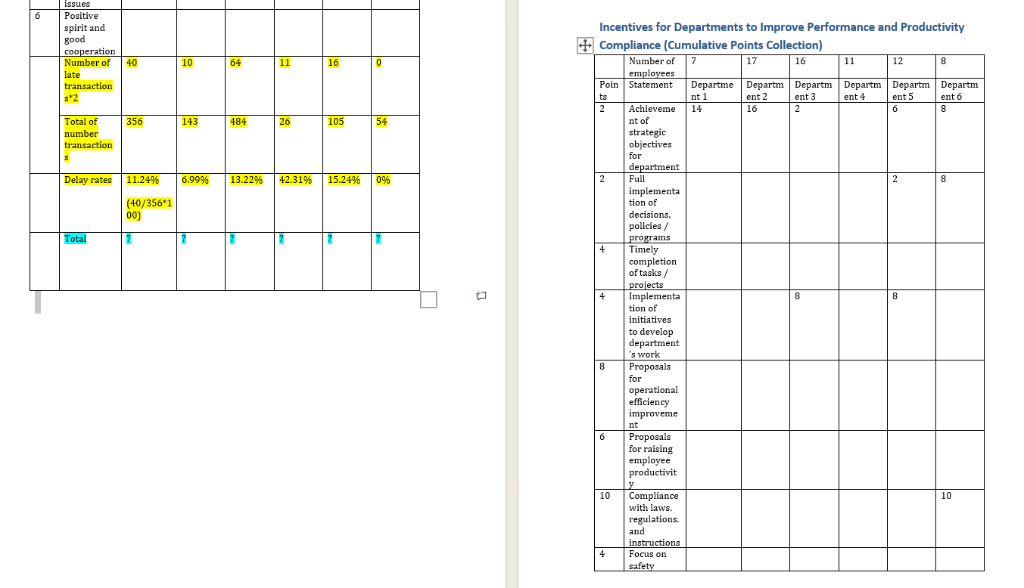 Ee
Posie
sit ana Incentives for Departments to Improve Performance and Productivity
Bion | Compliance (Cumulative Points Collection)
I ee A BO
Stormer: | Depa | Doar | Depare |Depare Depren
ES ml Pg pci eres exte
Tater 1 5
ror
-.
prom
pe
pros
Tra
pli
Sonor
Secinons.
polis /
Time
competion
Sheba
0 © 7 implemen
net
denon
Sepa
pacsey
Froposas
or
persons
ceny
improves
Fropests
or rating
pokimey
product
Compe i
Jv
Topas
-
5
pt
This is AI generated Response.
Asked by: Pagal
Created at: 2025-08-15 14:22:28
Asked by: Pagal
Created at: 2025-08-15 14:22:28
Final Answer:
Rendered
Raw Text
Did you like this answer?
Let's break down your question into **two steps** and explain the reasoning at each stage.
---
### **Step 1: Understanding What You Want to Total and How**
From the left table (highlighted in yellow), you are dealing with:
- The number of late transactions,
- The total number of transactions,
- The delay rates for six departments.
**Your "total" row** at the bottom is asking for the totals under each column (department).
#### **Explanation:**
To find the total number of late transactions or the total number of transactions, you should **add** the numbers for each department across columns.
- For example, the **total number of late transactions** for all departments = 40 + 10 + 64 + 11 + 16 + 0 = **141**.
**Multiplication** is not appropriate here, because you are summing up counts from different departments, not scaling a single value.
---
### **Step 2: Delay Rate Calculation**
For **delay rates**, you are already using the correct formula:
- Delay rate for each department = (Number of late transactions / Total number of transactions) × 100
If you want the **overall delay rate** for all departments together, you should:
1. Add up the total late transactions across all departments.
2. Add up the total number of transactions across all departments.
3. Use the formula:
(Total late transactions / Total number of transactions) × 100
#### **Explanation:**
Again, use **addition** to find the totals, then do **division** for the rate.
**Do not multiply** individual percentages or counts.
---
### **Final Answer**
- **Use addition** to find the totals for "number of late transactions" and "total number of transactions."
- **Use division** (not multiplication) to get the delay rate.
- **Multiplication is not correct** for finding these totals; addition is the right method.
**Summary:**
> **Your method should use addition for totals, and the delay rate should be calculated by dividing the total late transactions by the total number of transactions, then multiplying by 100. Multiplication is not correct for totaling these values.**
📢 Instructions:
- Ask anything relatd to above question only.
- For new Question goto :