 VIPSolutions
give answer in 2 step with explanation at the end of each step and final answer at the end:= (RawPoints * (1 - (LateTransactions / TotalTransactions))) / Employees This is my method for finding the total. Is it correct? Should | use multiplication or addition? {—Nuann
Question:
give answer in 2 step with explanation at the end of each step and final answer at the end: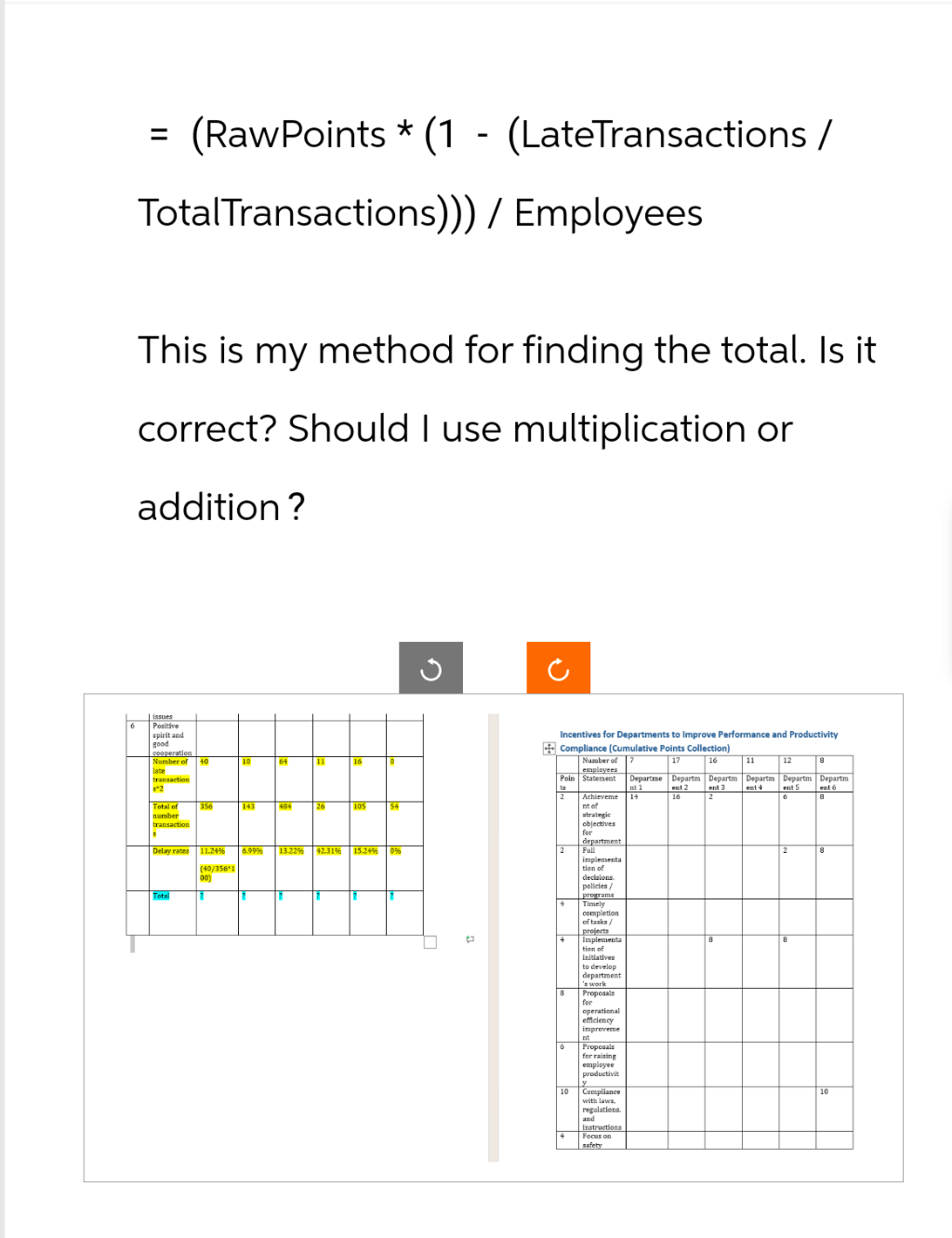 = (RawPoints * (1 - (LateTransactions /
TotalTransactions))) / Employees
This is my method for finding the total. Is it
correct? Should | use multiplication or
addition?
{—Nuann
This is AI generated Response.
Asked by: Pagal
Created at: 2025-08-15 14:19:50
Asked by: Pagal
Created at: 2025-08-15 14:19:50
Final Answer:
Rendered
Raw Text
Did you like this answer?
Let's break down your method into **2 steps** and explain whether multiplication or addition should be used.
---
### **Step 1: Understanding Your Formula**
Your formula is:
```
= (RawPoints * (1 - (LateTransactions / TotalTransactions))) / Employees
```
**Explanation:**
- **RawPoints**: The base points assigned.
- **LateTransactions / TotalTransactions**: The percentage of transactions that are late.
- **1 - (LateTransactions / TotalTransactions)**: The percentage of transactions that are NOT late (on time).
- **Multiplying RawPoints by this percentage**: Adjusts the points based on performance (fewer late transactions means more points).
- **Dividing by Employees**: Distributes the points per employee.
**Conclusion for Step 1:**
**Multiplication** is used to scale the RawPoints based on performance (timeliness). **Addition** would not make sense here, as you want to adjust (scale) the points, not just add or remove a flat amount.
---
### **Step 2: Is the Method Correct?**
- If your goal is to:
- Reward higher points for fewer late transactions,
- Penalize for more late transactions,
- And then find the average per employee,
**your formula is correct.**
**Explanation:**
- The *scaling* by `(1 - LateTransactions/TotalTransactions)` is an effective way to penalize lateness.
- *Dividing by Employees* gives an average per employee, which is fair for comparative purposes.
**Conclusion for Step 2:**
Your method is **correct** for finding a performance-adjusted total or average per employee.
You **should use multiplication** (not addition) for this purpose.
---
## **Final Answer**
Your formula is correct, and you should use **multiplication** (not addition) to adjust points for late transactions. The calculation method you are using makes sense for performance-based point allocation.
📢 Instructions:
- Ask anything relatd to above question only.
- For new Question goto :