 VIPSolutions
give answer in 2 step with explanation at the end of each step and final answer at the end:(18 points) Solve all of the following initial value problems: () he ( PY 2 Wy a(t —3) 0)=0, y'(0) = 3 (€) ga t+2g +y=30(t-3); y(0) =0, y'(0) =
Question:
give answer in 2 step with explanation at the end of each step and final answer at the end: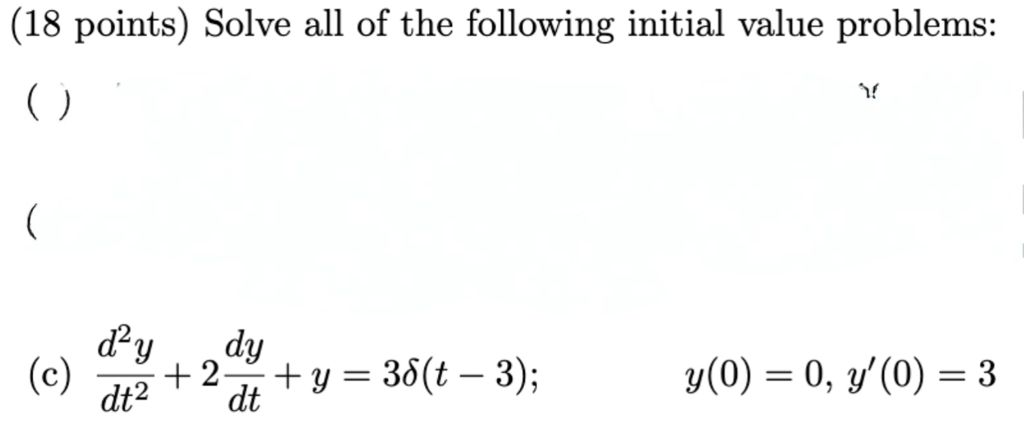 (18 points) Solve all of the following initial value problems:
() he
(
PY 2 Wy a(t —3) 0)=0, y'(0) = 3
(€) ga t+2g +y=30(t-3); y(0) =0, y'(0) =
This is AI generated Response.
Asked by: Pagal
Created at: 2025-08-12 02:47:46
Asked by: Pagal
Created at: 2025-08-12 02:47:46
Final Answer:
Rendered
Raw Text
Did you like this answer?
Let's solve the given initial value problem step-by-step:
Given:
\[
\frac{d^2y}{dt^2} + 2\frac{dy}{dt} + y = 3\delta(t-3), \quad y(0) = 0, \; y'(0) = 3
\]
---
### **Step 1: Take the Laplace Transform**
Take the Laplace Transform of both sides (let \( Y(s) = \mathcal{L}\{y(t)\} \)):
\[
\mathcal{L}\left\{ \frac{d^2y}{dt^2} + 2\frac{dy}{dt} + y \right\} = \mathcal{L}\{3\delta(t-3)\}
\]
Recall properties:
- \(\mathcal{L}\{y''\} = s^2 Y(s) - s y(0) - y'(0)\)
- \(\mathcal{L}\{y'\} = s Y(s) - y(0)\)
- \(\mathcal{L}\{y\} = Y(s)\)
- \(\mathcal{L}\{\delta(t-a)\} = e^{-as}\)
Plug in initial conditions (\(y(0) = 0, y'(0) = 3\)):
\[
[s^2 Y(s) - 0 - 3] + 2[s Y(s) - 0] + Y(s) = 3e^{-3s}
\]
\[
s^2 Y(s) - 3 + 2s Y(s) + Y(s) = 3e^{-3s}
\]
\[
(s^2 + 2s + 1)Y(s) = 3 + 3e^{-3s}
\]
\[
(s+1)^2 Y(s) = 3 + 3e^{-3s}
\]
\[
Y(s) = \frac{3}{(s+1)^2} + \frac{3e^{-3s}}{(s+1)^2}
\]
**Explanation:**
We've used the Laplace transform to convert the differential equation into an algebraic equation in terms of \( Y(s) \).
---
### **Step 2: Inverse Laplace Transform**
Now, take the inverse Laplace transform to find \( y(t) \):
We know:
- \( \mathcal{L}^{-1}\left\{ \frac{1}{(s+a)^2} \right\} = t e^{-a t} \)
- \( \mathcal{L}^{-1}\left\{ e^{-as}F(s) \right\} = f(t-a)u(t-a) \), where \( u(t-a) \) is the unit step function.
So,
\[
y(t) = 3 \cdot t e^{-t} + 3 \cdot (t-3)e^{-(t-3)} u(t-3)
\]
**Explanation:**
We used the inverse Laplace transform and the shifting property to get the solution in the time domain.
---
### **Final Answer**
\[
\boxed{
y(t) = 3 t e^{-t} + 3 (t-3) e^{-(t-3)} u(t-3)
}
\]
Where \( u(t-3) \) is the unit step function.
📢 Instructions:
- Ask anything relatd to above question only.
- For new Question goto :