 VIPSolutions
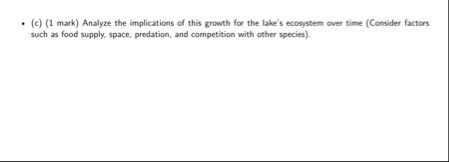
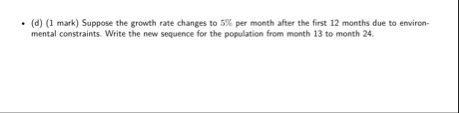
give answer in 2 step with explanation at the end of each step and final answer at the end:35 mk) A ow oc of sh cca 3 be Tho poi 20, nd cs by 10 Bla ht 4 nm LE 9) (Lm) ind eno the rs ening so pepo ov he 2 mr pri (0) Lm) Dc ten rm kh pooner diss © (0) (1 mh) Ane the implcations of thi growth for he e's cept cr time (Comer fcr Such fod upp. space, predation, 20 compen with ce 5ec) © (0) (1 mh) Supp th grove rte changes o 5. per rants ae th st 12 month doe 0 emi mena onsins. Wie tne rw suc fr the opis rom mh 1310 mh 2
Question:
give answer in 2 step with explanation at the end of each step and final answer at the end: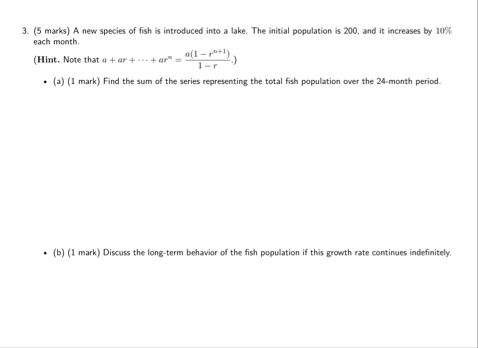
 35 mk) A ow oc of sh cca 3 be Tho poi 20, nd cs by 10
Bla ht 4 nm LE
9) (Lm) ind eno the rs ening so pepo ov he 2 mr pri
(0) Lm) Dc ten rm kh pooner diss
© (0) (1 mh) Ane the implcations of thi growth for he e's cept cr time (Comer fcr
Such fod upp. space, predation, 20 compen with ce 5ec)
© (0) (1 mh) Supp th grove rte changes o 5. per rants ae th st 12 month doe 0 emi
mena onsins. Wie tne rw suc fr the opis rom mh 1310 mh 2
This is AI generated Response.
Asked by: Pagal
Created at: 2025-08-04 07:01:39
Asked by: Pagal
Created at: 2025-08-04 07:01:39
Final Answer:
Rendered
Raw Text
Did you like this answer?
Let's solve each part **step by step** with explanations after each step, and give the final answer at the end.
---
### (a) Find the sum of the series representing the total fish population over the 24-month period.
#### **Step 1: Identify the Series**
- The initial population is **200**.
- Growth rate is **10% per month**: so each month, population is multiplied by **1.1**.
- The population each month forms a geometric sequence:
Month 1: 200
Month 2: 200 × 1.1
Month 3: 200 × (1.1)²
…
Month n: 200 × (1.1)^(n-1)
**Series for 24 months:**
200 + 200(1.1) + 200(1.1)² + ... + 200(1.1)²³
**Explanation:**
This is a geometric series with first term \( a = 200 \), common ratio \( r = 1.1 \), and number of terms \( n = 24 \).
---
#### **Step 2: Use the Sum Formula**
The sum of the first \( n \) terms of a geometric series is:
\[
S_n = a \frac{1-r^n}{1-r}
\]
Plug in the values:
- \( a = 200 \)
- \( r = 1.1 \)
- \( n = 24 \)
\[
S_{24} = 200 \frac{1 - (1.1)^{24}}{1 - 1.1}
\]
\[
S_{24} = 200 \frac{1 - (1.1)^{24}}{-0.1}
\]
\[
S_{24} = -2000 [1 - (1.1)^{24}]
\]
\[
S_{24} = 2000 [(1.1)^{24} - 1]
\]
**Final Answer for (a):**
\[
\boxed{S_{24} = 2000 \left[(1.1)^{24} - 1\right]}
\]
This is the sum of the series representing the total fish population over the 24-month period.
---
### (b) Long-term behavior if growth continues indefinitely
#### **Step 1: Consider the Formula as \( n \to \infty \)**
As \( n \to \infty \), \( (1.1)^n \to \infty \). The sum formula for a geometric series diverges (the sum grows without bound) if \( r > 1 \).
**Explanation:**
With a constant 10% monthly growth, the population would grow **exponentially** and become infinitely large in the long run, which is not realistic in nature.
---
**Final Answer for (b):**
If the growth rate continues indefinitely, the fish population will increase without bound (exponentially), eventually becoming infinitely large.
---
### (c) Implications for the lake’s ecosystem
#### **Step 1: Analyze Ecological Factors**
- **Food supply:** Rapid population growth will increase demand for food, potentially leading to shortages.
- **Space:** Overcrowding may occur, causing stress and disease.
- **Predation:** Predators may increase due to more prey, but could also be outpaced by fish growth.
- **Competition:** Other species may suffer due to increased competition for resources.
**Explanation:**
Uncontrolled exponential growth can disrupt the ecosystem, leading to resource depletion, imbalance, and possible collapse of the fish population or other species.
---
**Final Answer for (c):**
Exponential fish population growth can lead to resource depletion, overcrowding, increased disease, and competition, destabilizing the entire ecosystem.
---
### (d) New sequence if growth rate changes to 5% per month after month 12
#### **Step 1: Find Population at Month 12**
Population at month 12:
\[
P_{12} = 200 \times (1.1)^{11}
\]
#### **Step 2: Write New Sequence for Months 13 to 24**
From month 13 onwards, growth rate = 5% per month (\( r = 1.05 \)).
- Month 13: \( P_{12} \times 1.05 \)
- Month 14: \( P_{12} \times (1.05)^2 \)
- ...
- Month 24: \( P_{12} \times (1.05)^{12} \)
So, for month \( k \) (where \( k = 1 \) to \( 12 \)), population is:
\[
P_{12} \times (1.05)^k = 200 \times (1.1)^{11} \times (1.05)^k
\]
for \( k = 1, 2, ..., 12 \).
**Explanation:**
After month 12, the population continues to grow, but at a slower (5%) rate, starting from the value reached at month 12.
---
**Final Answer for (d):**
\[
P = 200 \times (1.1)^{11} \times (1.05)^k \quad \text{for} \quad k = 1, 2, ..., 12 \ (\text{months 13 to 24})
\]
---
Let me know if you need any further clarifications or calculations!
Question:
Give me final answer
This is AI generated Response.
Asked by: Pagal
Created at: 2025-08-04 07:02:43
Asked by: Pagal
Created at: 2025-08-04 07:02:43
Final Answer:
Rendered
Raw Text
Did you like this answer?
**Final summarized answers:**
**(a)** The total fish population over 24 months is:
\[
\boxed{2000 \left[(1.1)^{24} - 1\right]}
\]
**(b)** If growth continues indefinitely, the population grows exponentially without bound (it becomes infinitely large).
**(c)** The implications of such exponential growth include resource depletion, overcrowding, increased disease, and ecosystem imbalance.
**(d)** After month 12, if the growth rate drops to 5% per month, the population for months 13 to 24 is given by:
\[
P = 200 \times (1.1)^{11} \times (1.05)^k, \quad k=1,2,\ldots,12
\]
📢 Instructions:
- Ask anything relatd to above question only.
- For new Question goto :