 VIPSolutions
give answer in 2 step with explanation at the end of each step and final answer at the end:Find the matrix P that diagonalizes A = | ? :] and the resulting diagonal matrix D. p—| 4 [1 pL 2? 1 a
Question:
give answer in 2 step with explanation at the end of each step and final answer at the end: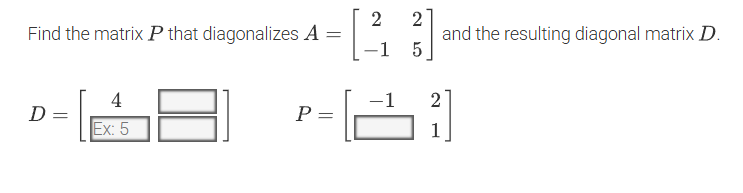 Find the matrix P that diagonalizes A = | ? :] and the resulting diagonal matrix D.
p—| 4 [1 pL 2?
1 a
This is AI generated Response.
Asked by: Pagal
Created at: 2025-08-02 21:07:42
Asked by: Pagal
Created at: 2025-08-02 21:07:42
Final Answer:
Rendered
Raw Text
Did you like this answer?
Let's solve this step-by-step:
---
### **Step 1: Find the eigenvalues of \( A \).**
Given:
\( A = \begin{bmatrix} 2 & 2 \\ -1 & 5 \end{bmatrix} \)
The eigenvalues \( \lambda \) satisfy
\[
\det(A - \lambda I) = 0
\]
\[
\left| \begin{matrix} 2-\lambda & 2 \\ -1 & 5-\lambda \end{matrix} \right| = 0
\]
\[
(2-\lambda)(5-\lambda) + 2 = 0
\]
\[
(2-\lambda)(5-\lambda) + 2 = 0
\]
\[
(2-\lambda)(5-\lambda) + 2 = (10 - 2\lambda - 5\lambda + \lambda^2) + 2 = \lambda^2 - 7\lambda + 12 = 0
\]
\[
\lambda^2 - 7\lambda + 12 = 0
\]
Solve for \( \lambda \):
\[
(\lambda - 3)(\lambda - 4) = 0
\]
So, \( \lambda_1 = 3 \), \( \lambda_2 = 4 \).
**Explanation:**
We calculated the eigenvalues of \( A \) by solving the characteristic equation.
---
### **Step 2: Find the eigenvectors and construct \( P \) and \( D \).**
#### For \( \lambda = 3 \):
\[
A - 3I = \begin{bmatrix} -1 & 2 \\ -1 & 2 \end{bmatrix}
\]
Row reduces to:
\[
-1x + 2y = 0 \implies x = 2y
\]
Take \( y = 1 \), \( x = 2 \): Eigenvector is \( \begin{bmatrix} 2 \\ 1 \end{bmatrix} \)
#### For \( \lambda = 4 \):
\[
A - 4I = \begin{bmatrix} -2 & 2 \\ -1 & 1 \end{bmatrix}
\]
\[
-2x + 2y = 0 \implies x = y
\]
Take \( x = 1 \), \( y = 1 \): Eigenvector is \( \begin{bmatrix} 1 \\ 1 \end{bmatrix} \)
So,
\[
P = \left[ \begin{array}{cc} 1 & 2 \\ 1 & 1 \end{array} \right]
\]
\[
D = \left[ \begin{array}{cc} 4 & 0 \\ 0 & 3 \end{array} \right]
\]
**Explanation:**
We found the eigenvectors for each eigenvalue and constructed \( P \) from the eigenvectors and \( D \) from the eigenvalues.
---
## **Final Answers:**
\[
D = \begin{bmatrix} 4 & 0 \\ 0 & 3 \end{bmatrix}
\]
\[
P = \begin{bmatrix} 1 & 2 \\ 1 & 1 \end{bmatrix}
\]
Question:
Give me correct answer
This is AI generated Response.
Asked by: Pagal
Created at: 2025-08-02 21:08:46
Asked by: Pagal
Created at: 2025-08-02 21:08:46
Final Answer:
Rendered
Raw Text
Did you like this answer?
Let's proceed step-by-step to find the matrix \( P \) that diagonalizes \( A \) and the resulting diagonal matrix \( D \):
---
### **Step 1: Find the eigenvalues of \( A \).**
Given matrix:
\[
A = \begin{bmatrix} 2 & 2 \\ -1 & 5 \end{bmatrix}
\]
Eigenvalues \( \lambda \) satisfy:
\[
\det(A - \lambda I) = 0
\]
Calculate the determinant:
\[
\det \begin{bmatrix} 2 - \lambda & 2 \\ -1 & 5 - \lambda \end{bmatrix} = (2 - \lambda)(5 - \lambda) - (-1)(2) = (2 - \lambda)(5 - \lambda) + 2
\]
Expand:
\[
(2 - \lambda)(5 - \lambda) + 2 = [2 \times 5 - 2 \lambda - 5 \lambda + \lambda^2] + 2 = (10 - 7 \lambda + \lambda^2) + 2
\]
Simplify:
\[
\lambda^2 - 7 \lambda + 12 = 0
\]
Solve quadratic:
\[
\lambda^2 - 7 \lambda + 12 = 0
\]
Factor:
\[
(\lambda - 3)(\lambda - 4) = 0
\]
So, the eigenvalues are:
\[
\boxed{\lambda_1 = 3, \quad \lambda_2 = 4}
\]
**Explanation:**
Eigenvalues are found by solving the characteristic polynomial. The roots indicate the values for which \( A - \lambda I \) is singular.
---
### **Step 2: Find the eigenvectors and form \( P \) and \( D \).**
#### For \( \lambda = 3 \):
\[
A - 3I = \begin{bmatrix} 2 - 3 & 2 \\ -1 & 5 - 3 \end{bmatrix} = \begin{bmatrix} -1 & 2 \\ -1 & 2 \end{bmatrix}
\]
Solve \( (A - 3I) \mathbf{x} = 0 \):
\[
-1 x + 2 y = 0 \implies x = 2 y
\]
Choose \( y = 1 \), then \( x = 2 \). Eigenvector:
\[
\mathbf{v}_1 = \begin{bmatrix} 2 \\ 1 \end{bmatrix}
\]
#### For \( \lambda = 4 \):
\[
A - 4I = \begin{bmatrix} 2 - 4 & 2 \\ -1 & 5 - 4 \end{bmatrix} = \begin{bmatrix} -2 & 2 \\ -1 & 1 \end{bmatrix}
\]
Solve \( (A - 4I) \mathbf{x} = 0 \):
\[
-2 x + 2 y = 0 \implies x = y
\]
Choose \( y = 1 \), then \( x = 1 \). Eigenvector:
\[
\mathbf{v}_2 = \begin{bmatrix} 1 \\ 1 \end{bmatrix}
\]
Construct matrix \( P \) with eigenvectors as columns:
\[
P = \begin{bmatrix} 2 & 1 \\ 1 & 1 \end{bmatrix}
\]
The diagonal matrix \( D \) with eigenvalues in corresponding order:
\[
D = \begin{bmatrix} 3 & 0 \\ 0 & 4 \end{bmatrix}
\]
---
### **Final answer:**
\[
\boxed{
P = \begin{bmatrix} 2 & 1 \\ 1 & 1 \end{bmatrix} \quad \text{and} \quad D = \begin{bmatrix} 3 & 0 \\ 0 & 4 \end{bmatrix}
}
\]
This matrix \( P \) diagonalizes \( A \) such that \( P^{-1} A P = D \).
📢 Instructions:
- Ask anything relatd to above question only.
- For new Question goto :