 VIPSolutions
give answer in 2 step with explanation at the end of each step and final answer at the end:4. Prove using the definition that 1 3 14 rdr=_. / =a Hint: Recall the formula for the arithmetic sum: 3 = 1). -l
Question:
give answer in 2 step with explanation at the end of each step and final answer at the end: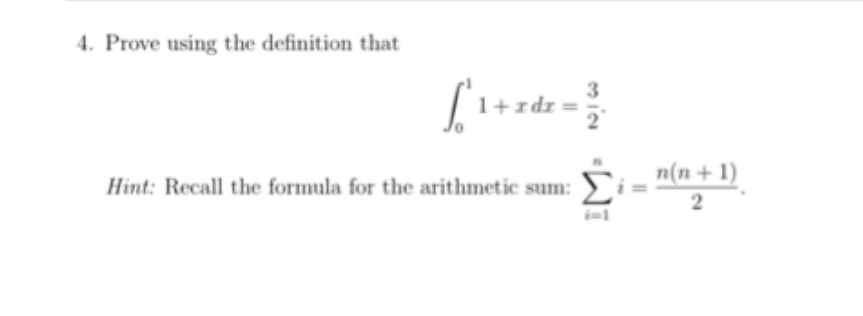 4. Prove using the definition that
1
3
14 rdr=_.
/ =a
Hint: Recall the formula for the arithmetic sum: 3 = 1).
-l
This is AI generated Response.
Asked by: Pagal
Created at: 2025-08-01 23:10:14
Asked by: Pagal
Created at: 2025-08-01 23:10:14
Final Answer:
Rendered
Raw Text
Did you like this answer?
Let's solve the problem step by step using the **definition of the definite integral** (Riemann sum).
---
### Step 1: Set Up the Riemann Sum
The definite integral from 0 to 1 of \( 1 + x \) dx is defined as:
\[
\int_0^1 (1 + x)\, dx = \lim_{n \to \infty} \sum_{i=1}^n f(x_i^*) \Delta x
\]
Where:
- \( \Delta x = \frac{1-0}{n} = \frac{1}{n} \)
- \( x_i^* \) is a sample point in the i-th subinterval. For simplicity, use the right endpoint: \( x_i^* = \frac{i}{n} \)
Plug into the function:
\[
f(x_i^*) = 1 + x_i^* = 1 + \frac{i}{n}
\]
So the sum becomes:
\[
\sum_{i=1}^n \left(1 + \frac{i}{n}\right) \Delta x = \sum_{i=1}^n \left(1 + \frac{i}{n}\right) \cdot \frac{1}{n}
\]
**Explanation:**
We broke the interval [0,1] into \( n \) equal parts and wrote the Riemann sum using the right endpoints.
---
### Step 2: Simplify the Sum
Expand the sum:
\[
\sum_{i=1}^n \left(1 + \frac{i}{n}\right) \cdot \frac{1}{n}
= \sum_{i=1}^n \frac{1}{n} + \sum_{i=1}^n \frac{i}{n^2}
\]
\[
= \frac{1}{n} \sum_{i=1}^n 1 + \frac{1}{n^2} \sum_{i=1}^n i
\]
Recall the sum formulas:
- \( \sum_{i=1}^n 1 = n \)
- \( \sum_{i=1}^n i = \frac{n(n+1)}{2} \)
Substitute:
\[
= \frac{1}{n} \cdot n + \frac{1}{n^2} \cdot \frac{n(n+1)}{2}
= 1 + \frac{n+1}{2n}
\]
Now, take the limit as \( n \to \infty \):
\[
\lim_{n \to \infty} \left[1 + \frac{n+1}{2n}\right] = 1 + \frac{1}{2} = \frac{3}{2}
\]
**Explanation:**
We simplified the sum using standard formulas, then took the limit as \( n \) becomes large.
---
### **Final Answer:**
\[
\boxed{\int_0^1 (1 + x)\, dx = \frac{3}{2}}
\]
This matches the required proof using the definition!
📢 Instructions:
- Ask anything relatd to above question only.
- For new Question goto :