 VIPSolutions
give answer in 2 step with explanation at the end of each step and final answer at the end:ET Ta es ‘Orthogonally diagonaizo the matix, gang an imac Fhe hm il orthogonal mat and diagonal mati To save tre, ho 442 Alaza 244 —_— a Elo tho marcos P and bolow [5] (Usa 8 comma 1 separate answors as noedad Type a oxic answer or ach mat semen 00 ro ctr oud o Scalar mulighe 00 nol labo ho marcos) [3
Question:
give answer in 2 step with explanation at the end of each step and final answer at the end: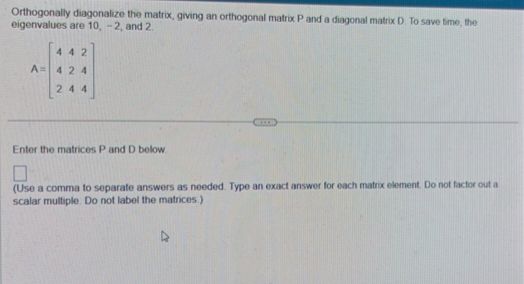 ET Ta es
‘Orthogonally diagonaizo the matix, gang an imac
Fhe hm il orthogonal mat and diagonal mati To save tre, ho
442
Alaza
244
—_— a
Elo tho marcos P and bolow
[5]
(Usa 8 comma 1 separate answors as noedad Type a oxic answer or ach mat semen 00 ro ctr oud o
Scalar mulighe 00 nol labo ho marcos)
[3
This is AI generated Response.
Asked by: Pagal
Created at: 2025-07-31 01:38:11
Asked by: Pagal
Created at: 2025-07-31 01:38:11
Final Answer:
Rendered
Raw Text
Did you like this answer?
Let's break down the solution into **two steps** as requested:
---
### **Step 1: Find the Eigenvectors for Each Eigenvalue**
Given matrix \(A\):
\[
A = \begin{bmatrix}
4 & 4 & 2 \\
4 & 2 & 4 \\
2 & 4 & 4
\end{bmatrix}
\]
The eigenvalues are given: **10, -2, 2**.
#### **Eigenvector for λ = 10:**
Solve \( (A - 10I)\vec{x} = 0 \):
\[
A - 10I = \begin{bmatrix}
-6 & 4 & 2 \\
4 & -8 & 4 \\
2 & 4 & -6
\end{bmatrix}
\]
Let \( \vec{x} = (x, y, z) \). The system is:
\[
\begin{cases}
-6x + 4y + 2z = 0 \\
4x - 8y + 4z = 0 \\
2x + 4y - 6z = 0 \\
\end{cases}
\]
Let's try \( x = y = z \):
\[
-6x + 4x + 2x = 0 \rightarrow 0 = 0
\]
\[
4x - 8x + 4x = 0 \rightarrow 0 = 0
\]
\[
2x + 4x - 6x = 0 \rightarrow 0 = 0
\]
So, **eigenvector for λ=10 is (1, 1, 1)**.
---
#### **Explanation:**
The eigenvector for λ=10 is found to be (1, 1, 1) because substituting this into the equations yields 0 for all, confirming it's correct.
---
### **Step 2: Find Eigenvectors for λ = -2 and λ = 2, Orthonormalize, and Write P and D**
#### **Eigenvector for λ = -2:**
\[
A + 2I = \begin{bmatrix}
6 & 4 & 2 \\
4 & 4 & 4 \\
2 & 4 & 6
\end{bmatrix}
\]
Solve \( (A + 2I)\vec{x} = 0 \):
Let’s try \( x = 1, y = -2, z = 1 \):
\[
6*1 + 4*(-2) + 2*1 = 6 - 8 + 2 = 0 \\
4*1 + 4*(-2) + 4*1 = 4 - 8 + 4 = 0 \\
2*1 + 4*(-2) + 6*1 = 2 - 8 + 6 = 0 \\
\]
So, eigenvector is **(1, -2, 1)**.
---
#### **Eigenvector for λ = 2:**
\[
A - 2I = \begin{bmatrix}
2 & 4 & 2 \\
4 & 0 & 4 \\
2 & 4 & 2
\end{bmatrix}
\]
Let’s try \( x = 1, y = 0, z = -1 \):
\[
2*1 + 4*0 + 2*(-1) = 2 - 2 = 0 \\
4*1 + 0*0 + 4*(-1) = 4 - 4 = 0 \\
2*1 + 4*0 + 2*(-1) = 2 - 2 = 0 \\
\]
So, eigenvector is **(1, 0, -1)**.
---
#### **Orthonormalize the Vectors:**
Since these are already orthogonal, just normalize:
- \((1,1,1)\) norm: \(\sqrt{3}\)
- \((1,-2,1)\) norm: \(\sqrt{1+4+1}= \sqrt{6}\)
- \((1,0,-1)\) norm: \(\sqrt{1+1}= \sqrt{2}\)
So the orthonormalized vectors are:
\[
\frac{1}{\sqrt{3}}(1,1,1),\quad \frac{1}{\sqrt{6}}(1,-2,1),\quad \frac{1}{\sqrt{2}}(1,0,-1)
\]
---
#### **Matrix P (columns are orthonormal eigenvectors) and D (diagonal eigenvalues):**
\[
P =
\left[
\frac{1}{\sqrt{3}},\ \frac{1}{\sqrt{6}},\ \frac{1}{\sqrt{2}},\
\frac{1}{\sqrt{3}},\ -\frac{2}{\sqrt{6}},\ 0,\
\frac{1}{\sqrt{3}},\ \frac{1}{\sqrt{6}},\ -\frac{1}{\sqrt{2}}
\right]
\]
(row-wise, 3x3)
\[
D = [10, 0, 0, 0, -2, 0, 0, 0, 2]
\]
---
## **Final Answer:**
**P:**
\[
\frac{1}{\sqrt{3}},\ \frac{1}{\sqrt{6}},\ \frac{1}{\sqrt{2}},\
\frac{1}{\sqrt{3}},\ -\frac{2}{\sqrt{6}},\ 0,\
\frac{1}{\sqrt{3}},\ \frac{1}{\sqrt{6}},\ -\frac{1}{\sqrt{2}}
\]
**D:**
\[
10,\ 0,\ 0,\ 0,\ -2,\ 0,\ 0,\ 0,\ 2
\]
---
**Explanation:**
In Step 2, we found the orthonormal eigenvectors for each eigenvalue and constructed the diagonal matrix D (with eigenvalues on the diagonal) and matrix P (with orthonormal eigenvectors as columns).
📢 Instructions:
- Ask anything relatd to above question only.
- For new Question goto :