 VIPSolutions
give answer in 2 step with explanation at the end of each step and final answer at the end:1. Let U © BR" be a subspace with an orthovormal basis {uy us... ua), and Jet U = ir 5 --- w) € R™ denote the matrix whose columns are the basis vectors. Let Put. (0) Let 1 € R". Show that Pr=Y (run. That is, Px expresses the orthogonal projection of z onto U as a linear combina- tion of the orthonormal basis sectors. (6) Prove that P is idempotent and symmetric, i... show that P? = P and PT = P. (¢) Let 2 € BR". Show that x — Pr is orthogonal to every vector in U.
Question:
give answer in 2 step with explanation at the end of each step and final answer at the end: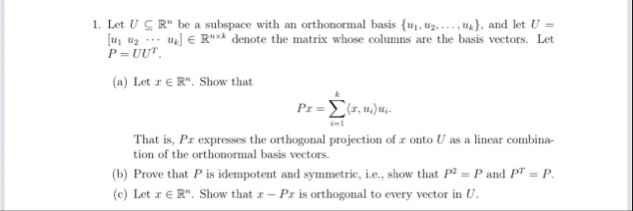 1. Let U © BR" be a subspace with an orthovormal basis {uy us... ua), and Jet U =
ir 5 --- w) € R™ denote the matrix whose columns are the basis vectors. Let
Put.
(0) Let 1 € R". Show that
Pr=Y (run.
That is, Px expresses the orthogonal projection of z onto U as a linear combina-
tion of the orthonormal basis sectors.
(6) Prove that P is idempotent and symmetric, i... show that P? = P and PT = P.
(¢) Let 2 € BR". Show that x — Pr is orthogonal to every vector in U.
This is AI generated Response.
Asked by: Pagal
Created at: 2025-07-30 06:28:24
Asked by: Pagal
Created at: 2025-07-30 06:28:24
Final Answer:
Rendered
Raw Text
Did you like this answer?
Let's solve each part step by step, with explanations after each step.
---
### (a) **Show that \( Px = \sum_{i=1}^k \langle x, u_i \rangle u_i \)**
**Step 1:**
Recall that \( U \) is the \( n \times k \) matrix whose columns are the orthonormal basis vectors \( u_1, u_2, \ldots, u_k \) for the subspace \( U \subseteq \mathbb{R}^n \).
So, \( U = [u_1\ u_2\ ...\ u_k] \), and \( P = UU^T \).
For any \( x \in \mathbb{R}^n \):
\[
Px = UU^T x
\]
Here, \( U^T x \) gives a \( k \times 1 \) vector whose \( i \)-th entry is \( u_i^T x = \langle u_i, x \rangle \).
**Explanation:**
\( U^T x = \begin{bmatrix} u_1^T x \\ u_2^T x \\ \vdots \\ u_k^T x \end{bmatrix} \)
This vector contains the projections of \( x \) onto each basis vector \( u_i \).
---
**Step 2:**
\( U \) times this vector reconstructs the linear combination:
\[
U (U^T x) = \sum_{i=1}^k (u_i^T x) u_i = \sum_{i=1}^k \langle x, u_i \rangle u_i
\]
So,
\[
Px = \sum_{i=1}^k \langle x, u_i \rangle u_i
\]
**Explanation:**
This shows that \( Px \) is the orthogonal projection of \( x \) onto the subspace \( U \), written as a linear combination of orthonormal basis vectors.
---
**Final Answer for (a):**
\[
Px = \sum_{i=1}^k \langle x, u_i \rangle u_i
\]
where \( \langle x, u_i \rangle \) is the inner product of \( x \) and \( u_i \).
---
Would you like to proceed to part (b)?
Question:
b
This is AI generated Response.
Asked by: Pagal
Created at: 2025-07-30 06:28:46
Asked by: Pagal
Created at: 2025-07-30 06:28:46
Final Answer:
Rendered
Raw Text
Did you like this answer?
### (b) **Prove that \( P \) is idempotent and symmetric, i.e., \( P^2 = P \) and \( P^T = P \).**
**Step 1:**
Recall that \( P = U U^T \), where \( U \) has orthonormal columns.
Compute \( P^2 \):
\[
P^2 = (U U^T)(U U^T) = U (U^T U) U^T
\]
**Explanation:**
Since \( U^T U \) is a \( k \times k \) matrix, and because the columns of \( U \) are orthonormal, we have:
\[
U^T U = I_k
\]
the \( k \times k \) identity matrix.
---
**Step 2:**
Substitute back:
\[
P^2 = U I_k U^T = U U^T = P
\]
which shows that \( P \) is **idempotent**.
To show symmetry:
\[
P^T = (U U^T)^T = (U^T)^T U^T = U U^T = P
\]
since transpose reverses the order and \( (U^T)^T = U \).
Thus, \( P \) is **symmetric**.
**Explanation:**
Idempotency indicates that projecting twice is the same as projecting once, and symmetry shows that the projection matrix is equal to its transpose.
**Final answer:**
\[
\boxed{
P^2 = P \quad \text{and} \quad P^T = P
}
\]
Would you like to continue to part (c)?
Question:
c
This is AI generated Response.
Asked by: Pagal
Created at: 2025-07-30 06:29:04
Asked by: Pagal
Created at: 2025-07-30 06:29:04
Final Answer:
Rendered
Raw Text
Did you like this answer?
### (c) **Show that \( x - Px \) is orthogonal to every vector in \( U \).**
**Step 1:**
Recall that \( Px \) is the projection of \( x \) onto \( U \), and \( x - Px \) is the residual vector. To show that \( x - Px \) is orthogonal to every vector \( u \in U \), it suffices to show that their inner product is zero for all \( u \in U \).
Since the basis vectors \( u_i \) span \( U \), it suffices to check for each basis vector \( u_i \):
\[
\langle x - Px, u_i \rangle = 0
\]
**Explanation:**
If the residual vector is orthogonal to each basis vector, it is orthogonal to the entire subspace \( U \).
---
**Step 2:**
Calculate \( \langle x - Px, u_i \rangle \):
\[
\langle x - Px, u_i \rangle = \langle x, u_i \rangle - \langle Px, u_i \rangle
\]
Recall from part (a):
\[
Px = \sum_{j=1}^k \langle x, u_j \rangle u_j
\]
So,
\[
\langle Px, u_i \rangle = \left\langle \sum_{j=1}^k \langle x, u_j \rangle u_j, u_i \right\rangle = \sum_{j=1}^k \langle x, u_j \rangle \langle u_j, u_i \rangle
\]
Since \( u_j \) are orthonormal:
\[
\langle u_j, u_i \rangle = \delta_{ji}
\]
where \( \delta_{ji} \) is the Kronecker delta, equal to 1 if \( j = i \), and 0 otherwise.
Therefore,
\[
\langle Px, u_i \rangle = \langle x, u_i \rangle
\]
Putting it all together:
\[
\langle x - Px, u_i \rangle = \langle x, u_i \rangle - \langle x, u_i \rangle = 0
\]
Since this is true for all basis vectors \( u_i \), the residual \( x - Px \) is orthogonal to all vectors in \( U \).
**Final conclusion:**
\[
\boxed{
\text{For all } u \in U,\quad \langle x - Px, u \rangle = 0
}
\]
which means \( x - Px \) is orthogonal to \( U \).
---
### **Summary of answers:**
- **(a)** \( Px = \sum_{i=1}^k \langle x, u_i \rangle u_i \)
- **(b)** \( P \) is idempotent and symmetric: \( P^2 = P \) and \( P^T = P \)
- **(c)** \( x - Px \) is orthogonal to every vector in \( U \)
Let me know if you'd like any further clarification!
Question:
Give me final answer
This is AI generated Response.
Asked by: Pagal
Created at: 2025-07-30 06:41:53
Asked by: Pagal
Created at: 2025-07-30 06:41:53
Final Answer:
Rendered
Raw Text
Did you like this answer?
Certainly! Here's the final summarized answer:
**(a)** The orthogonal projection of \( x \) onto \( U \) can be expressed as:
\[
\boxed{
Px = \sum_{i=1}^k \langle x, u_i \rangle u_i
}
\]
where \( u_i \) are the orthonormal basis vectors of \( U \).
**(b)** The projection matrix \( P \) is both idempotent and symmetric:
\[
\boxed{
P^2 = P \quad \text{and} \quad P^T = P
}
\]
**(c)** The residual vector \( x - Px \) is orthogonal to every vector in \( U \).
This completes the proof of all parts.
📢 Instructions:
- Ask anything relatd to above question only.
- For new Question goto :