 VIPSolutions
give answer in 2 step with explanation at the end of each step and final answer at the end:=) -1 4]5 eH -> 0 = + . 0) = . 7-5 sl] sell] a. Form the complementary solution to the homogeneous equation. - Ye) =c¢ | | +0 | |
Question:
give answer in 2 step with explanation at the end of each step and final answer at the end: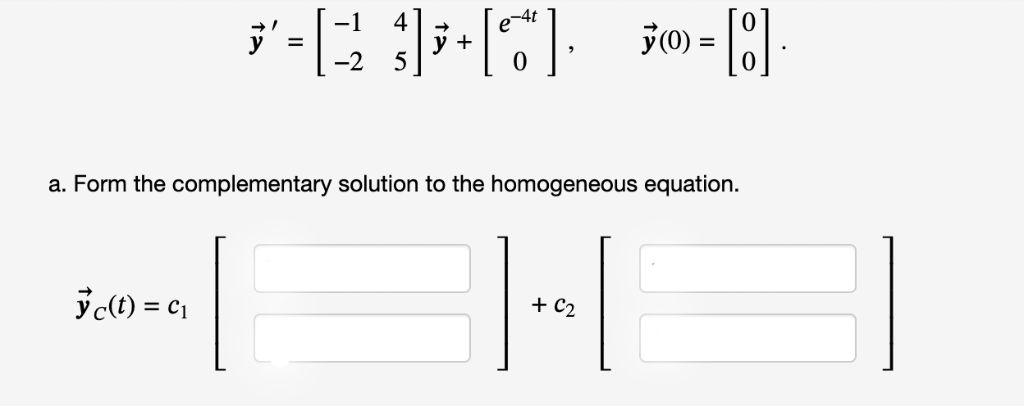 =) -1 4]5 eH -> 0
= + . 0) = .
7-5 sl] sell]
a. Form the complementary solution to the homogeneous equation.
-
Ye) =c¢ | | +0 | |
This is AI generated Response.
Asked by: Pagal
Created at: 2025-07-28 05:09:17
Asked by: Pagal
Created at: 2025-07-28 05:09:17
Final Answer:
Rendered
Raw Text
Did you like this answer?
Let's solve the given system step-by-step:
Given system:
\[
\vec{y}' =
\begin{bmatrix}
-1 & 4 \\
-2 & 5
\end{bmatrix}
\vec{y}
\]
We're asked for the **complementary solution** (homogeneous part):
---
### **Step 1: Find the eigenvalues of the matrix**
Matrix \( A = \begin{bmatrix} -1 & 4 \\ -2 & 5 \end{bmatrix} \)
The characteristic equation is:
\[
\det(A - \lambda I) = 0
\]
\[
\begin{vmatrix}
-1 - \lambda & 4 \\
-2 & 5 - \lambda
\end{vmatrix} = 0
\]
\[
(-1 - \lambda)(5 - \lambda) - (4)(-2) = 0
\]
\[
(-1 - \lambda)(5 - \lambda) + 8 = 0
\]
\[
( -1 \cdot 5 -1 \cdot (-\lambda) - \lambda \cdot 5 + \lambda^2 ) + 8 = 0
\]
\[
(-5 + \lambda -5\lambda + \lambda^2) + 8 = 0
\]
\[
\lambda^2 - 4\lambda + 3 = 0
\]
Solving the quadratic equation:
\[
(\lambda - 3)(\lambda - 1) = 0
\]
So, **eigenvalues** are: \(\lambda_1 = 3, \lambda_2 = 1\)
**Explanation:**
The eigenvalues represent the exponential rates in the solution to the homogeneous system.
---
### **Step 2: Find the eigenvectors for each eigenvalue**
#### For \(\lambda_1 = 3\):
Substitute \(\lambda = 3\) into \(A - \lambda I\):
\[
A - 3I = \begin{bmatrix} -1-3 & 4 \\ -2 & 5-3 \end{bmatrix} = \begin{bmatrix} -4 & 4 \\ -2 & 2 \end{bmatrix}
\]
Set up the equation for the eigenvector \(\begin{bmatrix} x_1 \\ x_2 \end{bmatrix}\):
\[
\begin{bmatrix} -4 & 4 \\ -2 & 2 \end{bmatrix} \begin{bmatrix} x_1 \\ x_2 \end{bmatrix} = 0
\]
This gives: \(-4x_1 + 4x_2 = 0\)
So, \(x_2 = x_1\)
So, the eigenvector is: \(\begin{bmatrix} 1 \\ 1 \end{bmatrix}\)
#### For \(\lambda_2 = 1\):
Substitute \(\lambda = 1\) into \(A - \lambda I\):
\[
A - 1I = \begin{bmatrix} -1-1 & 4 \\ -2 & 5-1 \end{bmatrix} = \begin{bmatrix} -2 & 4 \\ -2 & 4 \end{bmatrix}
\]
Set up the equation:
\[
-2x_1 + 4x_2 = 0 \implies x_2 = \frac{1}{2}x_1
\]
So, the eigenvector is: \(\begin{bmatrix} 1 \\ 0.5 \end{bmatrix}\)
**Explanation:**
The eigenvectors give the directions of the solution components for each exponential.
---
### **Final Answer:**
The complementary solution is:
\[
\vec{y}_c(t) = c_1 \begin{bmatrix} 1 \\ 1 \end{bmatrix} e^{3t} + c_2 \begin{bmatrix} 1 \\ 0.5 \end{bmatrix} e^{t}
\]
So, fill the boxes as follows:
\[
\vec{y}_c(t) = c_1 \begin{bmatrix} 1 \\ 1 \end{bmatrix} e^{3t} + c_2 \begin{bmatrix} 1 \\ 0.5 \end{bmatrix} e^{t}
\]
Question:
Give me correct solution
This is AI generated Response.
Asked by: Pagal
Created at: 2025-07-28 05:11:09
Asked by: Pagal
Created at: 2025-07-28 05:11:09
Final Answer:
Rendered
Raw Text
Did you like this answer?
Let's solve the problem step-by-step:
---
**Step 1: Find the eigenvalues of the matrix**
Given matrix:
\[
A = \begin{bmatrix} -1 & 4 \\ -2 & 5 \end{bmatrix}
\]
Characteristic equation:
\[
\det(A - \lambda I) = 0
\]
\[
\begin{vmatrix} -1 - \lambda & 4 \\ -2 & 5 - \lambda \end{vmatrix} = 0
\]
Calculating the determinant:
\[
(-1 - \lambda)(5 - \lambda) - (4)(-2) = 0
\]
\[
(-1 - \lambda)(5 - \lambda) + 8 = 0
\]
Expanding:
\[
(-1)(5) + (-1)(-\lambda) + (-\lambda)(5) + \lambda^2 + 8 = 0
\]
\[
-5 + \lambda - 5\lambda + \lambda^2 + 8 = 0
\]
\[
\lambda^2 - 4\lambda + 3 = 0
\]
Solving the quadratic:
\[
\lambda^2 - 4\lambda + 3 = 0
\]
\[
(\lambda - 3)(\lambda - 1) = 0
\]
**Eigenvalues:**
\[
\boxed{\lambda_1 = 3,\quad \lambda_2 = 1}
\]
---
**Step 2: Find the eigenvectors corresponding to each eigenvalue**
**For \(\lambda_1 = 3\):**
Compute \(A - 3I\):
\[
A - 3I = \begin{bmatrix} -1-3 & 4 \\ -2 & 5-3 \end{bmatrix} = \begin{bmatrix} -4 & 4 \\ -2 & 2 \end{bmatrix}
\]
Set up \(\left(A - 3I\right)\mathbf{v} = 0\):
From the first row:
\[
-4x + 4y = 0 \implies y = x
\]
Choose \(x=1\), then \(y=1\). Eigenvector:
\[
\boxed{\mathbf{v}_1 = \begin{bmatrix} 1 \\ 1 \end{bmatrix}}
\]
**For \(\lambda_2 = 1\):**
Compute \(A - I\):
\[
A - I = \begin{bmatrix} -1-1 & 4 \\ -2 & 5-1 \end{bmatrix} = \begin{bmatrix} -2 & 4 \\ -2 & 4 \end{bmatrix}
\]
Set up:
\[
-2x + 4y = 0 \implies y = \frac{1}{2} x
\]
Choose \(x=1\), then \(y=0.5\). Eigenvector:
\[
\boxed{\mathbf{v}_2 = \begin{bmatrix} 1 \\ 0.5 \end{bmatrix}}
\]
---
### **Final answer:**
The **complementary solution** (general solution to the homogeneous system) is:
\[
\boxed{
\vec{y}_c(t) = c_1 \begin{bmatrix} 1 \\ 1 \end{bmatrix} e^{3t} + c_2 \begin{bmatrix} 1 \\ 0.5 \end{bmatrix} e^{t}
}
\]
This represents the general solution to the homogeneous differential system.
📢 Instructions:
- Ask anything relatd to above question only.
- For new Question goto :