give answer in 2 step with explanation at the end of each step and final answer at the end:(1 point)
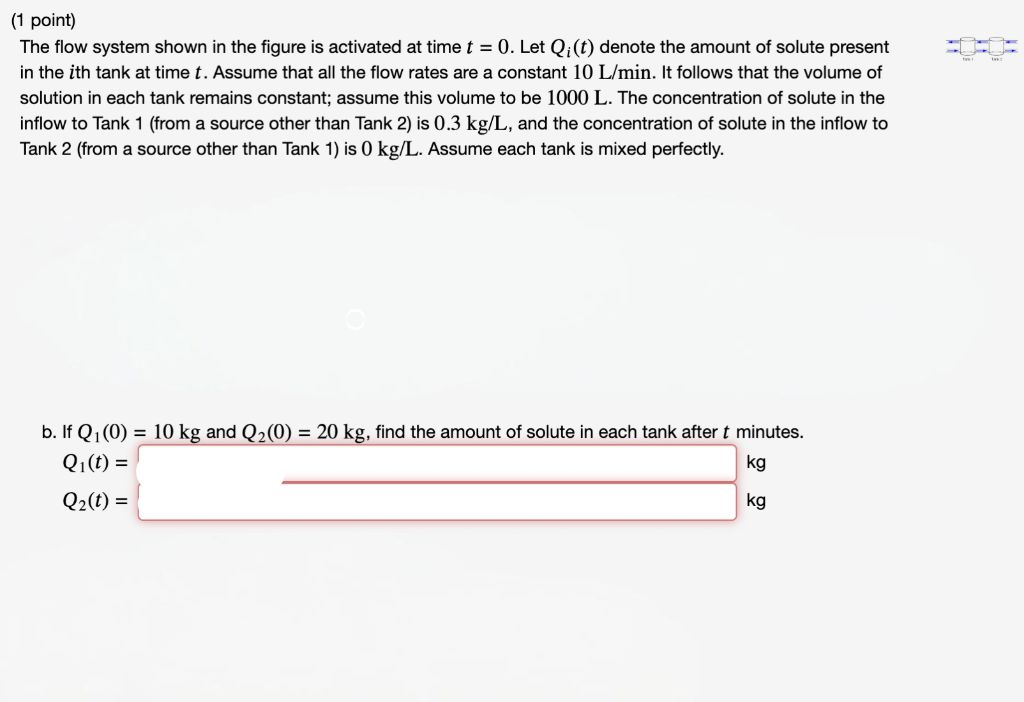
The flow system shown in the figure is activated at time ¢ = 0. Let Q;(t) denote the amount of solute present eo if on J
in the ith tank at time ¢. Assume that all the flow rates are a constant 10 L/min. It follows that the volume of
solution in each tank remains constant; assume this volume to be 1000 L. The concentration of solute in the
inflow to Tank 1 (from a source other than Tank 2) is 0.3 kg/L, and the concentration of solute in the inflow to
Tank 2 (from a source other than Tank 1) is 0 kg/L. Assume each tank is mixed perfectly.
b. If Q1(0) = 10 kg and Q,(0) = 20 kg, find the amount of solute in each tank after ¢ minutes.
(
QM =" kg
Qn =| | kg
Question:
give answer in 2 step with explanation at the end of each step and final answer at the end:(1 point)
The flow system shown in the figure is activated at time ¢ = 0. Let Q;(t) denote the amount of solute present eo if on J
in the ith tank at time ¢. Assume that all the flow rates are a constant 10 L/min. It follows that the volume of
solution in each tank remains constant; assume this volume to be 1000 L. The concentration of solute in the
inflow to Tank 1 (from a source other than Tank 2) is 0.3 kg/L, and the concentration of solute in the inflow to
Tank 2 (from a source other than Tank 1) is 0 kg/L. Assume each tank is mixed perfectly.
b. If Q1(0) = 10 kg and Q,(0) = 20 kg, find the amount of solute in each tank after ¢ minutes.
(
QM =" kg
Qn =| | kg
This is AI generated Response.
Asked by: Pagal
Created at: 2025-07-27 10:18:57
Final Answer:
RenderedRaw Text
Did you like this answer?
Let's solve the problem step by step.
### **Step 1: Set up the system of differential equations**
Let \( Q_1(t) \) and \( Q_2(t) \) be the amount of solute in tanks 1 and 2 at time \( t \).
- **Tank 1:**
- Inflow: \( 10 \) L/min × \( 0.3 \) kg/L = \( 3 \) kg/min (from outside)
- Outflow to Tank 2: \( 10 \) L/min, concentration in Tank 1 = \( Q_1/1000 \) kg/L
- Outflow rate of solute: \( 10 \times Q_1/1000 = Q_1/100 \) kg/min
So,
\[
\frac{dQ_1}{dt} = 3 - \frac{Q_1}{100}
\]
- **Tank 2:**
- Inflow from Tank 1: \( 10 \) L/min, concentration = \( Q_1/1000 \) kg/L ⇒ \( 10 \times Q_1/1000 = Q_1/100 \) kg/min
- Inflow from outside: 0 kg/min (since concentration is 0)
- Outflow: \( 10 \) L/min, concentration in Tank 2 = \( Q_2/1000 \) kg/L ⇒ \( 10 \times Q_2/1000 = Q_2/100 \) kg/min
So,
\[
\frac{dQ_2}{dt} = \frac{Q_1}{100} - \frac{Q_2}{100}
\]
**Explanation for Step 1:**
We set up the system of differential equations based on the inflow and outflow rates and solute concentrations in each tank.
---
### **Step 2: Solve the system with initial conditions \( Q_1(0) = 10 \), \( Q_2(0) = 20 \)**
#### **Solve for \( Q_1(t) \):**
\[
\frac{dQ_1}{dt} + \frac{1}{100}Q_1 = 3
\]
This is a first-order linear ODE. The integrating factor is \( e^{t/100} \):
\[
e^{t/100} \frac{dQ_1}{dt} + \frac{1}{100} e^{t/100} Q_1 = 3e^{t/100}
\]
\[
\frac{d}{dt}\left( e^{t/100} Q_1 \right) = 3e^{t/100}
\]
Integrate both sides:
\[
e^{t/100} Q_1 = 300 e^{t/100} + C
\]
\[
Q_1(t) = 300 + C e^{-t/100}
\]
Initial condition \( Q_1(0) = 10 \):
\[
10 = 300 + C \implies C = -290
\]
\[
Q_1(t) = 300 - 290 e^{-t/100}
\]
**Explanation for Step 2a:**
We solved the first ODE for \( Q_1(t) \) using integrating factors and initial conditions.
---
#### **Solve for \( Q_2(t) \):**
\[
\frac{dQ_2}{dt} + \frac{1}{100}Q_2 = \frac{Q_1}{100}
\]
This is a first-order linear ODE with a nonhomogeneous term. Substitute \( Q_1(t) \):
\[
\frac{dQ_2}{dt} + \frac{1}{100}Q_2 = \frac{1}{100} (300 - 290 e^{-t/100})
\]
\[
\frac{dQ_2}{dt} + \frac{1}{100}Q_2 = 3 - 2.9 e^{-t/100}
\]
Integrating factor: \( e^{t/100} \)
\[
e^{t/100} \frac{dQ_2}{dt} + \frac{1}{100} e^{t/100} Q_2 = 3e^{t/100} - 2.9 e^{t/100} e^{-t/100}
\]
\[
\frac{d}{dt}(e^{t/100} Q_2) = 3e^{t/100} - 2.9
\]
Now integrate both sides:
\[
e^{t/100} Q_2 = 300 e^{t/100} - 2.9 t + C
\]
\[
Q_2(t) = 300 - 2.9 t e^{-t/100} + C e^{-t/100}
\]
But integrating \( -2.9 \), you get \( -2.9 t \), so:
\[
Q_2(t) = 300 - 2.9 t + C e^{-t/100}
\]
Use initial condition \( Q_2(0) = 20 \):
\[
20 = 300 - 0 + C \implies C = -280
\]
Therefore,
\[
Q_2(t) = 300 - 2.9 t - 280 e^{-t/100}
\]
**Explanation for Step 2b:**
We solved the second ODE for \( Q_2(t) \), substituted \( Q_1(t) \), used integrating factor, and applied the initial condition.
---
### **Final Answers:**
\[
\boxed{
Q_1(t) = 300 - 290 e^{-t/100} \text{ kg}
}
\]
\[
\boxed{
Q_2(t) = 300 - 2.9 t - 280 e^{-t/100} \text{ kg}
}
\]
VIPSolutions focuses on clear, step‑by‑step explanations so you can learn quickly. Whether you need an AI‑generated walkthrough or a short hint to get unstuck, each solution is organized for fast reading and easy review later.
Search similar questions, compare approaches, and bookmark the best answers for revision. Our goal is simple: quick, reliable study help that feels natural—not noisy.
 VIPSolutions
 (1 point)
The flow system shown in the figure is activated at time ¢ = 0. Let Q;(t) denote the amount of solute present eo if on J
in the ith tank at time ¢. Assume that all the flow rates are a constant 10 L/min. It follows that the volume of
solution in each tank remains constant; assume this volume to be 1000 L. The concentration of solute in the
inflow to Tank 1 (from a source other than Tank 2) is 0.3 kg/L, and the concentration of solute in the inflow to
Tank 2 (from a source other than Tank 1) is 0 kg/L. Assume each tank is mixed perfectly.
b. If Q1(0) = 10 kg and Q,(0) = 20 kg, find the amount of solute in each tank after ¢ minutes.
(
QM =" kg
Qn =| | kg