 VIPSolutions
give answer in 2 step with explanation at the end of each step and final answer at the end: Required information Consider the following problem. Maximize Z = - 5 x _ ( 1 ) + 5 x _ ( 2 ) + 1 3 x _ ( 3 ) , subject to - x _ ( 1 ) + x _ ( 2 ) + 3 x _ ( 3 ) < = 2 0 1 2 x _ ( 1 ) + 4 x _ ( 2 ) + 1 0 x _ ( 3 ) < = 9 0 and x _ ( j ) > = 0 ( j = 1 , 2 , 3 ) . If we let x _ ( 4 ) and x _ ( 5 ) be the slack variables for the respective constraints, the simplex method yields the following final set of equations: ( 0 ) Z , + 2 x _ ( 3 ) + 5 x _ ( 4 ) = 1 0 0 ( 1 ) - x _ ( 1 ) + x _ ( 2 ) + 3 x _ ( 3 ) + x _ ( 4 ) = 2 0 ( 2 ) 1 6 x _ ( 1 ) - 2 x _ ( 3 ) - 4 x _ ( 4 ) + x _ ( 5 ) = 1 0 . Now you are to conduct sensitivity analysis by independently investigating the following change in the original model. For the following change, use the sensitivity analysis procedure to revise this set of equations ( in tableau form ) and convert it to proper form from Gaussian elimination for identifying and evaluating the current basic solution. Then test this solution for feasibility and for optimality. ( Do not reoptimize. ) Change the coefficient of x _ ( 3 ) in the objective function to c _ ( 3 ) = 7 .' Required information Consider the following problem. Maximize Z=-5x + 5x3 + 13x3, subject to —x1+ xp +3x3 £20 12x + 4x + 10x3 £90 and X20 (j=1,2,3). If we let x4 and xg be the slack variables for the respective constraints, the simplex method yields the following final set of equations: © z + 2x3 + 5x4 = 100 () =x + x2 +3x3 + x4 =20 (2) 16x —2x3 — dxg+ x5=10. Now you are to conduct sensitivity analysis by independently investigating the following change in the original model. For the following change, use the sensitivity analysis procedure to revise this set of equations (in tableau form) and convert it to proper form from Gaussian elimination for identifying and evaluating the current basic solution. Then test this solution for feasibility and for optimality. (Do not reoptimize.) Change the coefficient of a3 In the objective function to ¢; =7. Bas z Coefiicients of Right var side I I I I i = I hd 1 [mT [oA [13 [1 [02] [zs 2]ofw[of[ 2-41 [iw]
Question:
give answer in 2 step with explanation at the end of each step and final answer at the end:
Required information Consider the following problem. Maximize Z
=
-
5
x
_
(
1
)
+
5
x
_
(
2
)
+
1
3
x
_
(
3
)
,
subject to
-
x
_
(
1
)
+
x
_
(
2
)
+
3
x
_
(
3
)
<
=
2
0
1
2
x
_
(
1
)
+
4
x
_
(
2
)
+
1
0
x
_
(
3
)
<
=
9
0
and x
_
(
j
)
>
=
0
(
j
=
1
,
2
,
3
)
.
If we let x
_
(
4
)
and x
_
(
5
)
be the slack variables for the respective constraints, the simplex method yields the following final set of equations:
(
0
)
Z
,
+
2
x
_
(
3
)
+
5
x
_
(
4
)
=
1
0
0
(
1
)
-
x
_
(
1
)
+
x
_
(
2
)
+
3
x
_
(
3
)
+
x
_
(
4
)
=
2
0
(
2
)
1
6
x
_
(
1
)
-
2
x
_
(
3
)
-
4
x
_
(
4
)
+
x
_
(
5
)
=
1
0
.
Now you are to conduct sensitivity analysis by independently investigating the following change in the original model. For the following change, use the sensitivity analysis procedure to revise this set of equations
(
in tableau form
)
and convert it to proper form from Gaussian elimination for identifying and evaluating the current basic solution. Then test this solution for feasibility and for optimality.
(
Do not reoptimize.
)
Change the coefficient of x
_
(
3
)
in the objective function to c
_
(
3
)
=
7
.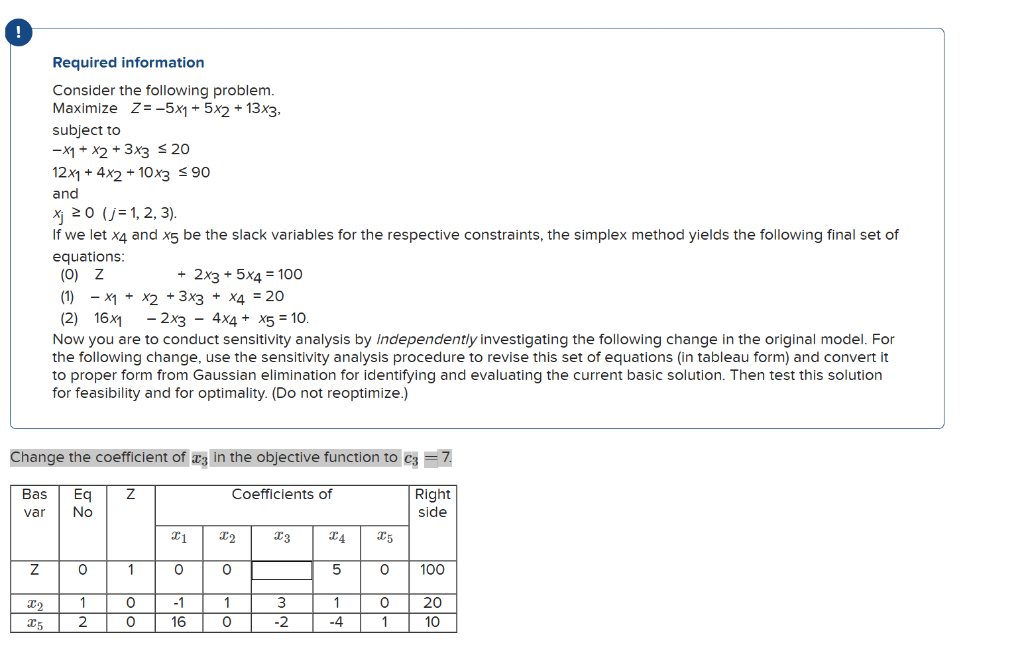 '
Required information
Consider the following problem.
Maximize Z=-5x + 5x3 + 13x3,
subject to
—x1+ xp +3x3 £20
12x + 4x + 10x3 £90
and
X20 (j=1,2,3).
If we let x4 and xg be the slack variables for the respective constraints, the simplex method yields the following final set of
equations:
© z + 2x3 + 5x4 = 100
() =x + x2 +3x3 + x4 =20
(2) 16x —2x3 — dxg+ x5=10.
Now you are to conduct sensitivity analysis by independently investigating the following change in the original model. For
the following change, use the sensitivity analysis procedure to revise this set of equations (in tableau form) and convert it
to proper form from Gaussian elimination for identifying and evaluating the current basic solution. Then test this solution
for feasibility and for optimality. (Do not reoptimize.)
Change the coefficient of a3 In the objective function to ¢; =7.
Bas z Coefiicients of Right
var side
I I I I i = I hd
1
[mT [oA [13 [1 [02]
[zs 2]ofw[of[ 2-41 [iw]
Asked by: Pagal
Created at: 2025-07-26 10:02:45
Final Answer:
📢 Instructions:
- Ask anything relatd to above question only.
- For new Question goto :