 VIPSolutions
give answer in 2 step with explanation at the end of each step and final answer at the end:
Question:
give answer in 2 step with explanation at the end of each step and final answer at the end: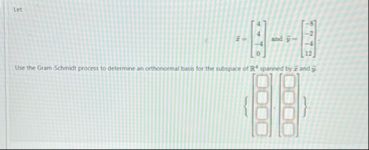
This is AI generated Response.
Asked by: Pagal
Created at: 2025-07-24 09:51:56
Asked by: Pagal
Created at: 2025-07-24 09:51:56
Final Answer:
Rendered
Raw Text
Did you like this answer?
Let's solve the problem step by step using the **Gram-Schmidt process** for the vectors:
\[
\vec{v}_1 = \begin{bmatrix} 4 \\ 1 \\ -2 \end{bmatrix}, \quad \vec{v}_2 = \begin{bmatrix} 3 \\ 7 \\ 12 \end{bmatrix}
\]
### **Step 1: Set the first orthogonal vector**
Let \( \vec{u}_1 = \vec{v}_1 \).
\[
\vec{u}_1 = \begin{bmatrix} 4 \\ 1 \\ -2 \end{bmatrix}
\]
**Explanation:**
The first orthogonal vector in Gram-Schmidt is just the first vector.
---
### **Step 2: Compute the second orthogonal vector**
\[
\vec{u}_2 = \vec{v}_2 - \operatorname{proj}_{\vec{u}_1} \vec{v}_2
\]
where
\[
\operatorname{proj}_{\vec{u}_1} \vec{v}_2 = \frac{\vec{v}_2 \cdot \vec{u}_1}{\vec{u}_1 \cdot \vec{u}_1} \vec{u}_1
\]
First, calculate dot products:
- \( \vec{v}_2 \cdot \vec{u}_1 = 3 \cdot 4 + 7 \cdot 1 + 12 \cdot (-2) = 12 + 7 - 24 = -5 \)
- \( \vec{u}_1 \cdot \vec{u}_1 = 4^2 + 1^2 + (-2)^2 = 16 + 1 + 4 = 21 \)
So,
\[
\operatorname{proj}_{\vec{u}_1} \vec{v}_2 = \frac{-5}{21} \begin{bmatrix} 4 \\ 1 \\ -2 \end{bmatrix} = \begin{bmatrix} -20/21 \\ -5/21 \\ 10/21 \end{bmatrix}
\]
Now subtract this from \(\vec{v}_2\):
\[
\vec{u}_2 = \begin{bmatrix} 3 \\ 7 \\ 12 \end{bmatrix} - \begin{bmatrix} -20/21 \\ -5/21 \\ 10/21 \end{bmatrix} = \begin{bmatrix} 3 + 20/21 \\ 7 + 5/21 \\ 12 - 10/21 \end{bmatrix}
\]
\[
= \begin{bmatrix} (63+20)/21 \\ (147+5)/21 \\ (252-10)/21 \end{bmatrix}
= \begin{bmatrix} 83/21 \\ 152/21 \\ 242/21 \end{bmatrix}
\]
**Explanation:**
We subtract the projection of \( \vec{v}_2 \) onto \( \vec{u}_1 \) from \( \vec{v}_2 \) to get the orthogonal component.
---
## **Final Answer:**
An **orthogonal basis** for the subspace of \( \mathbb{R}^3 \) spanned by \( \vec{v}_1 \) and \( \vec{v}_2 \) is:
\[
\boxed{
\left\{
\begin{bmatrix} 4 \\ 1 \\ -2 \end{bmatrix},
\begin{bmatrix} \frac{83}{21} \\ \frac{152}{21} \\ \frac{242}{21} \end{bmatrix}
\right\}
}
\]
If you need these vectors normalized for an *orthonormal* basis, let me know!
📢 Instructions:
- Ask anything relatd to above question only.
- For new Question goto :