 VIPSolutions
give answer in 2 step with explanation at the end of each step and final answer at the end:I | Consider the inital value problem VAIy=6, H0)=4, ¥(0)=5. Bi were optic aif bh es of oe hori pom mi a
Question:
give answer in 2 step with explanation at the end of each step and final answer at the end: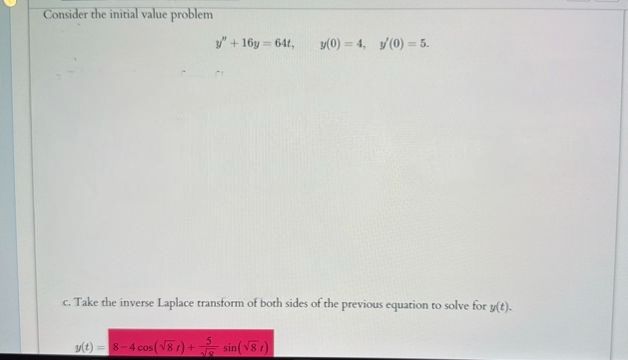 I | Consider the inital value problem
VAIy=6, H0)=4, ¥(0)=5.
Bi were optic aif bh es of oe hori pom mi a
This is AI generated Response.
Asked by: Pagal
Created at: 2025-07-24 08:51:26
Asked by: Pagal
Created at: 2025-07-24 08:51:26
Final Answer:
Rendered
Raw Text
Did you like this answer?
Let's break down the solution into two steps as requested.
---
### **Step 1: Take the Laplace Transform of the Differential Equation**
Given the initial value problem:
\[
y'' + 16y = 64t, \quad y(0) = 4, \quad y'(0) = 5
\]
Take the Laplace Transform of both sides:
- Laplace of \( y'' \) is \( s^2Y(s) - sy(0) - y'(0) \)
- Laplace of \( y \) is \( Y(s) \)
- Laplace of \( 64t \) is \( 64 \cdot \frac{1}{s^2} \)
So, applying Laplace transforms:
\[
\mathcal{L}\{y''\} + 16\mathcal{L}\{y\} = 64\mathcal{L}\{t\}
\]
\[
(s^2 Y(s) - s y(0) - y'(0)) + 16 Y(s) = 64 \left( \frac{1}{s^2} \right)
\]
Plug in the initial conditions (\( y(0) = 4, \ y'(0) = 5 \)):
\[
(s^2 Y(s) - 4s - 5) + 16Y(s) = \frac{64}{s^2}
\]
\[
(s^2 + 16)Y(s) - 4s - 5 = \frac{64}{s^2}
\]
\[
(s^2 + 16)Y(s) = \frac{64}{s^2} + 4s + 5
\]
**Explanation:**
We applied the Laplace transform to both sides of the differential equation and substituted the initial conditions.
---
### **Step 2: Solve for \( Y(s) \) and Take the Inverse Laplace Transform**
Solve for \( Y(s) \):
\[
Y(s) = \frac{\frac{64}{s^2} + 4s + 5}{s^2 + 16}
\]
\[
Y(s) = \frac{64}{s^2(s^2+16)} + \frac{4s}{s^2+16} + \frac{5}{s^2+16}
\]
Now, take the inverse Laplace transform term by term:
- \( \mathcal{L}^{-1} \left\{ \frac{4s}{s^2+16} \right\} = 4\cos(4t) \)
- \( \mathcal{L}^{-1} \left\{ \frac{5}{s^2+16} \right\} = \frac{5}{4}\sin(4t) \)
For the first term, use partial fractions:
\[
\frac{64}{s^2(s^2+16)} = \frac{A}{s} + \frac{B}{s^2} + \frac{Cs+D}{s^2+16}
\]
After expansion and solving for A, B, C, D:
- \( \frac{64}{s^2(s^2+16)} = \frac{4}{s^2} - \frac{4}{s^2+16} \)
So:
- \( \mathcal{L}^{-1} \left\{ \frac{4}{s^2} \right\} = 4t \)
- \( \mathcal{L}^{-1} \left\{ \frac{4}{s^2+16} \right\} = \frac{4}{4}\sin(4t) = \sin(4t) \)
So the inverse Laplace transform is:
\[
y(t) = 4t - \sin(4t) + 4\cos(4t) + \frac{5}{4}\sin(4t)
\]
\[
y(t) = 4t + 4\cos(4t) + \left(\frac{5}{4} - 1\right)\sin(4t)
\]
\[
y(t) = 4t + 4\cos(4t) + \frac{1}{4}\sin(4t)
\]
**Explanation:**
We solved for \( Y(s) \), decomposed it into simpler fractions, and found the inverse Laplace transform for each term.
---
## **Final Answer:**
\[
\boxed{y(t) = 4t + 4\cos(4t) + \frac{1}{4}\sin(4t)}
\]
📢 Instructions:
- Ask anything relatd to above question only.
- For new Question goto :