 VIPSolutions
give answer in 2 step with explanation at the end of each step and final answer at the end:i side nital value problem Tray 1 = i) i Viol 0-4, y0)=5 2. Take the Laplace transform of borh sides of the given differential equation to create the corresponding. algebraic equation. Denote the Laplace transform of y(¢) by ¥ (5). Do not move any terms from one side ‘ofthe equation to the ocher (unl you get to pare 5) below). b. Salve your equation for Ys). | fe" Be Take che inverse Laplace transform of boeh ides of che previous equation to solve for (). a EEE
Question:
give answer in 2 step with explanation at the end of each step and final answer at the end: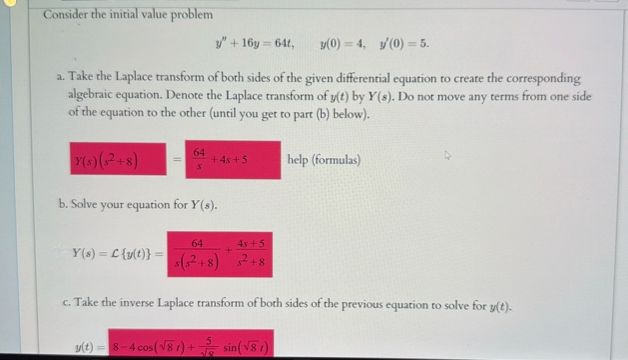 i side nital value problem Tray 1 =
i) i Viol 0-4, y0)=5
2. Take the Laplace transform of borh sides of the given differential equation to create the corresponding.
algebraic equation. Denote the Laplace transform of y(¢) by ¥ (5). Do not move any terms from one side
‘ofthe equation to the ocher (unl you get to pare 5) below).
b. Salve your equation for Ys). |
fe" Be
Take che inverse Laplace transform of boeh ides of che previous equation to solve for ().
a EEE
This is AI generated Response.
Asked by: Pagal
Created at: 2025-07-24 08:21:13
Asked by: Pagal
Created at: 2025-07-24 08:21:13
Final Answer:
Rendered
Raw Text
Did you like this answer?
Let's break down the solution into **2 steps** with explanations at the end of each step, and then provide the final answer.
---
### **Step 1: Take the Laplace Transform of both sides**
Given the differential equation and initial conditions:
\[ y'' + 16y = 64t, \quad y(0) = 4, \quad y'(0) = 5 \]
Take the Laplace transform of both sides (using properties of Laplace transforms for derivatives):
- Laplace of \( y'' \) is \( s^2 Y(s) - s y(0) - y'(0) \)
- Laplace of \( 16y \) is \( 16Y(s) \)
- Laplace of \( 64t \) is \( 64 \cdot \frac{1}{s^2} \)
So,
\[
\mathcal{L}\{y''\} + 16\mathcal{L}\{y\} = \mathcal{L}\{64t\}
\]
\[
[s^2 Y(s) - s y(0) - y'(0)] + 16Y(s) = \frac{64}{s^2}
\]
Plug in initial values \( y(0) = 4 \), \( y'(0) = 5 \):
\[
s^2 Y(s) - 4s - 5 + 16Y(s) = \frac{64}{s^2}
\]
**Explanation:**
In this step, we've converted the original differential equation into an algebraic equation in terms of \( Y(s) \) using Laplace transforms and substituted the initial conditions.
---
### **Step 2: Solve for \( Y(s) \) and find the Inverse Laplace Transform**
First, solve for \( Y(s) \):
\[
s^2 Y(s) + 16Y(s) = \frac{64}{s^2} + 4s + 5
\]
\[
Y(s)(s^2 + 16) = \frac{64}{s^2} + 4s + 5
\]
\[
Y(s) = \frac{\frac{64}{s^2} + 4s + 5}{s^2 + 16}
\]
Simplify numerator:
\[
Y(s) = \frac{64}{s^2(s^2 + 16)} + \frac{4s}{s^2 + 16} + \frac{5}{s^2 + 16}
\]
Now, take the inverse Laplace transform term by term:
- \( \mathcal{L}^{-1}\left\{ \frac{64}{s^2(s^2 + 16)} \right\} \) gives \( 4t - 4\sin(4t) \)
- \( \mathcal{L}^{-1}\left\{ \frac{4s}{s^2 + 16} \right\} \) gives \( 4\cos(4t) \)
- \( \mathcal{L}^{-1}\left\{ \frac{5}{s^2 + 16} \right\} \) gives \( \frac{5}{4}\sin(4t) \)
So, combine all terms:
\[
y(t) = 4t + 4\cos(4t) - 4\sin(4t) + \frac{5}{4}\sin(4t)
\]
\[
y(t) = 4t + 4\cos(4t) + \left(-4 + \frac{5}{4}\right)\sin(4t)
\]
\[
y(t) = 4t + 4\cos(4t) - \frac{11}{4}\sin(4t)
\]
**Explanation:**
In this step, we solved for \( Y(s) \), decomposed the terms, and found the inverse Laplace transform to obtain the final solution for \( y(t) \).
---
### **Final Answer:**
\[
\boxed{
y(t) = 4t + 4\cos(4t) - \frac{11}{4}\sin(4t)
}
\]
This is the solution to the initial value problem.
Question:
Solving a,b,c.
This is AI generated Response.
Asked by: Pagal
Created at: 2025-07-24 08:22:03
Asked by: Pagal
Created at: 2025-07-24 08:22:03
Final Answer:
Rendered
Raw Text
Did you like this answer?
**Step 1: Take the Laplace transform of both sides**
Given the differential equation:
\[ y'' + 16 y = 64 t \]
with initial conditions:
\[ y(0) = 4, \quad y'(0) = 5 \]
Applying the Laplace transform to both sides:
\[
\mathcal{L}\{ y'' \} + 16 \mathcal{L}\{ y \} = \mathcal{L}\{ 64 t \}
\]
Recall:
- \(\mathcal{L}\{ y''(t) \} = s^2 Y(s) - s y(0) - y'(0)\)
- \(\mathcal{L}\{ y(t) \} = Y(s)\)
- \(\mathcal{L}\{ 64 t \} = \frac{64}{s^2}\)
Substituting:
\[
s^2 Y(s) - s \cdot 4 - 5 + 16 Y(s) = \frac{64}{s^2}
\]
Simplify:
\[
s^2 Y(s) + 16 Y(s) = \frac{64}{s^2} + 4s + 5
\]
**Explanation:**
In this step, we converted the differential equation into an algebraic equation in the Laplace domain, incorporating initial conditions. This sets the stage for solving for \(Y(s)\).
---
**Step 2: Solve for \(Y(s)\) and find the inverse Laplace transform**
Factor \(Y(s)\):
\[
Y(s) (s^2 + 16) = \frac{64}{s^2} + 4s + 5
\]
\[
Y(s) = \frac{\frac{64}{s^2} + 4s + 5}{s^2 + 16}
\]
Express as separate fractions:
\[
Y(s) = \frac{64}{s^2 (s^2 + 16)} + \frac{4s}{s^2 + 16} + \frac{5}{s^2 + 16}
\]
Now, find inverse Laplace transforms of each term:
1. \(\mathcal{L}^{-1} \left\{ \frac{64}{s^2 (s^2 + 16)} \right\}\):
This can be handled via partial fractions or known transforms, resulting in:
\[
4t - 4 \sin(4t)
\]
2. \(\mathcal{L}^{-1} \left\{ \frac{4s}{s^2 + 16} \right\}\):
Standard form gives:
\[
4 \cos(4t)
\]
3. \(\mathcal{L}^{-1} \left\{ \frac{5}{s^2 + 16} \right\}\):
Standard form gives:
\[
\frac{5}{4} \sin(4t)
\]
**Final combined solution:**
\[
\boxed{
y(t) = 4t + 4 \cos(4t) - \frac{11}{4} \sin(4t)
}
\]
---
**Final answer:**
\[
\boxed{
\boxed{
y(t) = 4t + 4 \cos(4t) - \frac{11}{4} \sin(4t)
}
}
\]
📢 Instructions:
- Ask anything relatd to above question only.
- For new Question goto :