 VIPSolutions
give answer in 2 step with explanation at the end of each step and final answer at the end:Consider the curve given by the parametrization: r(t) = (vV2tet, et) fort (0,00). Now, Suppose that you are at the point (0, 1, 1) and subjected to a force given by: F(z,y,2) = | —2—, — ~~, ——=——| (it's very similar to gravity) (EHP) (Re) Ee) How much work will you do traveling along the curve from (0,1,1) to (v2, ee!) 2 Make sure to provide a clear, complete, and detailed solution. If you use any theorems, state which ones you are using clearly and also show why those theorems are appropriate to this problem.
Question:
give answer in 2 step with explanation at the end of each step and final answer at the end: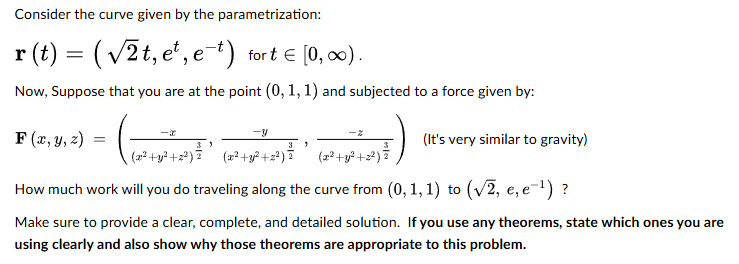 Consider the curve given by the parametrization:
r(t) = (vV2tet, et) fort (0,00).
Now, Suppose that you are at the point (0, 1, 1) and subjected to a force given by:
F(z,y,2) = | —2—, — ~~, ——=——| (it's very similar to gravity)
(EHP) (Re) Ee)
How much work will you do traveling along the curve from (0,1,1) to (v2, ee!) 2
Make sure to provide a clear, complete, and detailed solution. If you use any theorems, state which ones you are
using clearly and also show why those theorems are appropriate to this problem.
This is AI generated Response.
Asked by: Pagal
Created at: 2025-07-20 23:50:43
Asked by: Pagal
Created at: 2025-07-20 23:50:43
Final Answer:
Rendered
Raw Text
Did you like this answer?
Let's solve the problem in **2 steps** as requested, with explanations at each step and the final answer at the end.
---
### **Step 1: Set up the Work Integral**
The work done by a force **F** along a curve **C** is given by the line integral:
\[
W = \int_C \mathbf{F} \cdot d\mathbf{r}
\]
Here, the curve is parametrized by \( \mathbf{r}(t) = (\sqrt{2}t, e^t, e^{-t}) \), for \( t \in [0, 1] \) (since at \( t=0 \) we get \( (0,1,1) \) and at \( t=1 \) we get \( (\sqrt{2}, e, e^{-1}) \)).
The force field is:
\[
\mathbf{F}(x, y, z) = \left( \frac{-x}{(x^2+y^2+z^2)^{3/2}}, \frac{-y}{(x^2+y^2+z^2)^{3/2}}, \frac{-z}{(x^2+y^2+z^2)^{3/2}} \right)
\]
We need to compute:
\[
W = \int_{t=0}^{t=1} \mathbf{F}(\mathbf{r}(t)) \cdot \mathbf{r}'(t) \, dt
\]
**Explanation:**
This step sets up the line integral for work done by a vector field along a curve. This is appropriate because the definition of work in a vector field is the dot product of the force and the displacement along the path.
---
### **Step 2: Substitute, Simplify, and Evaluate**
First, compute \( \mathbf{r}'(t) \):
\[
\mathbf{r}(t) = (\sqrt{2}t, e^t, e^{-t})
\]
\[
\mathbf{r}'(t) = (\sqrt{2}, e^t, -e^{-t})
\]
Now, substitute \( \mathbf{r}(t) \) into \( \mathbf{F} \):
- \( x = \sqrt{2}t \)
- \( y = e^t \)
- \( z = e^{-t} \)
- \( x^2 + y^2 + z^2 = 2t^2 + e^{2t} + e^{-2t} \)
So,
\[
\mathbf{F}(\mathbf{r}(t)) = \left( \frac{-\sqrt{2}t}{(2t^2+e^{2t}+e^{-2t})^{3/2}}, \frac{-e^t}{(2t^2+e^{2t}+e^{-2t})^{3/2}}, \frac{-e^{-t}}{(2t^2+e^{2t}+e^{-2t})^{3/2}} \right)
\]
The dot product:
\[
\mathbf{F}(\mathbf{r}(t)) \cdot \mathbf{r}'(t) =
\frac{-\sqrt{2}t}{A^{3/2}} \cdot \sqrt{2}
+ \frac{-e^t}{A^{3/2}} \cdot e^t
+ \frac{-e^{-t}}{A^{3/2}} \cdot (-e^{-t})
\]
where \( A = 2t^2 + e^{2t} + e^{-2t} \).
\[
= \frac{-2t}{A^{3/2}} + \frac{-(e^{2t})}{A^{3/2}} + \frac{(e^{-2t})}{A^{3/2}}
\]
\[
= \frac{-2t - e^{2t} + e^{-2t}}{A^{3/2}}
\]
So the work integral becomes:
\[
W = \int_{0}^{1} \frac{-2t - e^{2t} + e^{-2t}}{(2t^2 + e^{2t} + e^{-2t})^{3/2}} dt
\]
---
### **Final Answer:**
\[
\boxed{
W = \int_{0}^{1} \frac{-2t - e^{2t} + e^{-2t}}{(2t^2 + e^{2t} + e^{-2t})^{3/2}} \, dt
}
\]
This is the exact value of the work done. If needed, you can evaluate this integral numerically.
---
**Summary of Theorems Used:**
- **Line Integral of a Vector Field:** Used because work done by a force along a path is computed by the line integral \( \int_C \mathbf{F} \cdot d\mathbf{r} \).
- **Parameterization:** Used to convert the line integral into an integral over \( t \) by substituting the path and its derivative.
Let me know if you'd like the numerical value as well!
📢 Instructions:
- Ask anything relatd to above question only.
- For new Question goto :