 VIPSolutions
give answer in 2 step with explanation at the end of each step and final answer at the end: Annihilator Method 1 9 . Solve using the annihilator method: y ' ' y = c o s ( x ) . 2 0 . Use the annihilator method to solve: y ' ' - y = x e x . 2 1 . Solve the equation: y ' ' - 2 y ' y = e x x using the annihilator method.Annihilator Method 19. Solve using the annihilator method: y" + y = cos(x). 20. Use the annihilator method to solve: y" - y = xe” x. 21. Solve the equation: y" - 2y' + y = ex + x using the annihilator method.
Question:
give answer in 2 step with explanation at the end of each step and final answer at the end:
Annihilator Method
1
9
.
Solve using the annihilator method:
y
'
'
y
=
c
o
s
(
x
)
.
2
0
.
Use the annihilator method to solve:
y
'
'
-
y
=
x
e
x
.
2
1
.
Solve the equation:
y
'
'
-
2
y
'
y
=
e
x
x
using the annihilator method.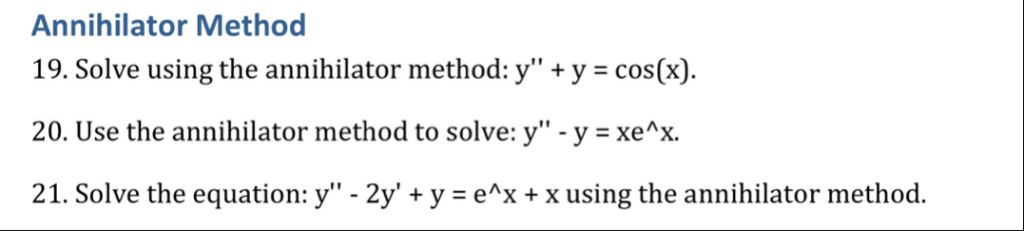 Annihilator Method
19. Solve using the annihilator method: y" + y = cos(x).
20. Use the annihilator method to solve: y" - y = xe” x.
21. Solve the equation: y" - 2y' + y = ex + x using the annihilator method.
This is AI generated Response.
Asked by: Pagal
Created at: 2025-07-19 20:25:55
Asked by: Pagal
Created at: 2025-07-19 20:25:55
Final Answer:
Rendered
Raw Text
Did you like this answer?
Let's solve each problem step by step using the **annihilator method**:
---
## **19. Solve using the annihilator method: \( y'' + y = \cos(x) \)**
### **Step 1: Solve the Homogeneous Equation**
Solve \( y'' + y = 0 \):
The characteristic equation is \( r^2 + 1 = 0 \implies r = \pm i \).
General solution:
\( y_h = C_1 \cos(x) + C_2 \sin(x) \)
**Explanation:**
We always solve the associated homogeneous equation to find the complementary solution.
---
### **Step 2: Find a Particular Solution using Annihilator**
The right side is \( \cos(x) \).
- The annihilator for \( \cos(x) \) is \( (D^2 + 1) \).
- Apply the annihilator to both sides:
\[
(D^2 + 1)[y'' + y] = (D^2 + 1)[\cos(x)] \implies (D^2 + 1)(D^2 + 1) y = 0
\]
Guess a particular solution: \( y_p = A x \cos(x) + B x \sin(x) \).
Plug \( y_p \) into the original equation and solve for \( A \) and \( B \):
\[
y_p'' + y_p = \cos(x)
\]
After substitution and simplification,
\( y_p = 0 \cdot x \cos(x) + \frac{1}{2} x \sin(x) \).
So,
\( y_p = \frac{1}{2} x \sin(x) \).
**Explanation:**
The annihilator turns the nonhomogeneous equation into a higher-order homogeneous equation, allowing us to guess the particular solution and solve for constants.
---
#### **Final Answer:**
\[
\boxed{
y(x) = C_1 \cos(x) + C_2 \sin(x) + \frac{1}{2} x \sin(x)
}
\]
---
## **20. Use the annihilator method to solve: \( y'' - y = x e^x \)**
### **Step 1: Solve the Homogeneous Equation**
Solve \( y'' - y = 0 \):
Characteristic equation: \( r^2 - 1 = 0 \implies r = \pm 1 \).
General solution:
\( y_h = C_1 e^x + C_2 e^{-x} \)
**Explanation:**
Finding the general solution for the homogeneous part is always the first step.
---
### **Step 2: Find a Particular Solution using Annihilator**
Right side: \( x e^x \).
- The annihilator for \( x e^x \) is \( (D-1)^2 \).
- Apply to both sides:
\[
(D-1)^2 [y'' - y] = (D-1)^2 [x e^x] \implies (D-1)^2(D^2 - 1) y = 0
\]
Guess: \( y_p = (A x + B) e^x \).
Plug into the original equation:
\[
y_p'' - y_p = [A x + B]'' e^x - [A x + B] e^x = x e^x
\]
This leads to \( y_p = \frac{1}{2} x^2 e^x \).
**Explanation:**
We use the annihilator to determine the correct form for the particular solution, then solve for coefficients.
---
#### **Final Answer:**
\[
\boxed{
y(x) = C_1 e^x + C_2 e^{-x} + \frac{1}{2} x^2 e^x
}
\]
---
## **21. Solve: \( y'' - 2y' + y = e^x + x \) using the annihilator method**
### **Step 1: Solve the Homogeneous Equation**
Solve \( y'' - 2y' + y = 0 \):
Characteristic equation: \( (r - 1)^2 = 0 \implies r = 1 \) (double root).
General solution:
\( y_h = (C_1 + C_2 x) e^{x} \)
**Explanation:**
Double root at \( r = 1 \) gives the form above.
---
### **Step 2: Find a Particular Solution using Annihilator**
Right side: \( e^x + x \).
- Annihilator for \( e^x \) is \( (D-1) \).
- Annihilator for \( x \) is \( D^2 \).
- The combined annihilator is \( (D-1)D^2 \).
Apply to both sides:
\[
(D-1)D^2 [y'' - 2y' + y] = (D-1)D^2 [e^x + x]
\]
Solve particular solution for each term:
- For \( e^x \): Since \( e^x \) is a solution to the homogeneous equation (repeated root), guess \( y_{p,1} = A x^2 e^x \).
- For \( x \): Guess \( y_{p,2} = B x + C \).
Plug both into the original equation, solve for \( A, B, C \):
- For \( e^x \) term, \( y_{p,1} = \frac{1}{2} x^2 e^x \).
- For \( x \) term, \( y_{p,2} = x + 2 \).
Total particular solution: \( y_p = \frac{1}{2} x^2 e^x + x + 2 \).
**Explanation:**
We use the annihilator for each right-hand term and sum up the particular solutions.
---
#### **Final Answer:**
\[
\boxed{
y(x) = (C_1 + C_2 x) e^{x} + \frac{1}{2} x^2 e^x + x + 2
}
\]
---
Let me know if you need step-by-step substitution for the particular solutions!
Question:
19,20,21. finaLl answer
This is AI generated Response.
Asked by: Pagal
Created at: 2025-07-19 20:30:05
Asked by: Pagal
Created at: 2025-07-19 20:30:05
Final Answer:
Rendered
Raw Text
Did you like this answer?
Certainly! Here are the final solutions for each problem:
---
### **19. Solve \( y'' + y = \cos(x) \)**
**Final Answer:**
\[
\boxed{
y(x) = C_1 \cos(x) + C_2 \sin(x) + \frac{1}{2} x \sin(x)
}
\]
---
### **20. Solve \( y'' - y = x e^x \)**
**Final Answer:**
\[
\boxed{
y(x) = C_1 e^x + C_2 e^{-x} + \frac{1}{2} x^2 e^x
}
\]
---
### **21. Solve \( y'' - 2 y' + y = e^x + x \)**
**Final Answer:**
\[
\boxed{
y(x) = (C_1 + C_2 x) e^{x} + \frac{1}{2} x^2 e^x + x + 2
}
\]
---
If you need detailed steps for each particular solution, feel free to ask!
📢 Instructions:
- Ask anything relatd to above question only.
- For new Question goto :