 VIPSolutions
give answer in 2 step with explanation at the end of each step and final answer at the end: Find the Laplace transform � ( � ) = � { � ( � ) } of the function � ( � ) = ( 2 - � ) ( ℎ ( � - 4 ) - ℎ ( � - 6 ) ) , for � ≠ 0 .5 Find the Laplsce tmtonn F(s) = L{/0)) of the anction 10) = (2-1) 4) Hit -6). for 140.
Question:
give answer in 2 step with explanation at the end of each step and final answer at the end:
Find the Laplace transform
�
(
�
)
=
�
{
�
(
�
)
}
of the function
�
(
�
)
=
(
2
-
�
)
(
ℎ
(
�
-
4
)
-
ℎ
(
�
-
6
)
)
,
for
�
≠
0
.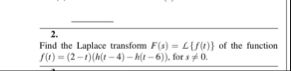 5
Find the Laplsce tmtonn F(s) = L{/0)) of the anction
10) = (2-1) 4) Hit -6). for 140.
This is AI generated Response.
Asked by: Pagal
Created at: 2025-07-18 21:17:07
Asked by: Pagal
Created at: 2025-07-18 21:17:07
Final Answer:
Rendered
Raw Text
Did you like this answer?
Let's solve the problem step by step:
---
### **Step 1: Simplify the function using Heaviside functions**
Given:
\[
f(t) = (2-t)[h(t-4) - h(t-6)]
\]
Recall:
- \( h(t-a) \) is the Heaviside (unit step) function.
- \( h(t-4) - h(t-6) \) is 1 when \( 4 \leq t < 6 \), 0 otherwise.
So, over \( 4 \leq t < 6 \):
\[
f(t) = 2-t
\]
We can write:
\[
f(t) = (2-t)[h(t-4) - h(t-6)] = (2-t)h(t-4) - (2-t)h(t-6)
\]
But we want each term as a function of \( t \) shifted by \( a \):
Let’s use the property:
\[
f(t)h(t-a) = f(t+a)h(t-a)
\]
So,
- \( (2-t)h(t-4) = (2-(t))h(t-4) = [2-(t-4+4)]h(t-4) = [2-(t-4)-4]h(t-4) \)
- Actually, the correct property is: for Laplace, \( f(t)h(t-a) \to e^{-as}\mathcal{L}\{f(t+a)\} \)
Instead, let's keep:
\[
f(t) = (2-t)h(t-4) - (2-t)h(t-6)
\]
---
**Explanation for Step 1:**
We rewrote \( f(t) \) in terms of Heaviside functions to identify the intervals for Laplace transform and set up for shifting properties.
---
### **Step 2: Apply Laplace Transform Using Shifting Property**
Recall Laplace property:
\[
\mathcal{L}\{f(t-a)h(t-a)\} = e^{-as}F(s)
\]
Let's write \( f(t) \) in shifted form:
- For \( (2-t)h(t-4) \), let \( \tau = t-4 \Rightarrow t = \tau+4 \):
\[
(2-t)h(t-4) = [2-(\tau+4)]h(\tau) = (-\tau-2)h(\tau)
\]
So, \( f_1(\tau) = -(\tau+2) \).
Now Laplace of \( f_1(\tau) \):
\[
\mathcal{L}\{-(t+2)\} = -\mathcal{L}\{t\} - 2\mathcal{L}\{1\} = -\frac{1}{s^2} - \frac{2}{s}
\]
So:
\[
\mathcal{L}\{(2-t)h(t-4)\} = e^{-4s}\left(-\frac{1}{s^2} - \frac{2}{s}\right)
\]
Similarly, for \( (2-t)h(t-6) \), shift by 6:
- Let \( \tau = t-6 \Rightarrow (2-t)h(t-6) = [2-(\tau+6)]h(\tau) = (-\tau-4)h(\tau) \)
So Laplace is:
\[
\mathcal{L}\{(2-t)h(t-6)\} = e^{-6s}\left(-\frac{1}{s^2} - \frac{4}{s}\right)
\]
**Now combine:**
\[
F(s) = \mathcal{L}\{f(t)\} = e^{-4s}\left(-\frac{1}{s^2} - \frac{2}{s}\right) - e^{-6s}\left(-\frac{1}{s^2} - \frac{4}{s}\right)
\]
---
**Explanation for Step 2:**
We used the Laplace shifting theorem to transform each term, shifted by 4 and 6, and subtracted to get the final Laplace transform.
---
## **Final Answer:**
\[
\boxed{
F(s) = -\left(\frac{1}{s^2} + \frac{2}{s}\right)e^{-4s} + \left(\frac{1}{s^2} + \frac{4}{s}\right)e^{-6s}
}
\]
Or, equivalently:
\[
\boxed{
F(s) = \left[-\frac{1}{s^2}-\frac{2}{s}\right]e^{-4s} + \left[\frac{1}{s^2}+\frac{4}{s}\right]e^{-6s}
}
\]
📢 Instructions:
- Ask anything relatd to above question only.
- For new Question goto :