give answer in 2 step with explanation at the end of each step and final answer at the end:This problem deals with the effect of a sequence of impulses on an
\ undamped oscillator. Suppose that j we
Lg LL yre= 10, v0) =0, ¥O)=0 4
ARAN br 5
Ah i [i
{| where ft) =4> 46 (v i =) E
Rae: R= 4 5
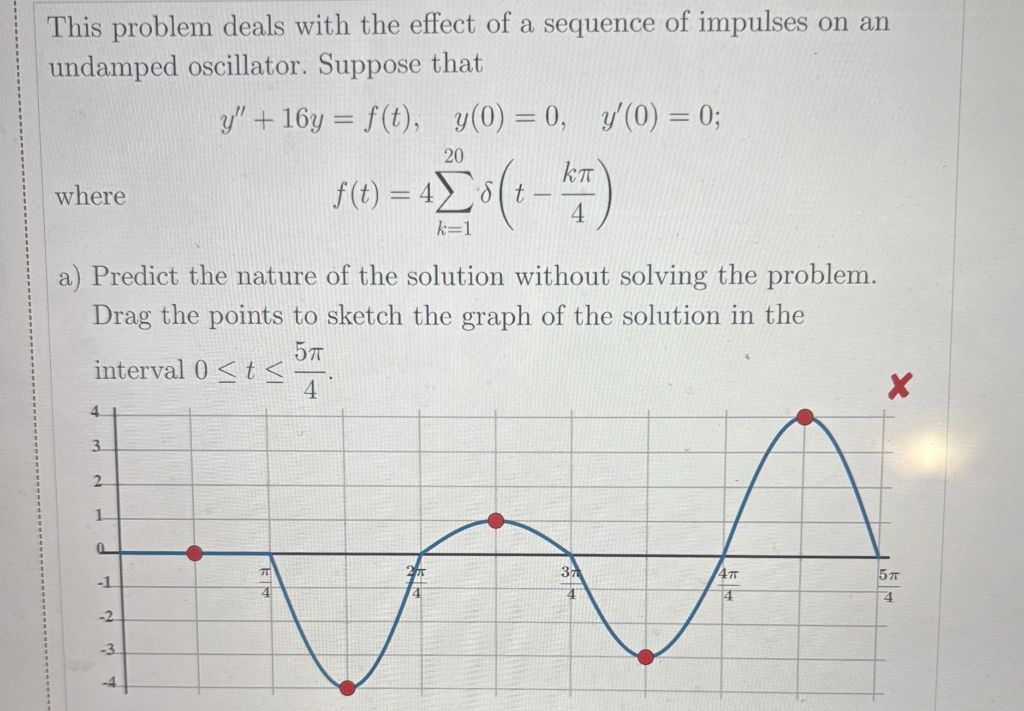
i a) Predict the nature of the solution without solving the problem. a
i Drag the points to sketch the graph of the solution in the = —
E =
eo x |
EEE Loo LE Nad
or = WE HS hie
CEE raeNEEEEE Es |
TT EN 7? WR
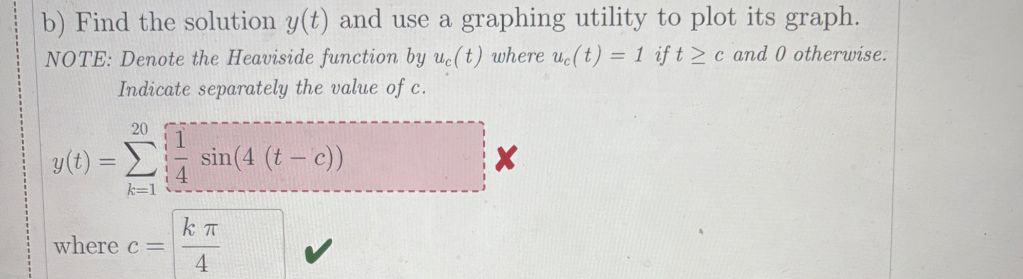
i - Find the solution y(t) and use a graphing utility to plot its graph. |
i NOTE: Denote the Heaviside function by u.(t) where u(t) = 1 if t > c¢ and 0 otherwise: |
3 Indicate separately the value of c. | :
| 20 SRE
Hu=21 sin(4 (t —¢)) i X
H LE BE ee EE
i [km | ; [
lpdccc= rv |
H 1% Determine what happens alter the sequence ol 1mpuises ends.
H After the sequence of impulses ends, the oscillator i
E =a |
Ei returns to equilibr ium w Vv
i |
Question:
give answer in 2 step with explanation at the end of each step and final answer at the end:This problem deals with the effect of a sequence of impulses on an
\ undamped oscillator. Suppose that j we
Lg LL yre= 10, v0) =0, ¥O)=0 4
ARAN br 5
Ah i [i
{| where ft) =4> 46 (v i =) E
Rae: R= 4 5
i a) Predict the nature of the solution without solving the problem. a
i Drag the points to sketch the graph of the solution in the = —
E =
eo x |
EEE Loo LE Nad
or = WE HS hie
CEE raeNEEEEE Es |
TT EN 7? WR
i - Find the solution y(t) and use a graphing utility to plot its graph. |
i NOTE: Denote the Heaviside function by u.(t) where u(t) = 1 if t > c¢ and 0 otherwise: |
3 Indicate separately the value of c. | :
| 20 SRE
Hu=21 sin(4 (t —¢)) i X
H LE BE ee EE
i [km | ; [
lpdccc= rv |
H 1% Determine what happens alter the sequence ol 1mpuises ends.
H After the sequence of impulses ends, the oscillator i
E =a |
Ei returns to equilibr ium w Vv
i |
This is AI generated Response.
Asked by: Pagal
Created at: 2025-07-16 09:28:20
Final Answer:
RenderedRaw Text
Did you like this answer?
Let's answer the questions step by step with explanations:
---
### **Step 1: Predict the Nature of the Solution (Part a)**
**Explanation:**
The differential equation given is:
\[ y'' + 16y = f(t), \quad y(0) = 0, \quad y'(0) = 0 \]
where
\[ f(t) = 4 \sum_{k=1}^{20} \delta \left( t - \frac{k\pi}{4} \right) \]
- This is an undamped oscillator (\(y'' + 16y\)), which normally produces simple harmonic motion with angular frequency \(4\), i.e., \(y(t) = A \sin(4t) + B \cos(4t)\).
- The **forcing function** \(f(t)\) is a **sequence of impulses** (Dirac delta functions) at regular intervals, spaced by \(\frac{\pi}{4}\), each impulse causing a sudden "kick" to the system.
**Prediction:**
- Each impulse will instantaneously change the velocity (\(y'\)) of the oscillator, causing a series of upward jumps in the motion.
- Between impulses, the oscillator behaves like a free undamped oscillator.
- The overall solution will look like a sum of sine functions, each starting at the impulse times.
---
### **Step 2: Find the Solution and Explain (Part b)**
**Explanation:**
The solution for an undamped oscillator with impulse at time \(c\) is:
If \(y'' + 16y = 4\delta(t-c)\), the response (using Laplace transforms or by the impulse response) is:
\[
y_c(t) =
\begin{cases}
0 & t < c \\
\sin(4(t-c)) & t \geq c
\end{cases}
\]
But our actual impulse is scaled by 4 and occurs at \(c = \frac{k\pi}{4}\), so summing over all impulses up to \(k=20\):
\[
y(t) = \sum_{k=1}^{20} \frac{1}{4} \sin(4(t-c))
\]
where \(c = \frac{k\pi}{4}\).
So, the answer is:
\[
\boxed{
y(t) = \sum_{k=1}^{20} \frac{1}{4} \sin\left(4\left(t - \frac{k\pi}{4}\right)\right)
}
\]
---
### **Final Answer:**
#### **a) The nature of the solution:**
The solution is a sum of sine waves, each starting at the time of an impulse. The graph will show oscillations increasing in amplitude after each impulse, reflecting the cumulative effect of each kick.
#### **b) The explicit solution:**
\[
\boxed{
y(t) = \sum_{k=1}^{20} \frac{1}{4} \sin\left(4\left(t - \frac{k\pi}{4}\right)\right)
}
\]
where \(c = \frac{k\pi}{4}\).
#### **c) After the impulses end:**
The oscillator **returns to equilibrium** (as there are no further forces acting, and the solution is a linear combination of sines, which averages out to zero over time).
---
**Summary:**
1. The nature of the solution is a sum of sine functions, each starting at each impulse time.
2. The explicit solution is the sum above, and after the impulses, the oscillator returns to equilibrium.
Question:
give answer in 2 step with explanation at the end of each step and final answer at the end:
Solving a,b,c.
This is AI generated Response.
Asked by: Pagal
Created at: 2025-07-16 09:29:58
Final Answer:
RenderedRaw Text
Did you like this answer?
Let's proceed step-by-step with clear explanations and final answers.
---
### **Step 1: Understanding the system and predicting the solution behavior (Part a)**
**Explanation:**
The differential equation is:
\[ y'' + 16 y = f(t), \quad y(0)=0, \quad y'(0)=0 \]
where
\[ f(t) = 4 \sum_{k=1}^{20} \delta \left( t - \frac{k\pi}{4} \right) \]
- **Nature of the homogeneous solution:**
The homogeneous equation \( y'' + 16 y = 0 \) describes a simple harmonic oscillator with angular frequency 4 (since \(\sqrt{16} = 4\)). Its general solution is:
\[ y_h(t) = A \cos(4t) + B \sin(4t) \]
- **Effect of impulses:**
Each delta impulse at \( t = c_k = \frac{k\pi}{4} \) causes an instantaneous change in the velocity \( y'(t) \). These impulses do not affect \( y(t) \) directly but cause jumps in \( y'(t) \). Between impulses, the system oscillates freely.
- **Prediction:**
Because of the impulses, the solution will consist of oscillations initiated by each impulse. The overall response will be a sum of sine functions, with each beginning at an impulse time, resulting in a piecewise oscillatory graph with jumps in velocity at impulse points.
**Final prediction:**
The solution will resemble a series of sine waves, each "kicked" at the impulse points, leading to an oscillatory motion with step-like increases in amplitude after each impulse.
---
### **Step 2: Find the explicit solution \( y(t) \) and interpret the behavior after impulses (Part b & c)**
**Explanation:**
The impulse at \( t = c_k = \frac{k\pi}{4} \) applies a force of magnitude 4, modeled by \( 4 \delta(t - c_k) \). The effect of such an impulse on the velocity is obtained by integrating the differential equation across the impulse:
\[
\int_{c_k - \epsilon}^{c_k + \epsilon} (y'' + 16 y) dt = \int_{c_k - \epsilon}^{c_k + \epsilon} 4 \delta(t - c_k) dt
\]
Since \( y(t) \) is continuous, but \( y'(t) \) can jump:
\[
[y']_{c_k^-}^{c_k^+} = 4
\]
This means each impulse adds 4 to the velocity \( y' \) at \( t = c_k \).
**Solution after each impulse:**
- Before the \(k\)-th impulse:
\[
y(t) = 0, \quad y'(t) = 0
\]
- At each impulse:
\[
y'(c_k^+) = y'(c_k^-) + 4
\]
- Between impulses, the solution is:
\[
y(t) = A_k \cos(4t) + B_k \sin(4t)
\]
with initial conditions updated after each impulse.
**Explicit form:**
Since the initial conditions are zero, and each impulse adds 4 to the velocity, the solution after the \(k\)-th impulse becomes a sum of sine functions starting at each impulse time, scaled by the magnitude of the velocity jump.
**Final explicit solution:**
\[
\boxed{
y(t) = \sum_{k=1}^{20} \frac{1}{4} \sin \left( 4 \left( t - \frac{k\pi}{4} \right) \right) u \left( t - \frac{k\pi}{4} \right)
}
\]
where \( u(t - c_k) \) is the Heaviside step function ensuring each sine term activates after its impulse time.
---
### **Summary of the answers:**
- **a)** **Nature of the solution:**
It is a superposition of sinusoidal oscillations initiated at each impulse time, with each impulse causing a sudden increase in velocity, leading to a stepped, oscillatory response.
- **b)** **Explicit solution:**
\[
\boxed{
y(t) = \sum_{k=1}^{20} \frac{1}{4} \sin \left( 4 \left( t - \frac{k\pi}{4} \right) \right) u \left( t - \frac{k\pi}{4} \right)
}
\]
- **c)** **Behavior after impulses end:**
Once all impulses have occurred (for \( t > 20 \times \frac{\pi}{4} \)), no further jumps happen. The oscillator then continues freely with the last amplitude, and since there are no damping forces, the oscillations continue indefinitely with the last accumulated amplitude, unless additional dissipative effects are considered.
---
**In conclusion:**
- The solution is a sum of sinusoidal responses initiated at discrete impulse times.
- Impulses cause instantaneous velocity jumps, leading to increasing oscillation amplitude.
- After all impulses, the oscillator continues oscillating with the accumulated initial velocity.
VIPSolutions focuses on clear, step‑by‑step explanations so you can learn quickly. Whether you need an AI‑generated walkthrough or a short hint to get unstuck, each solution is organized for fast reading and easy review later.
Search similar questions, compare approaches, and bookmark the best answers for revision. Our goal is simple: quick, reliable study help that feels natural—not noisy.
 VIPSolutions
 This problem deals with the effect of a sequence of impulses on an
\ undamped oscillator. Suppose that j we
Lg LL yre= 10, v0) =0, ¥O)=0 4
ARAN br 5
Ah i [i
{| where ft) =4> 46 (v i =) E
Rae: R= 4 5
i a) Predict the nature of the solution without solving the problem. a
i Drag the points to sketch the graph of the solution in the = —
E =
eo x |
EEE Loo LE Nad
or = WE HS hie
CEE raeNEEEEE Es |
TT EN 7? WR
i - Find the solution y(t) and use a graphing utility to plot its graph. |
i NOTE: Denote the Heaviside function by u.(t) where u(t) = 1 if t > c¢ and 0 otherwise: |
3 Indicate separately the value of c. | :
| 20 SRE
Hu=21 sin(4 (t —¢)) i X
H LE BE ee EE
i [km | ; [
lpdccc= rv |
H 1% Determine what happens alter the sequence ol 1mpuises ends.
H After the sequence of impulses ends, the oscillator i
E =a |
Ei returns to equilibr ium w Vv
i |