 VIPSolutions
give answer in 2 step with explanation at the end of each step and final answer at the end:(ii) Expand each of the following functions in a Fourier sine series then a Fourier cosine series on the prescribed interval. a. fx)=e*0
Question:
give answer in 2 step with explanation at the end of each step and final answer at the end: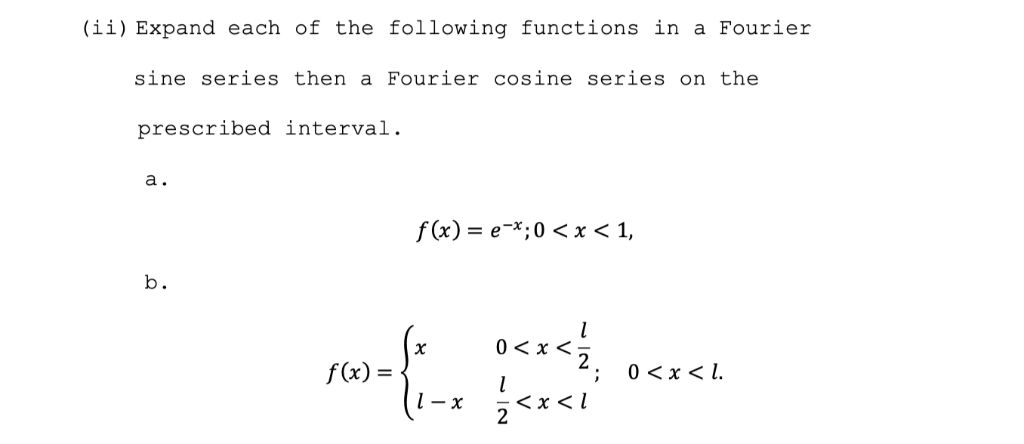 (ii) Expand each of the following functions in a Fourier
sine series then a Fourier cosine series on the
prescribed interval.
a.
fx)=e*0
This is AI generated Response.
Asked by: Babu
Created at: 2025-07-14 03:25:02
Asked by: Babu
Created at: 2025-07-14 03:25:02
Final Answer:
Rendered
Raw Text
Did you like this answer?
Let's solve **part (a)** step by step:
### Given function and interval:
\( f(x) = e^{-x}, \quad 0 < x < 1 \)
---
## **Step 1: Fourier Sine Series Expansion**
The Fourier sine series for \( f(x) \) on \( (0, 1) \) is:
\[
f(x) = \sum_{n=1}^{\infty} b_n \sin(n\pi x)
\]
where
\[
b_n = 2 \int_0^1 f(x) \sin(n\pi x) dx = 2 \int_0^1 e^{-x} \sin(n\pi x) dx
\]
**Let's compute \( b_n \):**
Let’s use integration by parts or a standard integral:
\[
\int_0^1 e^{-x} \sin(n\pi x) dx
\]
Let \( I = \int_0^1 e^{-x} \sin(n\pi x) dx \).
The standard result is:
\[
\int e^{ax} \sin(bx) dx = \frac{e^{ax}}{a^2 + b^2} (a \sin bx - b \cos bx)
\]
Here, \( a = -1 \), \( b = n\pi \):
So,
\[
I = \left[ \frac{e^{-x}}{1 + (n\pi)^2} \left( -\sin(n\pi x) - n\pi \cos(n\pi x) \right) \right]_0^1
\]
At \( x = 1 \):
- \( e^{-1} \)
- \( \sin(n\pi) = 0 \)
- \( \cos(n\pi) = (-1)^n \)
At \( x = 0 \):
- \( e^{0} = 1 \)
- \( \sin(0) = 0 \)
- \( \cos(0) = 1 \)
Evaluating:
\[
I = \frac{1}{1 + (n\pi)^2} \left[ e^{-1} (0 - n\pi(-1)^n) - (0 - n\pi(1)) \right]
\]
\[
= \frac{1}{1 + (n\pi)^2} \left[ -e^{-1} n\pi(-1)^n + n\pi \right]
\]
\[
= \frac{n\pi}{1 + (n\pi)^2} \left[ 1 - (-1)^n e^{-1} \right]
\]
So:
\[
b_n = 2I = \frac{2 n \pi}{1 + (n\pi)^2} \left[ 1 - (-1)^n e^{-1} \right]
\]
**Explanation:**
We used the formula for the sine series coefficients and calculated the integral using standard results for integrating products of exponentials and sines.
---
## **Step 2: Fourier Cosine Series Expansion**
The Fourier cosine series for \( f(x) \) on \( (0, 1) \) is:
\[
f(x) = \frac{a_0}{2} + \sum_{n=1}^\infty a_n \cos(n\pi x)
\]
where
\[
a_n = 2 \int_0^1 e^{-x} \cos(n\pi x) dx
\]
Again, use the standard integral:
\[
\int e^{ax} \cos(bx) dx = \frac{e^{ax}}{a^2 + b^2} (a \cos bx + b \sin bx)
\]
With \( a = -1 \), \( b = n\pi \):
\[
I_c = \int_0^1 e^{-x} \cos(n\pi x) dx
= \left[ \frac{e^{-x}}{1 + (n\pi)^2} (-\cos(n\pi x) + n\pi \sin(n\pi x)) \right]_0^1
\]
At \( x=1 \):
- \( e^{-1} \)
- \( \cos(n\pi) = (-1)^n \)
- \( \sin(n\pi) = 0 \)
At \( x=0 \):
- \( e^0 = 1 \)
- \( \cos(0) = 1 \)
- \( \sin(0) = 0 \)
Evaluating:
\[
I_c = \frac{1}{1 + (n\pi)^2} \left[ e^{-1} ( -(-1)^n + 0 ) - ( -1 + 0 ) \right]
\]
\[
= \frac{1}{1 + (n\pi)^2} \left[ -e^{-1}(-1)^n + 1 \right]
\]
\[
= \frac{1}{1 + (n\pi)^2} \left[ 1 - (-1)^n e^{-1} \right]
\]
Thus,
\[
a_n = 2 I_c = \frac{2}{1 + (n\pi)^2} \left[ 1 - (-1)^n e^{-1} \right]
\]
**Explanation:**
We used the formula for the cosine series coefficients and calculated the integral using the standard result for exponentials times cosines.
---
## **Final Answers**
### **(a)**
#### **Fourier Sine Series:**
\[
f(x) = e^{-x} = \sum_{n=1}^{\infty} \frac{2 n \pi}{1 + (n\pi)^2} \left[ 1 - (-1)^n e^{-1} \right] \sin(n\pi x)
\]
#### **Fourier Cosine Series:**
\[
f(x) = e^{-x} = \sum_{n=1}^{\infty} \frac{2}{1 + (n\pi)^2} \left[ 1 - (-1)^n e^{-1} \right] \cos(n\pi x)
\]
---
If you would like the solution for part (b), let me know!
📢 Instructions:
- Ask anything relatd to above question only.
- For new Question goto :