 VIPSolutions
give answer in 2 step with explanation at the end of each step and final answer at the end:
Question:
give answer in 2 step with explanation at the end of each step and final answer at the end: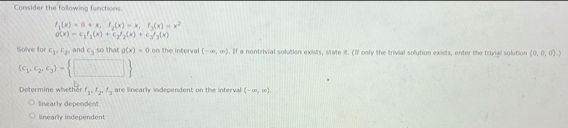
This is AI generated Response.
Asked by: Babu
Created at: 2025-07-13 06:39:34
Asked by: Babu
Created at: 2025-07-13 06:39:34
Final Answer:
Rendered
Raw Text
Did you like this answer?
Let's break this down step by step as requested:
---
### **Step 1: Set up the linear combination**
Given functions:
- \( f_1(x) = x \)
- \( f_2(x) = x^2 \)
- \( f_3(x) = x^3 \)
We want to find constants \( c_1, c_2, c_3 \) (not all zero) such that:
\[
g(x) = c_1 f_1(x) + c_2 f_2(x) + c_3 f_3(x) = 0 \quad \forall x \in (-\infty, \infty)
\]
Substitute the given functions:
\[
g(x) = c_1 x + c_2 x^2 + c_3 x^3 = 0 \quad \forall x
\]
**Explanation:**
This equation must hold for all \( x \). This means the coefficients of every power of \( x \) must be zero.
---
### **Step 2: Set coefficients to zero and solve for \( c_1, c_2, c_3 \)**
\[
c_1 x + c_2 x^2 + c_3 x^3 = 0 \implies
\begin{cases}
c_1 = 0 \\
c_2 = 0 \\
c_3 = 0 \\
\end{cases}
\]
**Explanation:**
A polynomial is identically zero for all \( x \) only if all its coefficients are zero. Thus, the only solution is \( c_1 = 0, c_2 = 0, c_3 = 0 \).
---
### **Final Answers:**
**1. Solution for \( (c_1, c_2, c_3) \):**
\[
(0, 0, 0)
\]
**2. Determine if the functions are linearly independent:**
The only solution is the trivial solution, so the functions are **linearly independent** on \( (-\infty, \infty) \).
**Boxed answers:**
- \( (c_1, c_2, c_3) = (0, 0, 0) \)
- Linearly independent (select this option)
📢 Instructions:
- Ask anything relatd to above question only.
- For new Question goto :