VIPSolutions logo ✨ VIPSolutions

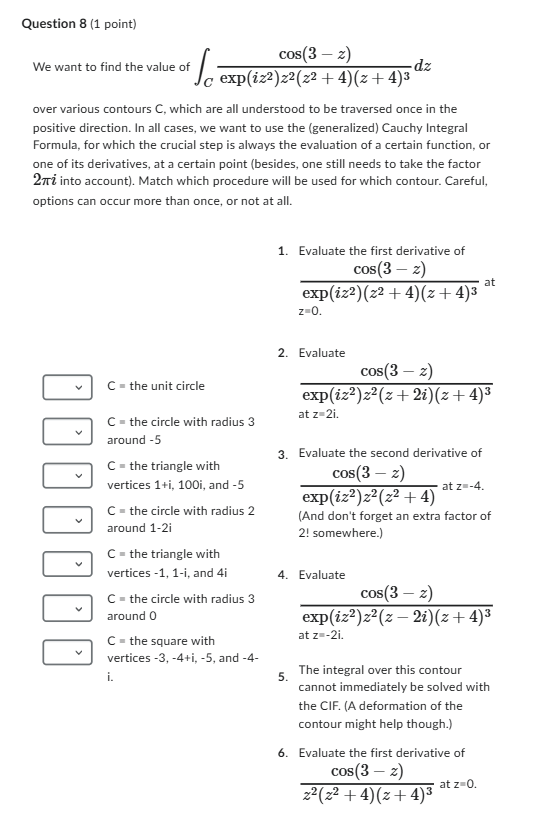
give answer in 2 step with explanation at the end of each step and final answer at the end:Question 8 (1 point) cos(3 — 2] Weare toa thevatseot [| —— SED __g lo pA) A(2 + A(z + 4° over various contours C which are al understood to be traversed once inthe positive direction. In al cases, we want to use the (generalized) Cauchy Integral Formula, fo which the crucial step is hays the evaluation of certain function, or one ofits derivatives, at a certain point (besides, on stil needs to take the factor 2m into account). Match which procedure will be used for which contour. Careful, aptions can occur more an once, or mot at a 1. Evaluate the first derivative of cos(3 — 2) JE E— p() (2 + H(z +48 0 2. Evalue cos(3 — 2) Ce the unit circ [EE ac EE SP) (2 1 20) + 9) C = the circle with radius 3 atze2i - around -5 3. Evaluate the second dervative of [rm ee C= PEA) +4) —] © - the circle with racius 2 (And don't forget an extra factor of around 1-2 2! somewhere.) [Creve vertices 1, 11, and i 4. Bale | = the circle with radius 3 cos(3 — 2) around 0 P(E) (z— 20) (z + AF C = the square with atze-2i vertices 3,411.5 3nd 4 k 5 The integral over this contour cannot immedistely be solved with the CIF. (A deformation of the contour might help though.) 6. Evaluate the first dervative of cos(3— 2) . EL E— PEEP

Question:

give answer in 2 step with explanation at the end of each step and final answer at the end:Uploaded ImageQuestion 8 (1 point) cos(3 — 2] Weare toa thevatseot [| —— SED __g lo pA) A(2 + A(z + 4° over various contours C which are al understood to be traversed once inthe positive direction. In al cases, we want to use the (generalized) Cauchy Integral Formula, fo which the crucial step is hays the evaluation of certain function, or one ofits derivatives, at a certain point (besides, on stil needs to take the factor 2m into account). Match which procedure will be used for which contour. Careful, aptions can occur more an once, or mot at a 1. Evaluate the first derivative of cos(3 — 2) JE E— p() (2 + H(z +48 0 2. Evalue cos(3 — 2) Ce the unit circ [EE ac EE SP) (2 1 20) + 9) C = the circle with radius 3 atze2i - around -5 3. Evaluate the second dervative of [rm ee C= PEA) +4) —] © - the circle with racius 2 (And don't forget an extra factor of around 1-2 2! somewhere.) [Creve vertices 1, 11, and i 4. Bale | = the circle with radius 3 cos(3 — 2) around 0 P(E) (z— 20) (z + AF C = the square with atze-2i vertices 3,411.5 3nd 4 k 5 The integral over this contour cannot immedistely be solved with the CIF. (A deformation of the contour might help though.) 6. Evaluate the first dervative of cos(3— 2) . EL E— PEEP
This is AI generated Response.
Asked by: Babu
Created at: 2025-07-12 12:04:39

Final Answer:

Rendered Raw Text
Did you like this answer?
Let's proceed step by step: --- ### **Step 1: Identify the Singularities** First, let's identify the singularities of the integrand: \[ \frac{\cos(3-z)}{\exp(iz^2)z^2(z^2+4)(z+4)^3} \] **Singularities:** - \( z = 0 \) (order 2, since \( z^2 \) in the denominator) - \( z = 2i \) (simple zero of \( z^2 + 4 = (z-2i)(z+2i) \)) - \( z = -2i \) (simple zero of \( z^2 + 4 \)) - \( z = -4 \) (pole of order 3, due to \( (z+4)^3 \)) --- ### **Step 2: Analyze Each Contour** Match each contour to the corresponding option by checking which singularities are inside each contour. 1. **C = the unit circle:** - Centered at 0, radius 1. - Contains: \( z = 0 \) only. - Since \( z=0 \) is a double pole, use the first derivative for Cauchy's formula (generalized version). - **Match:** Option 6. 2. **C = the circle with radius 3 around -5:** - Center: -5, radius 3. - Closest singularity is \( z = -4 \), but check if within radius: - \( |-5 - (-4)| = 1 < 3 \) (yes, \( z = -4 \) is inside). - Other singularities are further away. - Since \( z = -4 \) is a triple pole, need the second derivative. - **Match:** Option 3. 3. **C = the triangle with vertices 1+i, 100i, and -5:** - This large triangle contains \( z = 0, 2i, -2i, -4 \). - All singularities inside. Can't use standard Cauchy formula since multiple poles. - **Match:** Option 5. 4. **C = the circle with radius 2 around 1+2i:** - Center: \( 1+2i \), radius 2. - \( |1+2i - 2i| = |1| = 1 < 2 \), so \( z = 2i \) is inside. - Other singularities: \( z = 0 \) is \( |1+2i| = \sqrt{1^2 + 4} = \sqrt{5} \approx 2.2 \) (outside). - \( z = -2i \): \( |1+2i + 2i| = |1+4i| = \sqrt{1^2 + 16} = \sqrt{17} \approx 4.1 \) (outside). - \( z = -4 \): \( |1+2i+4| = |5+2i| = \sqrt{25+4} = \sqrt{29} \approx 5.4 \) (outside). - Only \( z = 2i \) is inside. It's a simple pole. - **Match:** Option 2. 5. **C = the triangle with vertices -1, 1-i, and 4i:** - This triangle contains \( z = 0 \) and \( z = 2i \) (since 4i is much further up, and -1, 1-i are close to origin). - If both \( z = 0 \) and \( z = 2i \) are inside, but let's check which is more relevant. - Since \( z = 0 \) is a double pole, use first derivative with full denominator. - **Match:** Option 1. 6. **C = the circle with radius 3 around 0:** - Center 0, radius 3. - \( z = 0 \) inside. - \( z = 2i \): \( |2i| = 2 < 3 \) (inside) - \( z = -2i \): \( |-2i| = 2 < 3 \) (inside) - \( z = -4 \): \( |-4| = 4 > 3 \) (outside) - Contains 0, 2i, -2i. - Can't use standard Cauchy formula immediately. - **Match:** Option 5. 7. **C = the square with vertices -3, -4+i, -5, and -4-i:** - This is a square around \( z = -4 \), includes -4. - Only \( z = -4 \) is inside. - Since it's a triple pole, use second derivative. - **Match:** Option 3. --- ### **Final Answers Table** | Contour Description | Option | |----------------------------------------------------------|--------| | C = the unit circle | 6 | | C = the circle with radius 3 around -5 | 3 | | C = the triangle with vertices 1+i, 100i, and -5 | 5 | | C = the circle with radius 2 around 1+2i | 2 | | C = the triangle with vertices -1, 1-i, and 4i | 1 | | C = the circle with radius 3 around 0 | 5 | | C = the square with vertices -3, -4+i, -5, and -4-i | 3 | --- #### **Explanation for Each Step** - **Step 1:** Identified singularities and their order. - **Step 2:** Checked which singularities are inside each contour, and matched to the corresponding evaluation procedure based on pole order and the Cauchy Integral Formula. --- **Final Answer:** | C = the unit circle | 6 | |---------------------|---| | C = the circle with radius 3 around -5 | 3 | | C = the triangle with vertices 1+i, 100i, and -5 | 5 | | C = the circle with radius 2 around 1+2i | 2 | | C = the triangle with vertices -1, 1-i, and 4i | 1 | | C = the circle with radius 3 around 0 | 5 | | C = the square with vertices -3, -4+i, -5, and -4-i | 3 |

📢 Instructions:

  • Ask anything relatd to above question only.
  • For new Question goto :

Study Help, Fast Answers

VIPSolutions focuses on clear, step‑by‑step explanations so you can learn quickly. Whether you need an AI‑generated walkthrough or a short hint to get unstuck, each solution is organized for fast reading and easy review later.

Search similar questions, compare approaches, and bookmark the best answers for revision. Our goal is simple: quick, reliable study help that feels natural—not noisy.