 VIPSolutions
give answer in 2 step with explanation at the end of each step and final answer at the end:(1 point) Consider the linear system 5’ _| 5 2 3 = -1]7 Find the eigenvalues and eigenvectors for the coefficient matrix. A= Dy = | | ,and A; = Dp = | |
Question:
give answer in 2 step with explanation at the end of each step and final answer at the end: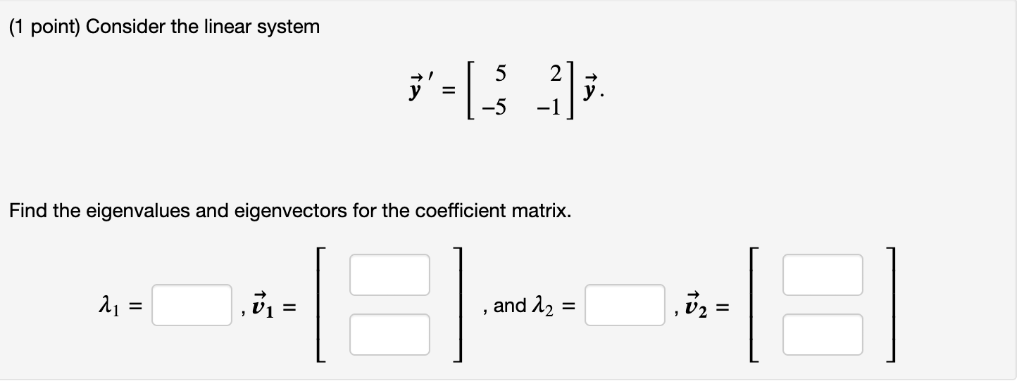 (1 point) Consider the linear system
5’ _| 5 2 3
= -1]7
Find the eigenvalues and eigenvectors for the coefficient matrix.
A= Dy = | | ,and A; = Dp = | |
This is AI generated Response.
Asked by: Pagal
Created at: 2025-07-12 05:55:31
Asked by: Pagal
Created at: 2025-07-12 05:55:31
Final Answer:
Rendered
Raw Text
Did you like this answer?
Let's solve the problem step by step:
---
### **Step 1: Find the Eigenvalues**
Given matrix:
\[
A = \begin{bmatrix} 5 & 2 \\ -5 & -1 \end{bmatrix}
\]
The characteristic equation is:
\[
\det(A - \lambda I) = 0
\]
So,
\[
\begin{vmatrix}
5 - \lambda & 2 \\
-5 & -1 - \lambda
\end{vmatrix} = 0
\]
\[
(5 - \lambda)(-1 - \lambda) - (2)(-5) = 0
\]
\[
(5 - \lambda)(-1 - \lambda) + 10 = 0
\]
\[
(5 - \lambda)(-1 - \lambda) = -5 - 5\lambda + \lambda + \lambda^2 = \lambda^2 - 4\lambda - 5
\]
So:
\[
\lambda^2 - 4\lambda - 5 + 10 = 0
\]
\[
\lambda^2 - 4\lambda + 5 = 0
\]
Solve quadratic:
\[
\lambda = \frac{4 \pm \sqrt{(-4)^2 - 4 \cdot 1 \cdot 5}}{2}
= \frac{4 \pm \sqrt{16 - 20}}{2}
= \frac{4 \pm \sqrt{-4}}{2}
= \frac{4 \pm 2i}{2}
= 2 \pm i
\]
**End of Step 1 Explanation:**
The eigenvalues are \( \lambda_1 = 2 + i \) and \( \lambda_2 = 2 - i \).
---
### **Step 2: Find the Corresponding Eigenvectors**
Let's find the eigenvector for \( \lambda_1 = 2 + i \):
Solve \((A - \lambda_1 I)\vec{v} = 0\):
\[
A - \lambda_1 I =
\begin{bmatrix}
5 - (2+i) & 2 \\
-5 & -1 - (2+i)
\end{bmatrix}
=
\begin{bmatrix}
3-i & 2 \\
-5 & -3-i
\end{bmatrix}
\]
Let \(\vec{v}_1 = \begin{bmatrix} x \\ y \end{bmatrix}\), so:
\[
(3-i)x + 2y = 0 \implies y = \frac{-(3-i)}{2}x
\]
Let \(x = 1\), then \(y = \frac{-(3-i)}{2}\).
So,
\[
\vec{v}_1 = \begin{bmatrix} 1 \\ \frac{-(3-i)}{2} \end{bmatrix}
\]
Similarly, for \( \lambda_2 = 2 - i \):
\[
A - \lambda_2 I =
\begin{bmatrix}
3+i & 2 \\
-5 & -3+i
\end{bmatrix}
\]
\[
(3+i)x + 2y = 0 \implies y = \frac{-(3+i)}{2}x
\]
Let \(x = 1\), then \(y = \frac{-(3+i)}{2}\).
So,
\[
\vec{v}_2 = \begin{bmatrix} 1 \\ \frac{-(3+i)}{2} \end{bmatrix}
\]
**End of Step 2 Explanation:**
We found the eigenvectors corresponding to each eigenvalue.
---
### **Final Answers:**
\[
\boxed{
\lambda_1 = 2 + i, \quad \vec{v}_1 = \begin{bmatrix} 1 \\ \frac{-(3-i)}{2} \end{bmatrix}
}
\]
\[
\boxed{
\lambda_2 = 2 - i, \quad \vec{v}_2 = \begin{bmatrix} 1 \\ \frac{-(3+i)}{2} \end{bmatrix}
}
\]
📢 Instructions:
- Ask anything relatd to above question only.
- For new Question goto :