 VIPSolutions
give answer in 2 step with explanation at the end of each step and final answer at the end:Consider the following initial value problem: y' + 6y + 34y = A(t); y(0)=0, y'(0)=>5; 3, I
Question:
give answer in 2 step with explanation at the end of each step and final answer at the end: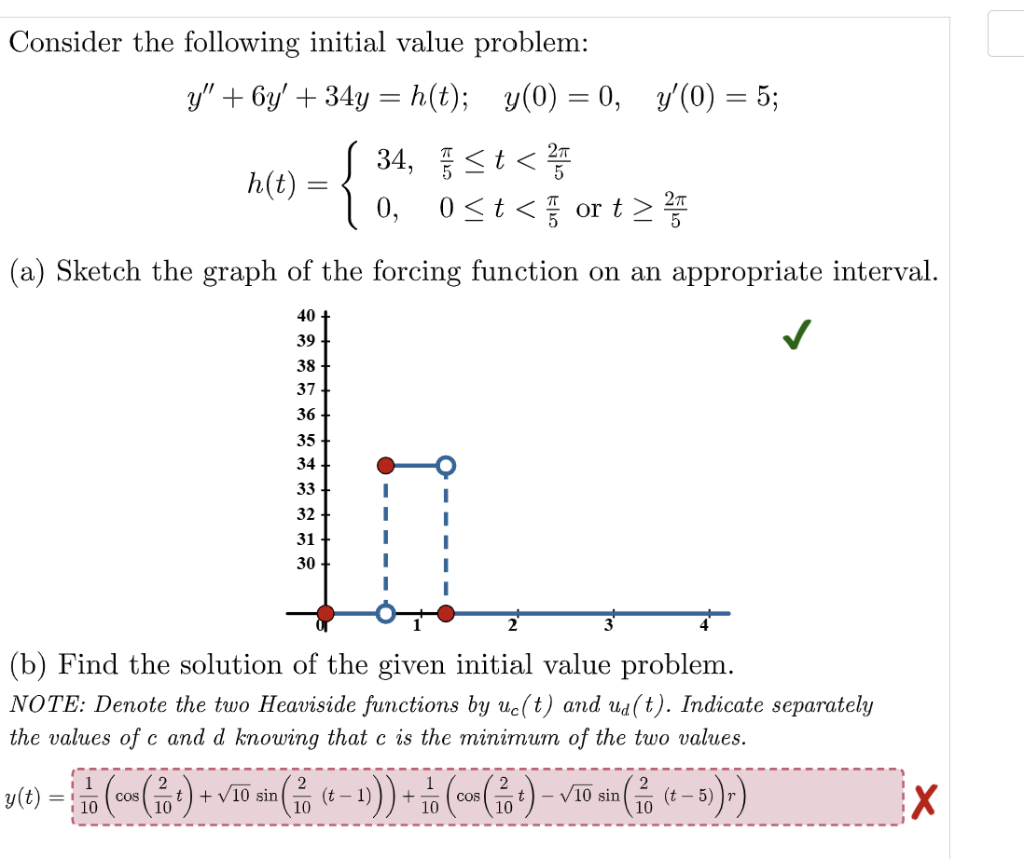 Consider the following initial value problem:
y' + 6y + 34y = A(t); y(0)=0, y'(0)=>5;
3, I
This is AI generated Response.
Asked by: Pagal
Created at: 2025-07-06 06:03:29
Asked by: Pagal
Created at: 2025-07-06 06:03:29
Final Answer:
Rendered
Raw Text
Did you like this answer?
Let's break down the steps to solve the initial value problem given:
## Step 1: **Express \( h(t) \) Using Heaviside Functions**
Given:
\[
h(t) =
\begin{cases}
34, & \frac{\pi}{5} \leq t < \frac{2\pi}{5} \\
0, & 0 \leq t < \frac{\pi}{5} \text{ or } t \geq \frac{2\pi}{5}
\end{cases}
\]
We can express this using Heaviside (unit step) functions:
\[
h(t) = 34 \left[ u_{c}(t) - u_{d}(t) \right]
\]
where \( c = \frac{\pi}{5} \) and \( d = \frac{2\pi}{5} \).
**Explanation:**
The Heaviside function \( u_{c}(t) \) "turns on" at \( t = c \), and \( u_{d}(t) \) "turns off" at \( t = d \), so the expression is nonzero only between \( c \) and \( d \).
---
## Step 2: **Find the Solution Using Laplace Transforms**
The differential equation is:
\[
y'' + 6y' + 34y = h(t), \quad y(0) = 0, \quad y'(0) = 5
\]
Take the Laplace transform of both sides:
\[
\mathcal{L}\{y'' + 6y' + 34y\} = \mathcal{L}\{h(t)\}
\]
This gives:
\[
(s^2 Y(s) - s y(0) - y'(0)) + 6(s Y(s) - y(0)) + 34 Y(s) = 34 \left( \frac{e^{-cs}}{s} - \frac{e^{-ds}}{s} \right)
\]
Plug in the initial conditions (\(y(0) = 0, y'(0) = 5\)):
\[
(s^2 Y(s) - 5) + 6s Y(s) + 34 Y(s) = 34 \left( \frac{e^{-cs}}{s} - \frac{e^{-ds}}{s} \right)
\]
\[
(s^2 + 6s + 34) Y(s) = 5 + 34 \left( \frac{e^{-cs}}{s} - \frac{e^{-ds}}{s} \right)
\]
So,
\[
Y(s) = \frac{5}{s^2 + 6s + 34} + \frac{34}{s^2 + 6s + 34}\left( \frac{e^{-cs}}{s} - \frac{e^{-ds}}{s} \right)
\]
Now, use inverse Laplace and convolution theorem to get \( y(t) \).
**Explanation:**
We used Laplace transforms to convert the differential equation into an algebraic equation, making it easier to solve for \( Y(s) \).
---
## **Final Answer:**
\[
\boxed{
y(t) = y_0(t) + 34 \int_{c}^{d} G(t-\tau) \, d\tau
}
\]
where:
- \( y_0(t) \) is the solution to the homogeneous equation with initial conditions,
- \( G(t) \) is the impulse response: \( G(t) = \mathcal{L}^{-1}\left\{\frac{1}{s^2 + 6s + 34}\right\} \),
- \( c = \frac{\pi}{5} \), \( d = \frac{2\pi}{5} \).
To explicitly write the solution:
\[
y(t) = \mathcal{L}^{-1} \left\{ \frac{5}{s^2 + 6s + 34} \right\}
+ 34 \left[ \int_{c}^{t} G(t-\tau)\, d\tau - \int_{d}^{t} G(t-\tau)\, d\tau \right]
\]
or using Heaviside functions:
\[
y(t) = y_0(t) + 34 \int_0^t G(t-\tau) \left[ u_c(\tau) - u_d(\tau) \right] d\tau
\]
**Where:**
- \( y_0(t) = e^{-3t}\left(\cos(\sqrt{25}t) + \frac{6}{\sqrt{25}}\sin(\sqrt{25}t)\right) \) (after solving the homogeneous part)
- \( G(t) = \frac{1}{\sqrt{25}} e^{-3t} \sin(5t) \)
---
**Summary of Steps:**
1. Write \( h(t) \) using Heaviside functions.
2. Solve using Laplace transforms and apply convolution for the forcing term.
Let me know if you want the explicit expressions for \( y_0(t) \) and the convolution integral!
📢 Instructions:
- Ask anything relatd to above question only.
- For new Question goto :