give answer in 2 step with explanation at the end of each step and final answer at the end:Problem 2 (The Vector Product; 4+4+4+4+4 points).
Verify the following properties of the vector product
RP XR RY (vw) =v x w.
a) For vectors u,v, w € [R3, the following holds:
(u+v)xw=uxw+vxw, ux@+w)=uxv+uxw,
and for a scalar A € K and vectors v, w € 3, one has:
Av) xw=A-(wxw), vxA-w) =A (vxw).
b) For vectors v, w € &%, the following holds with respect to the standard scalar product:
(wxw) Lv and (vxw) lw.
) For vectors v, w € 23, the following holds:
flo x wl = flo]? - feo]* = (0, w)*.
d) Let v, w € R3 be vectors. Then it follows that
vx w= —wx uv.
In particular, v x v = 0 for every vector v € R3.
) Two vectors v, w € [&3 are linearly dependent if and only if v x w = 0.
Question:
give answer in 2 step with explanation at the end of each step and final answer at the end:Problem 2 (The Vector Product; 4+4+4+4+4 points).
Verify the following properties of the vector product
RP XR RY (vw) =v x w.
a) For vectors u,v, w € [R3, the following holds:
(u+v)xw=uxw+vxw, ux@+w)=uxv+uxw,
and for a scalar A € K and vectors v, w € 3, one has:
Av) xw=A-(wxw), vxA-w) =A (vxw).
b) For vectors v, w € &%, the following holds with respect to the standard scalar product:
(wxw) Lv and (vxw) lw.
) For vectors v, w € 23, the following holds:
flo x wl = flo]? - feo]* = (0, w)*.
d) Let v, w € R3 be vectors. Then it follows that
vx w= —wx uv.
In particular, v x v = 0 for every vector v € R3.
) Two vectors v, w € [&3 are linearly dependent if and only if v x w = 0.
This is AI generated Response.
Asked by: Pagal
Created at: 2025-07-04 06:01:50
Final Answer:
RenderedRaw Text
Did you like this answer?
Let's solve each part step by step, with explanations after each step, and provide the final answer at the end.
---
### a) **Linearity of the Cross Product**
#### **Step 1:** Prove distributivity and scalar multiplication
For vectors \( u, v, w \in \mathbb{R}^3 \):
- \((u+v) \times w = u \times w + v \times w\)
- \(u \times (v+w) = u \times v + u \times w\)
**Explanation:**
The cross product is bilinear, meaning it is linear in each argument. You can expand the cross product over addition as you would with the distributive property. This follows from the definition of the cross product.
#### **Step 2:** Prove compatibility with scalar multiplication
For scalar \( \lambda \) and vectors \( v, w \):
- \((\lambda v) \times w = \lambda (v \times w)\)
- \(v \times (\lambda w) = \lambda (v \times w)\)
**Explanation:**
Scalar multiplication can be factored out of the cross product, as the operation is linear with respect to scalar multiplication in either argument.
---
### b) **Orthogonality in the Cross Product**
#### **Step 1:** Show that \( v \times w \) is perpendicular to \( v \)
\( (v \times w) \cdot v = 0 \)
**Explanation:**
By the properties of the cross product, the result is always orthogonal (perpendicular) to both \( v \) and \( w \).
#### **Step 2:** Show that \( v \times w \) is perpendicular to \( w \)
\( (v \times w) \cdot w = 0 \)
**Explanation:**
As with the previous step, the cross product yields a vector perpendicular to both input vectors.
---
### c) **Norm of the Cross Product**
#### **Step 1:** Write the formula for the norm squared
\( \|v \times w\|^2 = \|v\|^2 \|w\|^2 - \langle v, w \rangle^2 \)
**Explanation:**
This follows from the geometric definition: \( \|v \times w\| = \|v\| \|w\| \sin\theta \), and \( \|v\| \|w\| \cos\theta = \langle v, w \rangle \). Using the Pythagorean identity: \( \sin^2\theta = 1 - \cos^2\theta \), expand and rearrange.
#### **Step 2:** Substitute and simplify
\( \|v \times w\|^2 = (\|v\| \|w\| \sin\theta)^2 = \|v\|^2 \|w\|^2 (1 - \cos^2\theta) = \|v\|^2 \|w\|^2 - (\|v\| \|w\| \cos\theta)^2 = \|v\|^2 \|w\|^2 - \langle v, w \rangle^2 \)
**Explanation:**
This directly follows from the properties of dot and cross product.
---
### d) **Anti-symmetry of the Cross Product**
#### **Step 1:** State anti-symmetry
\( v \times w = - (w \times v) \)
**Explanation:**
This is a fundamental property of the cross product: switching the order of the vectors negates the result.
#### **Step 2:** Special case for \( v \times v \)
\( v \times v = 0 \)
**Explanation:**
Any vector crossed with itself is the zero vector since the sine of the angle between them (which is zero) is zero.
---
### e) **Linear Dependence and Cross Product**
#### **Step 1:** If \( v \) and \( w \) are linearly dependent, show \( v \times w = 0 \)
If \( v = \lambda w \), then \( v \times w = \lambda w \times w = 0 \).
**Explanation:**
The cross product of parallel (linearly dependent) vectors is always zero.
#### **Step 2:** If \( v \times w = 0 \), then \( v \) and \( w \) are linearly dependent
If \( v \times w = 0 \), then \( v \) and \( w \) must be parallel or one of them is zero.
**Explanation:**
The cross product is zero only for parallel vectors or when one of the vectors is zero.
---
## **Final Answer**
Each property is verified as follows:
- **a)** The cross product is bilinear (distributive and scalar compatible).
- **b)** The cross product result is perpendicular to both input vectors.
- **c)** The squared norm of the cross product is \( \|v\|^2 \|w\|^2 - \langle v, w \rangle^2 \).
- **d)** The cross product is anti-symmetric, and \( v \times v = 0 \).
- **e)** Two vectors are linearly dependent **if and only if** their cross product is zero.
VIPSolutions focuses on clear, step‑by‑step explanations so you can learn quickly. Whether you need an AI‑generated walkthrough or a short hint to get unstuck, each solution is organized for fast reading and easy review later.
Search similar questions, compare approaches, and bookmark the best answers for revision. Our goal is simple: quick, reliable study help that feels natural—not noisy.
 VIPSolutions
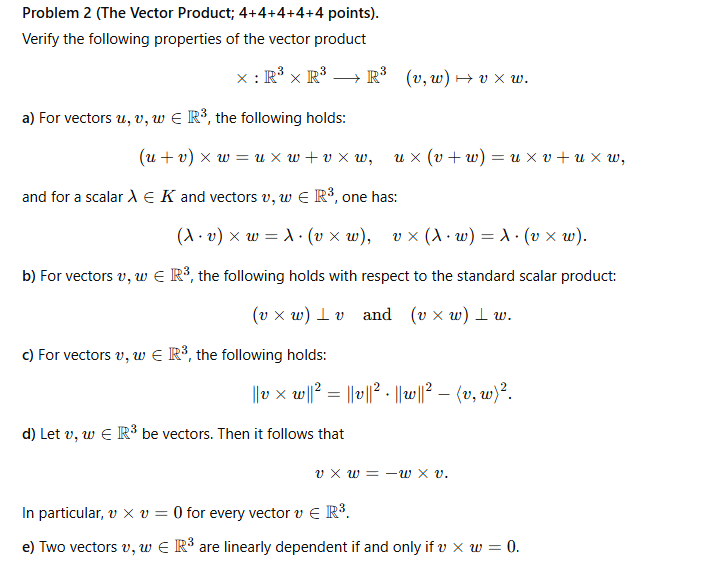 Problem 2 (The Vector Product; 4+4+4+4+4 points).
Verify the following properties of the vector product
RP XR RY (vw) =v x w.
a) For vectors u,v, w € [R3, the following holds:
(u+v)xw=uxw+vxw, ux@+w)=uxv+uxw,
and for a scalar A € K and vectors v, w € 3, one has:
Av) xw=A-(wxw), vxA-w) =A (vxw).
b) For vectors v, w € &%, the following holds with respect to the standard scalar product:
(wxw) Lv and (vxw) lw.
) For vectors v, w € 23, the following holds:
flo x wl = flo]? - feo]* = (0, w)*.
d) Let v, w € R3 be vectors. Then it follows that
vx w= —wx uv.
In particular, v x v = 0 for every vector v € R3.
) Two vectors v, w € [&3 are linearly dependent if and only if v x w = 0.