 VIPSolutions
give answer in 2 step with explanation at the end of each step and final answer at the end:14 Fromx = ,v )findx. =(_,v_ )in 0 0'0 1 1" 3 Newton's method for the equationsu -v=10 3 andv -u =0. Newton converges to the solution (0,0) or (1,1) or (- 1, - 1) or it goes off to infinity. If you use four colors for the starting points (ue, Vy ) that lead to those four limits, the printed picture is beautiful.
Question:
give answer in 2 step with explanation at the end of each step and final answer at the end: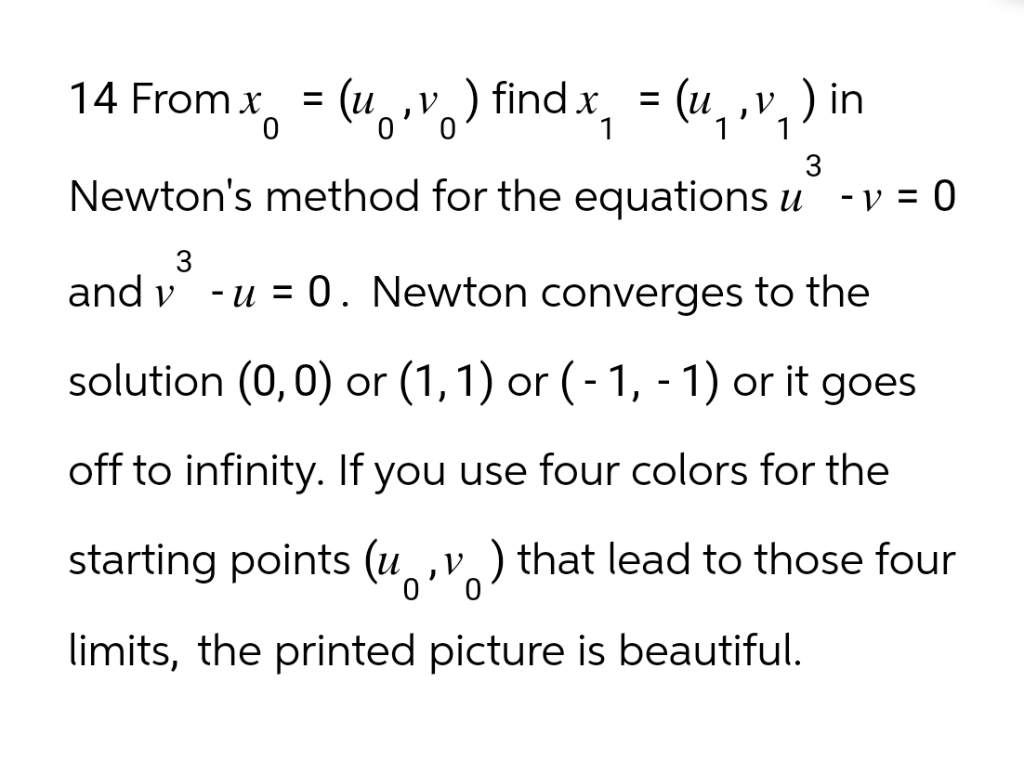 14 Fromx = ,v )findx. =(_,v_ )in
0 0'0 1 1"
3
Newton's method for the equationsu -v=10
3
andv -u =0. Newton converges to the
solution (0,0) or (1,1) or (- 1, - 1) or it goes
off to infinity. If you use four colors for the
starting points (ue, Vy ) that lead to those four
limits, the printed picture is beautiful.
This is AI generated Response.
Asked by: Pagal
Created at: 2025-07-04 04:05:12
Asked by: Pagal
Created at: 2025-07-04 04:05:12
Final Answer:
Rendered
Raw Text
Did you like this answer?
Let's break this problem into **two steps** as requested:
---
### **Step 1: Write Down the Equations and the Newton's Method Update Formula**
Given the equations:
- \( f(u, v) = u^3 - v = 0 \)
- \( g(u, v) = v^3 - u = 0 \)
Let \(\mathbf{x}_0 = (u_0, v_0)\) be the starting point.
For Newton's method in two variables, the update rule is:
\[
\mathbf{x}_1 = \mathbf{x}_0 - J^{-1} F(\mathbf{x}_0)
\]
where \(F(\mathbf{x}_0) = \begin{bmatrix} f(u_0, v_0) \\ g(u_0, v_0) \end{bmatrix}\) and \(J\) is the Jacobian matrix of partial derivatives.
**Explanation:**
This sets up the system and the Newton's method formula we will use. Next, we compute the Jacobian and carry out the update step.
---
### **Step 2: Compute the Jacobian, its Inverse, and Apply Newton's Step**
**Jacobian Matrix:**
\[
J = \begin{bmatrix}
\frac{\partial f}{\partial u} & \frac{\partial f}{\partial v} \\
\frac{\partial g}{\partial u} & \frac{\partial g}{\partial v}
\end{bmatrix}
= \begin{bmatrix}
3u^2 & -1 \\
-1 & 3v^2
\end{bmatrix}
\]
At \((u_0, v_0)\), the Jacobian is:
\[
J_0 = \begin{bmatrix}
3u_0^2 & -1 \\
-1 & 3v_0^2
\end{bmatrix}
\]
**Function Vector:**
\[
F(\mathbf{x}_0) = \begin{bmatrix}
u_0^3 - v_0 \\
v_0^3 - u_0
\end{bmatrix}
\]
**Inverse of 2x2 Jacobian:**
\[
J_0^{-1} = \frac{1}{\det J_0} \begin{bmatrix}
3v_0^2 & 1 \\
1 & 3u_0^2
\end{bmatrix}
\]
where \(\det J_0 = 3u_0^2 \cdot 3v_0^2 - (-1) \cdot (-1) = 9u_0^2 v_0^2 - 1\).
**Newton's Step:**
\[
\begin{bmatrix}
u_1 \\
v_1
\end{bmatrix}
=
\begin{bmatrix}
u_0 \\
v_0
\end{bmatrix}
- J_0^{-1}
\begin{bmatrix}
u_0^3 - v_0 \\
v_0^3 - u_0
\end{bmatrix}
\]
Plugging in the inverse:
\[
\begin{bmatrix}
u_1 \\
v_1
\end{bmatrix}
=
\begin{bmatrix}
u_0 \\
v_0
\end{bmatrix}
- \frac{1}{9u_0^2 v_0^2 - 1}
\begin{bmatrix}
3v_0^2 & 1 \\
1 & 3u_0^2
\end{bmatrix}
\begin{bmatrix}
u_0^3 - v_0 \\
v_0^3 - u_0
\end{bmatrix}
\]
**Explanation:**
In this step, we calculated the Jacobian, its determinant, and its inverse, then applied Newton's method to get the explicit update for \((u_1, v_1)\) in terms of \((u_0, v_0)\).
---
## **Final Answer**
\[
\boxed{
\begin{aligned}
u_1 &= u_0 - \frac{1}{9u_0^2 v_0^2 - 1} \left[ 3v_0^2(u_0^3 - v_0) + (v_0^3 - u_0) \right] \\
v_1 &= v_0 - \frac{1}{9u_0^2 v_0^2 - 1} \left[ (u_0^3 - v_0) + 3u_0^2(v_0^3 - u_0) \right]
\end{aligned}
}
\]
This gives the next point \((u_1, v_1)\) from the starting point \((u_0, v_0)\) using Newton's method for the given system.
📢 Instructions:
- Ask anything relatd to above question only.
- For new Question goto :