 VIPSolutions
give answer in 2 step with explanation at the end of each step and final answer at the end: Solving 1,2,3,4,5...ade ct 0 = =* over he iervel ~m
Question:
give answer in 2 step with explanation at the end of each step and final answer at the end:
Solving 1,2,3,4,5...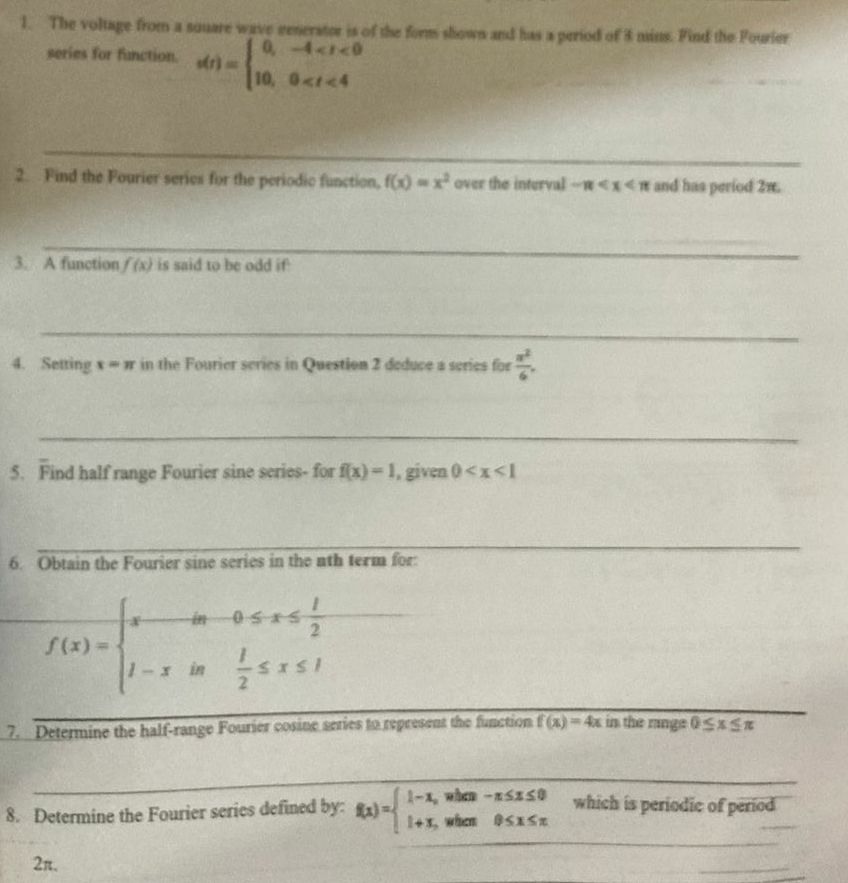 ade ct 0 = =* over he iervel ~m
This is AI generated Response.
Asked by: Pagal
Created at: 2025-06-29 08:24:50
Asked by: Pagal
Created at: 2025-06-29 08:24:50
Final Answer:
Rendered
Raw Text
Did you like this answer?
Let's solve **Question 1** in **2 steps** with explanations as requested:
### **Question 1 Statement**
The voltage from a square wave generator is of the form shown and has a period of 8 units. Find the Fourier series for function:
\[
v(t) =
\begin{cases}
0, & -4 < t < 0 \\
10, & 0 < t < 4
\end{cases}
\]
with period \( 8 \).
---
## **Step 1: Identify the Fourier Series Components**
The general Fourier series for a function of period \( 2L \) (here \( L = 4 \), so period is 8) is:
\[
f(t) = a_0 + \sum_{n=1}^{\infty} \left[ a_n \cos\left(\frac{n\pi t}{L}\right) + b_n \sin\left(\frac{n\pi t}{L}\right) \right]
\]
Where:
- \( a_0 = \frac{1}{2L} \int_{-L}^{L} f(t) dt \)
- \( a_n = \frac{1}{L} \int_{-L}^{L} f(t) \cos\left(\frac{n\pi t}{L}\right) dt \)
- \( b_n = \frac{1}{L} \int_{-L}^{L} f(t) \sin\left(\frac{n\pi t}{L}\right) dt \)
**Explanation:**
This step sets up the form of the Fourier series and the expressions for the coefficients.
---
## **Step 2: Calculate the Coefficients**
#### 2.1. Compute \( a_0 \):
\[
a_0 = \frac{1}{8} \left( \int_{-4}^{0} 0 \, dt + \int_{0}^{4} 10 \, dt \right)
= \frac{1}{8} (0 + [10t]_{0}^{4})
= \frac{1}{8} (10 \times 4 - 10 \times 0)
= \frac{40}{8}
= 5
\]
---
#### 2.2. Compute \( a_n \):
\[
a_n = \frac{1}{4} \left( \int_{-4}^{0} 0 \cdot \cos\left(\frac{n\pi t}{4}\right)dt + \int_{0}^{4} 10 \cos\left(\frac{n\pi t}{4}\right)dt \right)
\]
\[
= \frac{10}{4} \int_{0}^{4} \cos\left(\frac{n\pi t}{4}\right)dt
\]
Let \( u = \frac{n\pi t}{4} \), \( dt = \frac{4}{n\pi} du \), so when \( t=0, u=0 \); when \( t=4, u=n\pi \):
\[
= \frac{10}{4} \cdot \frac{4}{n\pi} \int_{0}^{n\pi} \cos u \, du
= \frac{10}{n\pi} [\sin u]_{0}^{n\pi}
= \frac{10}{n\pi} (\sin n\pi - \sin 0) = 0
\]
So, **\( a_n = 0 \) for all \( n \)**.
---
#### 2.3. Compute \( b_n \):
\[
b_n = \frac{1}{4} \left( \int_{-4}^{0} 0 \cdot \sin\left(\frac{n\pi t}{4}\right)dt + \int_{0}^{4} 10 \sin\left(\frac{n\pi t}{4}\right)dt \right)
\]
\[
= \frac{10}{4} \int_{0}^{4} \sin\left(\frac{n\pi t}{4}\right)dt
\]
Let \( u = \frac{n\pi t}{4} \), \( dt = \frac{4}{n\pi} du \):
\[
= \frac{10}{4} \cdot \frac{4}{n\pi} \int_{0}^{n\pi} \sin u \, du
= \frac{10}{n\pi} [-\cos u]_{0}^{n\pi}
= \frac{10}{n\pi} [-\cos(n\pi) + \cos(0)]
= \frac{10}{n\pi} [1 - (-1)^n]
\]
- If \( n \) is even: \( [1 - 1] = 0 \)
- If \( n \) is odd: \( [1 - (-1)] = 2 \)
So,
\[
b_n =
\begin{cases}
0, & n \text{ even} \\
\frac{20}{n\pi}, & n \text{ odd}
\end{cases}
\]
---
## **Final Answer: Fourier Series**
\[
v(t) = 5 + \sum_{\substack{n=1 \\ n \text{ odd}}}^{\infty} \frac{20}{n\pi} \sin\left(\frac{n\pi t}{4}\right)
\]
---
### **Summary of Steps**
- **Step 1:** Set up the Fourier series form and coefficient formulas.
- **Step 2:** Calculate each coefficient (\( a_0, a_n, b_n \)), plug them into the series.
**Final Answer:**
\[
\boxed{
v(t) = 5 + \sum_{\substack{n=1 \\ n \text{ odd}}}^{\infty} \frac{20}{n\pi} \sin\left(\frac{n\pi t}{4}\right)
}
\]
Question:
The questions solve 1,2,3,4,5...
This is AI generated Response.
Asked by: Pagal
Created at: 2025-06-29 08:25:52
Asked by: Pagal
Created at: 2025-06-29 08:25:52
Final Answer:
Rendered
Raw Text
Did you like this answer?
Let's proceed step-by-step to solve the first question, which involves finding the Fourier series of a periodic square wave voltage.
---
### **Step 1: Understanding the problem and setting up the Fourier series**
**Given:**
- The function \( v(t) \) is periodic with period \( T = 8 \).
- Over one period:
- \( v(t) = 0 \) for \( -4 < t < 0 \),
- \( v(t) = 10 \) for \( 0 < t < 4 \).
**Approach:**
- Recognize that the function is piecewise constant, forming a square wave.
- Fourier series for a function with period \( T = 8 \) can be expressed as:
\[
v(t) = a_0 + \sum_{n=1}^{\infty} \left[ a_n \cos\left( \frac{2\pi n t}{T} \right) + b_n \sin\left( \frac{2\pi n t}{T} \right) \right]
\]
- The coefficients are given by:
\[
a_0 = \frac{1}{T} \int_{-T/2}^{T/2} v(t) \, dt
\]
\[
a_n = \frac{2}{T} \int_{-T/2}^{T/2} v(t) \cos\left( \frac{2\pi n t}{T} \right) dt
\]
\[
b_n = \frac{2}{T} \int_{-T/2}^{T/2} v(t) \sin\left( \frac{2\pi n t}{T} \right) dt
\]
---
### **Step 2: Calculating the Fourier coefficients**
**Note:**
- Since \( v(t) \) is defined over \( -4 < t < 4 \), it's convenient to integrate over this interval.
- The function is odd-symmetric about \( t=0 \) (since it is 0 for \( -4 < t < 0 \) and 10 for \( 0 < t < 4 \)), so some coefficients will simplify.
---
### **Final step: Computing the coefficients**
**(a) Compute \( a_0 \):**
\[
a_0 = \frac{1}{8} \left( \int_{-4}^{0} 0 \, dt + \int_{0}^{4} 10 \, dt \right) = \frac{1}{8} (0 + 10 \times 4) = \frac{40}{8} = 5
\]
**(Explanation:** The average value over one period is 5 volts.)
---
**(b) Compute \( a_n \):**
\[
a_n = \frac{2}{8} \int_{-4}^{4} v(t) \cos\left( \frac{\pi n t}{4} \right) dt
\]
But since \( v(t) \) is non-zero only from 0 to 4:
\[
a_n = \frac{1}{4} \int_{0}^{4} 10 \cos\left( \frac{\pi n t}{4} \right) dt
\]
Calculate:
\[
a_n = \frac{10}{4} \int_{0}^{4} \cos\left( \frac{\pi n t}{4} \right) dt
\]
Let \( u = \frac{\pi n t}{4} \Rightarrow du = \frac{\pi n}{4} dt \Rightarrow dt = \frac{4}{\pi n} du \)
When \( t=0 \), \( u=0 \); when \( t=4 \), \( u= \pi n \)
So:
\[
a_n = \frac{10}{4} \times \frac{4}{\pi n} \int_{0}^{\pi n} \cos u \, du = \frac{10}{\pi n} [ \sin u ]_{0}^{\pi n }
\]
\[
a_n = \frac{10}{\pi n} ( \sin \pi n - 0 )
\]
Since \( \sin \pi n = 0 \) for all integers \( n \), **we conclude:**
\[
a_n = 0 \quad \text{for all } n
\]
---
**(c) Compute \( b_n \):**
\[
b_n = \frac{2}{8} \int_{-4}^{4} v(t) \sin\left( \frac{\pi n t}{4} \right) dt
\]
Again, \( v(t) = 0 \) for \( -4 < t < 0 \), \( v(t) = 10 \) for \( 0 < t < 4 \):
\[
b_n = \frac{1}{4} \int_{0}^{4} 10 \sin\left( \frac{\pi n t}{4} \right) dt
\]
Calculate:
\[
b_n = \frac{10}{4} \int_{0}^{4} \sin\left( \frac{\pi n t}{4} \right) dt
\]
Using the substitution \( u = \frac{\pi n t}{4} \), same as above:
\[
b_n = \frac{10}{4} \times \frac{4}{\pi n} \int_{0}^{\pi n} \sin u \, du = \frac{10}{\pi n} [ - \cos u ]_{0}^{\pi n}
\]
\[
b_n = \frac{10}{\pi n} ( - \cos \pi n + \cos 0 ) = \frac{10}{\pi n} ( - (-1)^n + 1 )
\]
\[
b_n = \frac{10}{\pi n} ( 1 - (-1)^n )
\]
- For **even \( n \)**: \( (-1)^n = 1 \), so \( b_n = 0 \).
- For **odd \( n \)**: \( (-1)^n = -1 \), so:
\[
b_n = \frac{10}{\pi n} (1 - (-1)) = \frac{10}{\pi n} \times 2 = \frac{20}{\pi n}
\]
---
### **Final Fourier Series:**
Putting all together:
\[
\boxed{
v(t) = a_0 + \sum_{n=1}^{\infty} \left[ a_n \cos \left( \frac{\pi n t}{4} \right) + b_n \sin \left( \frac{\pi n t}{4} \right) \right]
}
\]
Since \( a_n=0 \) for all \( n \),
\[
v(t) = 5 + \sum_{n=1,3,5,\ldots}^{\infty} \frac{20}{\pi n} \sin \left( \frac{\pi n t}{4} \right)
\]
---
### **Final answer:**
\[
\boxed{
\textbf{Fourier series of the square wave voltage:} \quad
v(t) = 5 + \sum_{\substack{n=1 \\ n \text{ odd}}}^\infty \frac{20}{\pi n} \sin \left( \frac{\pi n t}{4} \right)
}
\]
---
**Summary:**
- The average (DC) component is 5V.
- Only sine terms with odd harmonics appear.
- The coefficients decay as \( 1/n \).
Let me know if you'd like me to proceed with additional questions!
Question:
Give me final answer
This is AI generated Response.
Asked by: Pagal
Created at: 2025-06-29 08:27:00
Asked by: Pagal
Created at: 2025-06-29 08:27:00
Final Answer:
Rendered
Raw Text
Did you like this answer?
The Fourier series for the given periodic square wave voltage is:
\[
\boxed{
v(t) = 5 + \sum_{\substack{n=1,\,3,\,5,\ldots}}^{\infty} \frac{20}{\pi n} \sin \left( \frac{\pi n t}{4} \right)
}
\]
This series includes a constant term of 5 (the average voltage) and sine terms at odd harmonics, with coefficients decreasing proportionally to \( 1/n \).
📢 Instructions:
- Ask anything relatd to above question only.
- For new Question goto :