 VIPSolutions
give answer in 2 step with explanation at the end of each step and final answer at the end:| would like to determine that SR. S and SR, S are isomorphic or not when $p = 2,5,11S$. For the case of Sp = 2S, decide whether the following rings are isomorphic Z kl ZI i hr PO (2-2) x2-3 1 mathbb{Z} 2 langleX -2——Sand$ rangle 2 R = — Xanglex -3—S. 2 mathbb{Z} rangle Determine if SR, =R Sin the cases Sp = 2$ , Sp = 55, 0rSp = 118.
Question:
give answer in 2 step with explanation at the end of each step and final answer at the end: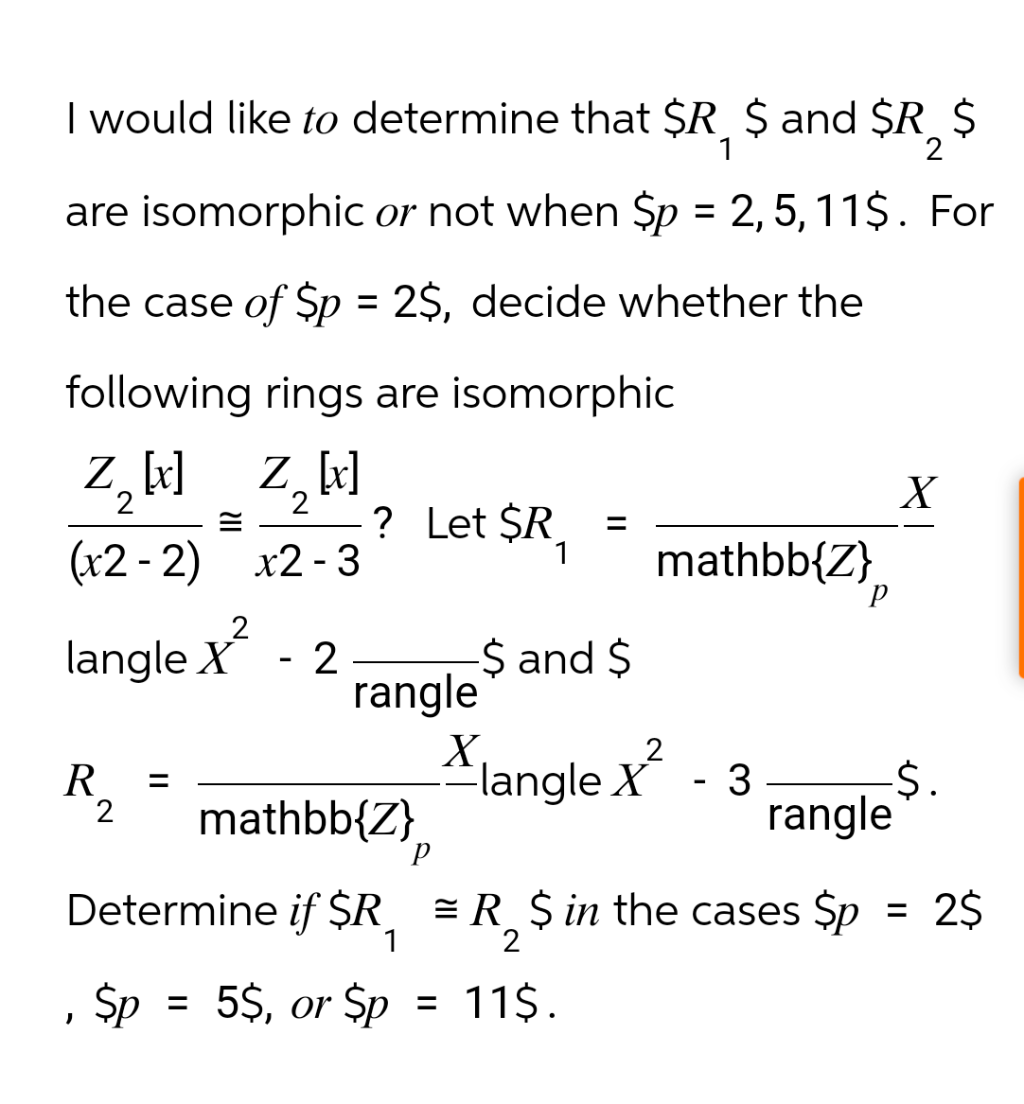 | would like to determine that SR. S and SR, S
are isomorphic or not when $p = 2,5,11S$. For
the case of Sp = 2S, decide whether the
following rings are isomorphic
Z kl ZI
i hr PO
(2-2) x2-3 1 mathbb{Z}
2
langleX -2——Sand$
rangle
2
R = — Xanglex -3—S.
2 mathbb{Z} rangle
Determine if SR, =R Sin the cases Sp = 2$
, Sp = 55, 0rSp = 118.
This is AI generated Response.
Asked by: Pagal
Created at: 2025-06-27 15:21:25
Asked by: Pagal
Created at: 2025-06-27 15:21:25
Final Answer:
Rendered
Raw Text
Did you like this answer?
Let's solve the problem step by step for \( p = 2 \):
---
### **Step 1: Analyze the Rings for \( p = 2 \)**
We are asked whether:
\[
\frac{\mathbb{Z}_2[x]}{(x^2 - 2)} \cong \frac{\mathbb{Z}_2[x]}{(x^2 - 3)}
\]
But in \( \mathbb{Z}_2 \), both \( 2 \) and \( 3 \) reduce modulo 2 as follows:
- \( 2 \equiv 0 \pmod{2} \)
- \( 3 \equiv 1 \pmod{2} \)
So the quotients become:
\[
\frac{\mathbb{Z}_2[x]}{(x^2 - 0)} = \frac{\mathbb{Z}_2[x]}{(x^2)}
\]
and
\[
\frac{\mathbb{Z}_2[x]}{(x^2 - 1)}
\]
**Explanation:**
We reduced the constants modulo 2, simplifying the polynomials. This step checks how the ideals look in \( \mathbb{Z}_2[x] \).
---
### **Step 2: Check If the Two Quotient Rings are Isomorphic**
- \( \frac{\mathbb{Z}_2[x]}{(x^2)} \):
Elements look like \( a + bx \), since \( x^2 = 0 \).
- \( \frac{\mathbb{Z}_2[x]}{(x^2-1)} \):
Elements look like \( a + bx \), but with \( x^2 = 1 \).
These two rings are not isomorphic:
- In the first ring, \( x^2 = 0 \)
- In the second ring, \( x^2 = 1 \)
Their structure is different (one is local with nilpotent \( x \), and the other is semisimple and splits as \( \mathbb{Z}_2 \times \mathbb{Z}_2 \)), so they are **not isomorphic**.
**Explanation:**
We compared the relations in the quotient rings and saw that they are fundamentally different in structure.
---
### **Final Answer:**
For \( p = 2 \), the rings \( R_1 \) and \( R_2 \) are **not isomorphic**.
📢 Instructions:
- Ask anything relatd to above question only.
- For new Question goto :