 VIPSolutions
give answer in 2 step with explanation at the end of each step and final answer at the end:. Consider the set A = {a,b,c}. [f 2) List all equivalence relations on A. ) For each relation provide the partition classes. Are there any partial order relation among above relations? If yes, identify them.
Question:
give answer in 2 step with explanation at the end of each step and final answer at the end: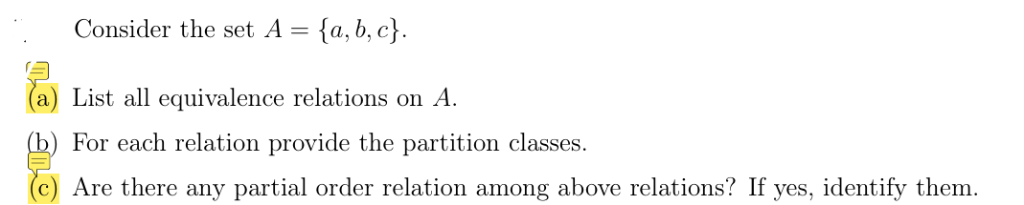 . Consider the set A = {a,b,c}.
[f
2) List all equivalence relations on A.
) For each relation provide the partition classes.
Are there any partial order relation among above relations? If yes, identify them.
This is AI generated Response.
Asked by: Ratan
Created at: 2025-06-23 05:41:55
Asked by: Ratan
Created at: 2025-06-23 05:41:55
Final Answer:
Rendered
Raw Text
Did you like this answer?
Let's solve the problem **step by step** as requested.
---
### **Step 1: List all equivalence relations on \( A \).**
**Explanation:**
An equivalence relation on a set corresponds to a partition of that set. For \( A = \{a, b, c\} \), the partitions (and thus the equivalence relations) are:
1. **All elements in their own class:**
- Partition: \( \{\{a\}, \{b\}, \{c\}\} \)
- Relation: \( \{(a, a), (b, b), (c, c)\} \)
2. **One pair together, one separate:**
- Partition: \( \{\{a, b\}, \{c\}\} \)
- Relation: \( \{(a, a), (b, b), (c, c), (a, b), (b, a)\} \)
- Partition: \( \{\{a, c\}, \{b\}\} \)
- Relation: \( \{(a, a), (b, b), (c, c), (a, c), (c, a)\} \)
- Partition: \( \{\{b, c\}, \{a\}\} \)
- Relation: \( \{(a, a), (b, b), (c, c), (b, c), (c, b)\} \)
3. **All together:**
- Partition: \( \{\{a, b, c\}\} \)
- Relation: \( \{(a, a), (b, b), (c, c), (a, b), (b, a), (a, c), (c, a), (b, c), (c, b)\} \)
**Summary:**
There are **5 equivalence relations** on \( A \).
---
### **Step 2: For each relation provide the partition classes.**
**Explanation:**
The partition classes are given above for each relation. Let's write them clearly:
1. \( \{\{a\}, \{b\}, \{c\}\} \)
2. \( \{\{a, b\}, \{c\}\} \)
3. \( \{\{a, c\}, \{b\}\} \)
4. \( \{\{b, c\}, \{a\}\} \)
5. \( \{\{a, b, c\}\} \)
---
### **Final Answer:**
#### **(a) List of all equivalence relations on \( A \):**
- \( \{(a, a), (b, b), (c, c)\} \)
- \( \{(a, a), (b, b), (c, c), (a, b), (b, a)\} \)
- \( \{(a, a), (b, b), (c, c), (a, c), (c, a)\} \)
- \( \{(a, a), (b, b), (c, c), (b, c), (c, b)\} \)
- \( \{(a, a), (b, b), (c, c), (a, b), (b, a), (a, c), (c, a), (b, c), (c, b)\} \)
#### **(b) Partition classes for each relation:**
- \( \{\{a\}, \{b\}, \{c\}\} \)
- \( \{\{a, b\}, \{c\}\} \)
- \( \{\{a, c\}, \{b\}\} \)
- \( \{\{b, c\}, \{a\}\} \)
- \( \{\{a, b, c\}\} \)
#### **(c) Are any of these partial order relations?**
**Explanation:**
A partial order must be **reflexive, antisymmetric, and transitive**.
Equivalence relations are reflexive, symmetric, and transitive (not antisymmetric unless each class is a singleton).
- The only candidate is the relation where each element is only related to itself:
\( \{(a, a), (b, b), (c, c)\} \).
This is the **equality relation**, which **is** a partial order (and a total order).
**Final Answer:**
**Yes, the relation \( \{(a, a), (b, b), (c, c)\} \) is a partial order (the equality relation).**
Question:
Solving a,b,c.
This is AI generated Response.
Asked by: Ratan
Created at: 2025-06-23 05:43:54
Asked by: Ratan
Created at: 2025-06-23 05:43:54
Final Answer:
Rendered
Raw Text
Did you like this answer?
Let's approach this systematically:
---
### **Step 1: List all equivalence relations on \( A = \{a, b, c\} \).**
**Explanation:**
Equivalence relations on a set correspond to partitions of that set. For a set with 3 elements, the possible partitions are well-known:
1. **Each element in its own singleton:**
- Partition: \(\{\{a\}, \{b\}, \{c\}\}\)
- Relation: all pairs \((x, x)\) (reflexivity), plus no off-diagonal pairs.
- Relation: \(\{(a, a), (b, b), (c, c)\}\)
2. **One pair together, the other separate:**
- Partitions:
a) \(\{\{a, b\}, \{c\}\}\)
b) \(\{\{a, c\}, \{b\}\}\)
c) \(\{\{b, c\}, \{a\}\}\)
- Relations include all pairs within each block, plus the diagonal:
- For \(\{\{a, b\}, \{c\}\}\): \(\{(a, a), (b, b), (c, c), (a, b), (b, a)\}\)
- Similarly for others.
3. **All elements together:**
- Partition: \(\{\{a, b, c\}\}\)
- Relation: all pairs \((x, y)\) where \(x, y \in \{a, b, c\}\).
**Total equivalence relations:** **5**
---
### **Step 2: Provide the partition classes for each relation.**
**Answer:**
1. \(\{\{a\}, \{b\}, \{c\}\}\)
2. \(\{\{a, b\}, \{c\}\}\)
3. \(\{\{a, c\}, \{b\}\}\)
4. \(\{\{b, c\}, \{a\}\}\)
5. \(\{\{a, b, c\}\}\)
---
### **Are any of these relations partial orders?**
**Explanation:**
A partial order must be **reflexive, antisymmetric, and transitive**.
- Equivalence relations are **reflexive, symmetric, and transitive**, but **not necessarily antisymmetric** unless each class is a singleton.
- The relation where each element is only related to itself: \(\{(a, a), (b, b), (c, c)\}\), is **reflexive, antisymmetric, transitive** — i.e., a partial order (specifically, the equality relation).
**Final conclusion:**
Yes, **the relation with only diagonal pairs** is a partial order.
---
### **Final answer:**
- **All equivalence relations** are the five listed above, corresponding to the partitions:
1. \(\{\{a\}, \{b\}, \{c\}\}\)
2. \(\{\{a, b\}, \{c\}\}\)
3. \(\{\{a, c\}, \{b\}\}\)
4. \(\{\{b, c\}, \{a\}\}\)
5. \(\{\{a, b, c\}\}\)
- **Partial order relation among these:**
The only partial order relation is the identity (equality) relation: \(\{(a, a), (b, b), (c, c)\}\).
---
Let me know if you'd like further clarification!
📢 Instructions:
- Ask anything relatd to above question only.
- For new Question goto :