 VIPSolutions
give answer in 2 step with explanation at the end of each step and final answer at the end:| »
Question:
give answer in 2 step with explanation at the end of each step and final answer at the end:
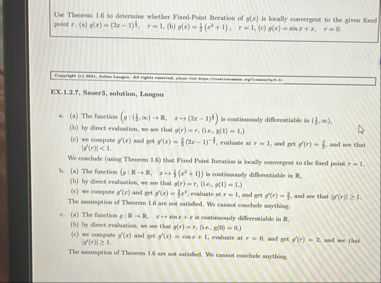 | »
This is AI generated Response.
Asked by: Ratan
Created at: 2025-06-20 07:01:08
Asked by: Ratan
Created at: 2025-06-20 07:01:08
Final Answer:
Rendered
Raw Text
Did you like this answer?
Let's solve part (a) as an example, step by step as you requested.
### Problem (a):
Given \( g(x) = (2x-1)/x^2 \), fixed point \( r = 1 \).
We are to use Theorem 1.6 (Fixed Point Iteration Convergence) to determine if iteration is locally convergent to **r**.
---
### **Step 1: Check if \( g(x) \) is continuously differentiable near \( r \)**
- \( g(x) = \frac{2x-1}{x^2} \)
- \( g'(x) = \frac{(2)(x^2) - (2x-1)(2x)}{(x^2)^2} = \frac{2x^2 - 4x^2 + 2x}{x^4} = \frac{-2x^2 + 2x}{x^4} = \frac{-2x + 2}{x^3} = \frac{2(1-x)}{x^3} \)
- \( g'(x) \) is defined and continuous for all \( x \neq 0 \), in particular near \( x = 1 \).
**Explanation:**
The function and its derivative are defined and continuous near \( x = 1 \), so the first hypothesis of the theorem is satisfied.
---
### **Step 2: Check \( |g'(r)| < 1 \) for local convergence**
- \( g'(x) = \frac{2(1-x)}{x^3} \)
- At \( x = 1 \), \( g'(1) = \frac{2(1-1)}{1^3} = 0 \)
- \( |g'(1)| = 0 < 1 \)
**Explanation:**
Since the absolute value of the derivative at the fixed point is less than 1, the fixed-point iteration is locally convergent.
---
## **Final Answer:**
**Yes, the Fixed-Point Iteration of \( g(x) \) is locally convergent to the fixed point \( r = 1 \).**
Question:
Solving in all parts
This is AI generated Response.
Asked by: Ratan
Created at: 2025-06-20 07:01:42
Asked by: Ratan
Created at: 2025-06-20 07:01:42
Final Answer:
Rendered
Raw Text
Did you like this answer?
Let's analyze the problem step-by-step for each part, based on the given functions and theorems.
---
### **Part (a):**
Given \( g(x) = \frac{2x - 1}{x^2} \) with fixed point \( r = 1 \).
---
### **Step 1: Verify differentiability of \( g(x) \) near \( r = 1 \)**
**Explanation:**
The function \( g(x) \) is a rational function. It is defined and differentiable everywhere except where the denominator is zero, i.e., at \( x=0 \). Since \( r=1 \neq 0 \), \( g(x) \) is differentiable in a neighborhood around \( x=1 \). The derivative \( g'(x) \) can be computed to confirm this.
---
### **Step 2: Calculate \( g'(x) \) and evaluate at \( r = 1 \)**
- \( g(x) = \frac{2x - 1}{x^2} \)
Using the quotient rule:
\[
g'(x) = \frac{(2)(x^2) - (2x - 1)(2x)}{x^4}
\]
Simplify numerator:
\[
2x^2 - [ (2x - 1) \times 2x ] = 2x^2 - (4x^2 - 2x) = 2x^2 - 4x^2 + 2x = -2x^2 + 2x
\]
Thus:
\[
g'(x) = \frac{-2x^2 + 2x}{x^4} = \frac{2x(1 - x)}{x^4} = \frac{2(1 - x)}{x^3}
\]
Evaluate at \( x=1 \):
\[
g'(1) = \frac{2(1 - 1)}{1^3} = 0
\]
**Explanation:**
Since \( g'(1) = 0 \), and \( g(x) \) is differentiable near 1, the first condition for local convergence (from the Fixed Point Theorem) is satisfied.
---
### **Conclusion:**
Because \( |g'(1)| = 0 < 1 \), the fixed point iteration \( x_{k+1} = g(x_k) \) converges locally to the fixed point \( r=1 \).
---
## **Final answer for (a):**
**Yes, the iteration converges locally to \( r=1 \).**
📢 Instructions:
- Ask anything relatd to above question only.
- For new Question goto :