 VIPSolutions
give answer in 2 step with explanation at the end of each step and final answer at the end:Lo place e gual = ET pr a he Uber + Uy =< subject +o Ee iE poo fe =o ese Eres & UceH)=o U(og)=fd + a ; 24 We ia : J) 7% a 0 rg : ho Ge ro ei 0 : [4 a ah Ras 4 kd aR wii u=+ ©) E Xj wn gt u=o 2 i Bi Sa Bi on gies ad gy Ge
Question:
give answer in 2 step with explanation at the end of each step and final answer at the end: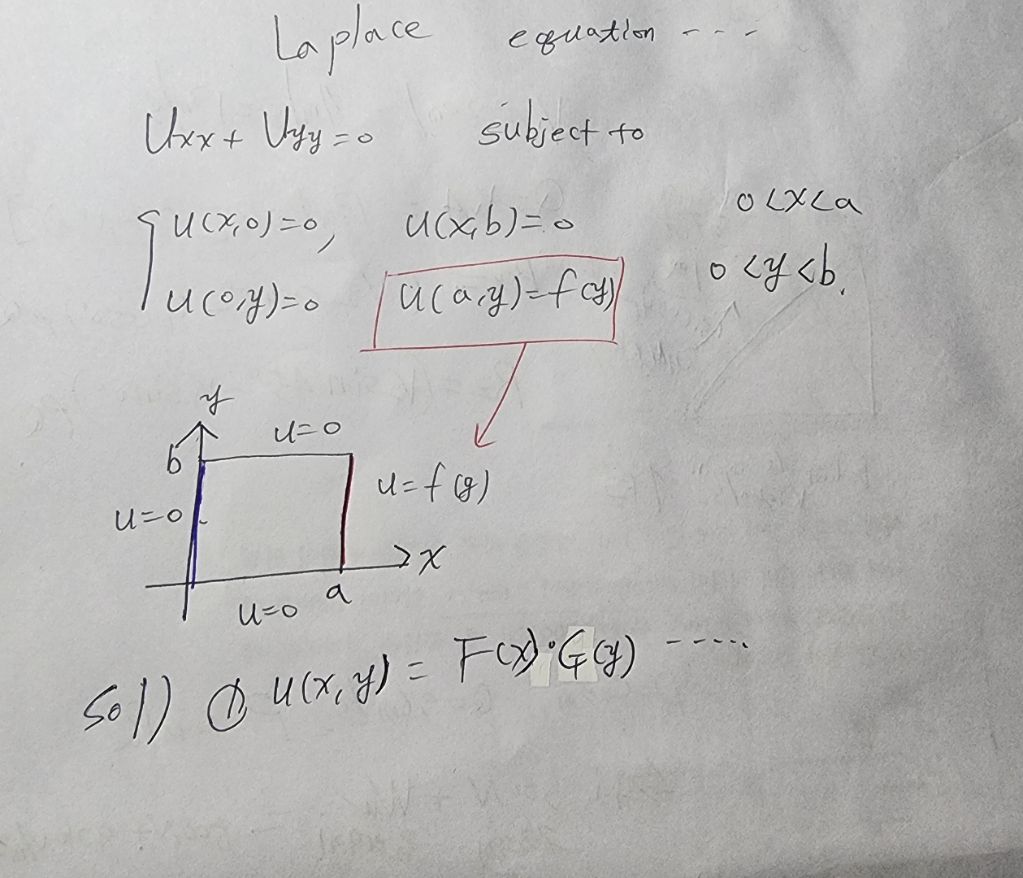 Lo place e gual = ET pr
a he
Uber + Uy =< subject +o Ee
iE poo
fe =o ese Eres &
UceH)=o U(og)=fd + a ; 24
We
ia : J) 7% a 0 rg
: ho Ge ro ei 0
: [4 a ah Ras
4 kd aR
wii u=+ ©) E Xj wn gt
u=o 2 i Bi Sa Bi on gies
ad gy
Ge
This is AI generated Response.
Asked by: Pagal
Created at: 2025-06-16 20:39:12
Asked by: Pagal
Created at: 2025-06-16 20:39:12
Final Answer:
Rendered
Raw Text
Did you like this answer?
Let's solve the given Laplace equation step by step as requested.
---
**Step 1: Write the Laplace equation and assume a separable solution.**
Equation:
\[
u_{xx} + u_{yy} = 0
\]
Boundary conditions:
\[
\begin{cases}
u(x,0) = 0 \\
u(0,y) = 0 \\
u(x,b) = 0 \\
u(a,y) = f(y)
\end{cases}
\]
Domain: \(0 < x < a\), \(0 < y < b\)
Assume a separable solution:
\[
u(x, y) = F(x) \cdot G(y)
\]
**Explanation:**
We assume the solution can be written as a product of functions, each depending only on one variable. This is a standard method for solving PDEs with homogeneous boundary conditions.
---
**Step 2: Plug the separable solution into the Laplace equation and separate variables.**
Plug \(u(x, y) = F(x)G(y)\) into the PDE:
\[
u_{xx} + u_{yy} = 0 \implies F''(x)G(y) + F(x)G''(y) = 0
\]
Divide both sides by \(F(x)G(y)\):
\[
\frac{F''(x)}{F(x)} + \frac{G''(y)}{G(y)} = 0
\]
\[
\frac{F''(x)}{F(x)} = -\frac{G''(y)}{G(y)} = -\lambda
\]
where \(\lambda\) is a separation constant.
So, we get two ODEs:
\[
F''(x) + \lambda F(x) = 0
\]
\[
G''(y) - \lambda G(y) = 0
\]
**Explanation:**
By substituting the separable form into the PDE and dividing by \(F(x)G(y)\), we separate the equation into two ODEs—one for each variable. The separation constant \(\lambda\) appears with opposite signs in the two equations.
---
**Final Answer:**
**Step 1:** Assume \(u(x, y) = F(x) G(y)\).
**Step 2:** Substitute into the Laplace equation to get:
\[
F''(x) + \lambda F(x) = 0, \quad G''(y) - \lambda G(y) = 0
\]
These ODEs, along with the boundary conditions, can now be solved to find the specific form of \(u(x, y)\).
📢 Instructions:
- Ask anything relatd to above question only.
- For new Question goto :