 VIPSolutions
give answer in 2 step with explanation at the end of each step and final answer at the end: A F ( x , y , z ) = ( 9 y z , - 4 x z , 6 x y ) . Find the divergence and curl o f F . div ( F ) = grad * F = curl ( F ) = grad × F = ( ◻ ) . B F ( x , y , z ) = ( 3 x 2 , - 3 ( x + y ) 2 , - 7 ( x + y + z ) 2 ) . Find the divergence and curl o f F .BO) Consider the vector field F(z, 4,2) = (99%, ~4z7,621). Find the divergence and curl of F. div(F) = V-F = mE an(p)=vxF=(_}J) 8 Consider the vector field F(z, ,2) = (32%, ~3( + 1)", ~T( + y + 2°). Find the vergence and curl of F. div(F)=V-F= [} cunl(F) =v x F=([_}[ J):
Question:
give answer in 2 step with explanation at the end of each step and final answer at the end:
A
F
(
x
,
y
,
z
)
=
(
9
y
z
,
-
4
x
z
,
6
x
y
)
.
Find the divergence and curl
o
f
F
.
div
(
F
)
=
grad
*
F
=
curl
(
F
)
=
grad
×
F
=
(
◻
)
.
B
F
(
x
,
y
,
z
)
=
(
3
x
2
,
-
3
(
x
+
y
)
2
,
-
7
(
x
+
y
+
z
)
2
)
.
Find the divergence and curl
o
f
F
.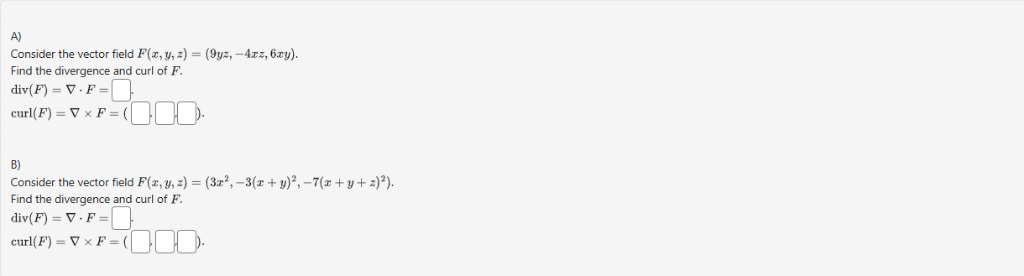 BO)
Consider the vector field F(z, 4,2) = (99%, ~4z7,621).
Find the divergence and curl of F.
div(F) = V-F = mE
an(p)=vxF=(_}J)
8
Consider the vector field F(z, ,2) = (32%, ~3( + 1)", ~T( + y + 2°).
Find the vergence and curl of F.
div(F)=V-F= [}
cunl(F) =v x F=([_}[ J):
This is AI generated Response.
Asked by: Ratan
Created at: 2025-06-16 14:27:18
Asked by: Ratan
Created at: 2025-06-16 14:27:18
Final Answer:
Rendered
Raw Text
Did you like this answer?
Let's solve both parts **step by step** with explanations.
---
### **A)**
Given:
\(\vec{F}(x, y, z) = (9yz, -4xz, 6xy)\)
#### **Step 1: Find the Divergence (\(\nabla \cdot \vec{F}\))**
The divergence formula:
\[
\nabla \cdot \vec{F} = \frac{\partial F_1}{\partial x} + \frac{\partial F_2}{\partial y} + \frac{\partial F_3}{\partial z}
\]
- \(F_1 = 9yz\) ⟹ \(\frac{\partial}{\partial x}(9yz) = 0\)
- \(F_2 = -4xz\) ⟹ \(\frac{\partial}{\partial y}(-4xz) = 0\)
- \(F_3 = 6xy\) ⟹ \(\frac{\partial}{\partial z}(6xy) = 0\)
**So,**
\[
\nabla \cdot \vec{F} = 0 + 0 + 0 = 0
\]
**Explanation:**
Each component does not depend on its respective variable, so all partial derivatives are zero.
---
#### **Step 2: Find the Curl (\(\nabla \times \vec{F}\))**
The curl formula:
\[
\nabla \times \vec{F} = \left(
\frac{\partial F_3}{\partial y} - \frac{\partial F_2}{\partial z},
\frac{\partial F_1}{\partial z} - \frac{\partial F_3}{\partial x},
\frac{\partial F_2}{\partial x} - \frac{\partial F_1}{\partial y}
\right)
\]
Calculate each component:
- First: \(\frac{\partial F_3}{\partial y} - \frac{\partial F_2}{\partial z} = \frac{\partial}{\partial y}(6xy) - \frac{\partial}{\partial z}(-4xz) = 6x - (-4x) = 6x + 4x = 10x\)
- Second: \(\frac{\partial F_1}{\partial z} - \frac{\partial F_3}{\partial x} = \frac{\partial}{\partial z}(9yz) - \frac{\partial}{\partial x}(6xy) = 9y - 6y = 3y\)
- Third: \(\frac{\partial F_2}{\partial x} - \frac{\partial F_1}{\partial y} = \frac{\partial}{\partial x}(-4xz) - \frac{\partial}{\partial y}(9yz) = -4z - 9z = -13z\)
So,
\[
\nabla \times \vec{F} = (10x, 3y, -13z)
\]
**Explanation:**
Apply the curl formula, taking the appropriate partial derivatives.
---
**Final Answers for (A):**
\[
\boxed{
\text{div}(\vec{F}) = 0
}
\]
\[
\boxed{
\text{curl}(\vec{F}) = (10x, 3y, -13z)
}
\]
---
### **B)**
Given:
\(\vec{F}(x, y, z) = (3x^2, -3(x+y)^2, -7(x+y+z)^2)\)
#### **Step 1: Find the Divergence (\(\nabla \cdot \vec{F}\))**
- \(F_1 = 3x^2\) ⟹ \(\frac{\partial}{\partial x}(3x^2) = 6x\)
- \(F_2 = -3(x+y)^2\) ⟹ \(\frac{\partial}{\partial y}(-3(x+y)^2) = -3 \cdot 2(x+y) = -6(x+y)\)
- \(F_3 = -7(x+y+z)^2\) ⟹ \(\frac{\partial}{\partial z}(-7(x+y+z)^2) = -7 \cdot 2(x+y+z) = -14(x+y+z)\)
So,
\[
\nabla \cdot \vec{F} = 6x - 6(x+y) - 14(x+y+z)
\]
Simplifying:
\[
= 6x - 6x - 6y - 14x - 14y - 14z
= (6x - 6x - 14x) + (-6y - 14y) + (-14z)
= -14x - 20y - 14z
\]
**Explanation:**
Take the partial derivatives of each component w.r.t its variable and sum them.
---
#### **Step 2: Find the Curl (\(\nabla \times \vec{F}\))**
Calculate each component:
- First: \(\frac{\partial F_3}{\partial y} - \frac{\partial F_2}{\partial z}\)
- \(\frac{\partial}{\partial y}(-7(x+y+z)^2) = -7 \cdot 2(x+y+z) = -14(x+y+z)\)
- \(\frac{\partial}{\partial z}(-3(x+y)^2) = 0\) (no z dependence)
- So, first component: \(-14(x+y+z) - 0 = -14(x+y+z)\)
- Second: \(\frac{\partial F_1}{\partial z} - \frac{\partial F_3}{\partial x}\)
- \(\frac{\partial}{\partial z}(3x^2) = 0\)
- \(\frac{\partial}{\partial x}(-7(x+y+z)^2) = -7 \cdot 2(x+y+z) = -14(x+y+z)\)
- So, second component: \(0 - [-14(x+y+z)] = 14(x+y+z)\)
- Third: \(\frac{\partial F_2}{\partial x} - \frac{\partial F_1}{\partial y}\)
- \(\frac{\partial}{\partial x}(-3(x+y)^2) = -3 \cdot 2(x+y) = -6(x+y)\)
- \(\frac{\partial}{\partial y}(3x^2) = 0\)
- So, third component: \(-6(x+y) - 0 = -6(x+y)\)
So,
\[
\nabla \times \vec{F} = (-14(x+y+z),\ 14(x+y+z),\ -6(x+y))
\]
**Explanation:**
Apply the curl formula and compute partial derivatives as needed.
---
**Final Answers for (B):**
\[
\boxed{
\text{div}(\vec{F}) = -14x - 20y - 14z
}
\]
\[
\boxed{
\text{curl}(\vec{F}) = (-14(x+y+z),\ 14(x+y+z),\ -6(x+y))
}
\]
---
**If you need these in box format for your answer boxes, here are the numbers/expressions to fill in:**
A)
div(\(\vec{F}\)) = **0**
curl(\(\vec{F}\)) = (**10x**, **3y**, **-13z**)
B)
div(\(\vec{F}\)) = **-14x - 20y - 14z**
curl(\(\vec{F}\)) = (**-14(x+y+z)**, **14(x+y+z)**, **-6(x+y)**)
📢 Instructions:
- Ask anything relatd to above question only.
- For new Question goto :