 VIPSolutions
give answer in 2 step with explanation at the end of each step and final answer at the end: the Taylor polynoemial of degree 4 for f ( x ) = x - 9 about the polnt x 0 = 1 . th The the result of ( a ) to apperoximuate f ( 0 . 9 ) and f ( 1 . 1 ) . of the two approimations made in part ( b ) . Which of the tee appeonimations in part ( b ) do yoe expect to be thent to the norrer thes? Une a calculator to compare the actual error in each cane with your error hound from part ( c ) .Fd kept of 19) 2st hep [SI TR——y i nT be fd nr fre eT br. Go ee hd fe EE LE SI RE TRE
Question:
give answer in 2 step with explanation at the end of each step and final answer at the end:
the Taylor polynoemial of degree
4
for
f
(
x
)
=
x
-
9
about the polnt
x
0
=
1
.
th The the result of
(
a
)
to apperoximuate f
(
0
.
9
)
and f
(
1
.
1
)
.
of the two approimations made in part
(
b
)
.
Which of the tee appeonimations in part
(
b
)
do yoe expect to be thent to the norrer thes?
Une a calculator to compare the actual error in each cane with your error hound from part
(
c
)
.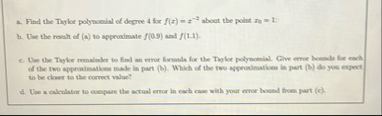 Fd kept of 19) 2st hep
[SI TR——y
i nT be fd nr fre eT br. Go ee hd fe
EE LE SI RE TRE
This is AI generated Response.
Asked by: Ratan
Created at: 2025-06-16 12:30:53
Asked by: Ratan
Created at: 2025-06-16 12:30:53
Final Answer:
Rendered
Raw Text
Did you like this answer?
Let's answer **part (a)** and **part (b)** step-by-step, with explanations at the end of each step.
We'll find the Taylor polynomial (step 1), then use it to approximate values (step 2).
---
### **Step 1: Find the Taylor polynomial of degree 4 for \( f(x) = x^2 - x \) about \( x_0 = 1 \).**
Recall the general Taylor polynomial of degree 4 centered at \( x_0 \):
\[
P_4(x) = f(x_0) + f'(x_0)(x-x_0) + \frac{f''(x_0)}{2!}(x-x_0)^2 + \frac{f'''(x_0)}{3!}(x-x_0)^3 + \frac{f^{(4)}(x_0)}{4!}(x-x_0)^4
\]
First, compute the derivatives:
- \( f(x) = x^2 - x \)
- \( f'(x) = 2x - 1 \)
- \( f''(x) = 2 \)
- \( f'''(x) = 0 \)
- \( f^{(4)}(x) = 0 \)
Now, evaluate at \( x_0 = 1 \):
- \( f(1) = 1^2 - 1 = 0 \)
- \( f'(1) = 2 \cdot 1 - 1 = 1 \)
- \( f''(1) = 2 \)
- \( f'''(1) = 0 \)
- \( f^{(4)}(1) = 0 \)
Plug into the Taylor formula:
\[
P_4(x) = 0 + 1(x-1) + \frac{2}{2!}(x-1)^2 + 0 + 0
\]
\[
= (x-1) + (x-1)^2
\]
**Explanation (Step 1):**
We calculated the first four derivatives of \( f(x) \) and evaluated them at \( x_0 = 1 \). Since the third and fourth derivatives are zero, their terms vanish. The Taylor polynomial of degree 4 is \( \boxed{P_4(x) = (x-1) + (x-1)^2} \).
---
### **Step 2: Use the result of (a) to approximate \( f(0.9) \) and \( f(1.1) \).**
Substitute \( x = 0.9 \) and \( x = 1.1 \) into \( P_4(x) \):
#### For \( x = 0.9 \):
\[
P_4(0.9) = (0.9-1) + (0.9-1)^2 = (-0.1) + (-0.1)^2 = -0.1 + 0.01 = -0.09
\]
#### For \( x = 1.1 \):
\[
P_4(1.1) = (1.1-1) + (1.1-1)^2 = (0.1) + (0.1)^2 = 0.1 + 0.01 = 0.11
\]
**Explanation (Step 2):**
We substituted the values \( x = 0.9 \) and \( x = 1.1 \) into the Taylor polynomial to get the approximations \( f(0.9) \approx -0.09 \) and \( f(1.1) \approx 0.11 \).
---
### **Final Answers:**
- **(a) The Taylor polynomial of degree 4 is \( \boxed{(x-1) + (x-1)^2} \).**
- **(b) Using this polynomial:**
- \( f(0.9) \approx \boxed{-0.09} \)
- \( f(1.1) \approx \boxed{0.11} \)
📢 Instructions:
- Ask anything relatd to above question only.
- For new Question goto :