 VIPSolutions
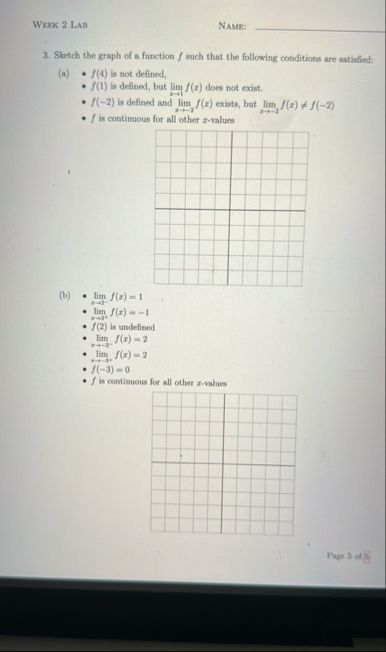
give answer in 2 step with explanation at the end of each step and final answer at the end: de student question Time Left : 01 : 22 : 10 Student question Whek 2 Lab Name: 3 . Sketch the graph of a function f such that the following conditions are satisfied: ( a ) - f ( 4 ) is not defined, f ( 1 ) is defined, but lim x → 1 f ( x ) does not exist. f ( - 2 ) is defined and lim x → - 2 f ( x ) exists, but lim x → - 2 f ( x ) ≠ f ( - 2 ) f is continuous for all other x - values ( b ) * lim x → 2 - f ( x ) = 1 lim x → 2 f ( x ) = - 1 f ( 2 ) is undefined lim x → - 3 - f ( x ) = 2 lim x → - 3 , f ( x ) = 2 f ( - 3 ) = 0 is continuous for all other x - values Puge 3 of ( 5 )
Question:
give answer in 2 step with explanation at the end of each step and final answer at the end:
de student question
Time Left :
01
:
22
:
10
Student question
Whek
2
Lab
Name:
3
.
Sketch the graph of a function
f
such that the following conditions are satisfied:
(
a
)
-
f
(
4
)
is not defined,
f
(
1
)
is defined, but
lim
x
→
1
f
(
x
)
does not exist.
f
(
-
2
)
is defined and
lim
x
→
-
2
f
(
x
)
exists, but
lim
x
→
-
2
f
(
x
)
≠
f
(
-
2
)
f
is continuous for all other
x
-
values
(
b
)
*
lim
x
→
2
-
f
(
x
)
=
1
lim
x
→
2
f
(
x
)
=
-
1
f
(
2
)
is undefined
lim
x
→
-
3
-
f
(
x
)
=
2
lim
x
→
-
3
,
f
(
x
)
=
2
f
(
-
3
)
=
0
is continuous for all other
x
-
values
Puge
3
of
(
5
)
This is AI generated Response.
Asked by: Ratan
Created at: 2025-06-16 04:24:20
Asked by: Ratan
Created at: 2025-06-16 04:24:20
Final Answer:
Rendered
Raw Text
Did you like this answer?
Let's break down the solution into **two steps** for each part (a) and (b), providing explanations at each step and then summarizing the final answer at the end.
---
## (a) **Step 1: Interpret and apply each condition**
Let's analyze each condition:
1. **f(4) is not defined:**
- At \(x = 4\), there should be a *hole* (no value).
2. **f(1) is defined, but \(\lim_{x \to 1} f(x)\) does not exist:**
- At \(x = 1\), the function has a value (a point), but the left and right limits do **not** meet. This could be a jump.
3. **f(-2) is defined and \(\lim_{x \to -2} f(x)\) exists, but \(\lim_{x \to -2} f(x) \ne f(-2)\):**
- At \(x = -2\), there's a defined value, but it's *not* equal to the limit (removable discontinuity).
4. **f is continuous for all other x-values:**
- Everywhere else, the function is smooth with no breaks.
**Explanation:**
At this stage, we set up our function to have:
- a hole at \(x = 4\),
- a jump at \(x = 1\),
- a removable discontinuity at \(x = -2\),
- and smooth/continuous elsewhere.
---
## (a) **Step 2: Sketch the graph**
- Draw a smooth curve everywhere.
- At \(x = 4\): leave an open circle (hole), don't define \(f(4)\).
- At \(x = 1\): make a jump (e.g., left side approaches 2, right side approaches -1), but put a filled point for \(f(1)\) at any value (e.g., 5).
- At \(x = -2\): draw the curve so that the limit as \(x \to -2\) is, say, 1, but \(f(-2)\) is a different value (e.g., 3), so you put a filled dot at (−2, 3) and an open circle at (−2, 1).
**Explanation:**
This sketch will satisfy all the required conditions: the jump, hole, removable discontinuity, and continuity elsewhere.
---
**Final Answer (a):**
> - The graph is continuous everywhere except:
> - Hole at \(x = 4\),
> - Jump at \(x = 1\) (with \(f(1)\) defined, but different left/right limits),
> - Removable discontinuity at \(x = -2\) (limit exists, but not equal to value).
---
---
## (b) **Step 1: Interpret and apply each condition**
Let's analyze each condition:
1. **\(\lim_{x \to 2^-} f(x) = 1\), \(\lim_{x \to 2^+} f(x) = -1\):**
- At \(x = 2\), left and right limits are different (jump discontinuity).
2. **f(2) is undefined:**
- No value at \(x = 2\), so an open circle.
3. **\(\lim_{x \to -3^-} f(x) = 2\), \(\lim_{x \to -3^+} f(x) = 2\), \(f(-3) = 0\):**
- Limit exists and equals 2, but function value is 0 (removable discontinuity).
4. **f is continuous for all other x-values:**
- Smooth everywhere else.
**Explanation:**
At this stage, we plan for:
- a jump at \(x = 2\) with no defined value (open circle),
- a removable discontinuity at \(x = -3\) (limit ≠ value),
- and continuous elsewhere.
---
## (b) **Step 2: Sketch the graph**
- Draw a smooth curve everywhere.
- At \(x = 2\): left side approaches 1, right side approaches -1, no point at \(x = 2\).
- At \(x = -3\): left and right both approach 2 (so open circle at (−3, 2)), but define \(f(-3) = 0\) (filled dot at (−3, 0)).
- Rest: smooth curve.
**Explanation:**
This graph will show the jump discontinuity with undefined value at 2, and removable discontinuity at −3, continuous elsewhere.
---
**Final Answer (b):**
> - The graph is continuous everywhere except:
> - Jump at \(x = 2\) (left limit 1, right limit -1, no value at 2),
> - Removable discontinuity at \(x = -3\) (limit is 2, but value is 0).
---
**If you want to see how to draw these, let me know!**
📢 Instructions:
- Ask anything relatd to above question only.
- For new Question goto :