 VIPSolutions
give answer in 2 step with explanation at the end of each step and final answer at the end: Let � � � a Hermitian operator, the eigenvectors � � which form a complete orthonormal set and the eigenvalues � � which are all positive. Prove that for any two vectors | � : and | � : , | ( : � | � | � : ) | 2 ≤ ( : � | � | � : ) ( : � | � | � : ) Also prove that � � ( � ) > 0 .Let H be a Hermitian operator, the eigenvectors of which form a complete orthonormal set and the eigenvalues of which are all positive. Prove that for any two vectors |u) and |v), [(ulHIV)[* < (ulH]u)(v[H]v). Also prove that Tr(H) > 0. (3 marks)
Question:
give answer in 2 step with explanation at the end of each step and final answer at the end:
Let
�
�
�
a Hermitian operator, the eigenvectors
�
�
which form a complete orthonormal
set and the eigenvalues
�
�
which are all positive. Prove that for any two vectors
|
�
:
and
|
�
:
,
|
(
:
�
|
�
|
�
:
)
|
2
≤
(
:
�
|
�
|
�
:
)
(
:
�
|
�
|
�
:
)
Also prove that
�
�
(
�
)
>
0
.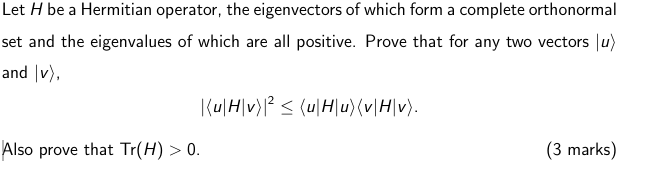 Let H be a Hermitian operator, the eigenvectors of which form a complete orthonormal
set and the eigenvalues of which are all positive. Prove that for any two vectors |u)
and |v),
[(ulHIV)[* < (ulH]u)(v[H]v).
Also prove that Tr(H) > 0. (3 marks)
This is AI generated Response.
Asked by: Pagal
Created at: 2025-06-15 19:19:17
Asked by: Pagal
Created at: 2025-06-15 19:19:17
Final Answer:
Rendered
Raw Text
Did you like this answer?
Let's break down the solution into **two steps** as requested, with explanations at each step:
---
### **Step 1: Prove the Inequality Using Cauchy-Schwarz**
**Statement:**
For any two vectors \( |\mu\rangle \) and \( |\nu\rangle \), and a Hermitian operator \( H \) with positive eigenvalues,
\[
|\langle \mu | H | \nu \rangle|^2 \leq \langle \mu | H | \mu \rangle \langle \nu | H | \nu \rangle
\]
**Proof & Explanation:**
- Define a new inner product: \( (\phi, \psi)_H = \langle \phi | H | \psi \rangle \).
- Since \( H \) is Hermitian and has positive eigenvalues, this is a valid inner product.
- By the **Cauchy-Schwarz inequality** for inner products:
\[
|(\mu, \nu)_H|^2 \leq (\mu, \mu)_H (\nu, \nu)_H
\]
which gives:
\[
|\langle \mu | H | \nu \rangle|^2 \leq \langle \mu | H | \mu \rangle \langle \nu | H | \nu \rangle
\]
**Explanation:**
This follows directly from the Cauchy-Schwarz inequality, as the positivity of \( H \) ensures the inner product is well-defined.
---
### **Step 2: Prove \(\mathrm{Tr}(H) > 0\)**
**Proof & Explanation:**
- The trace of an operator in an orthonormal eigenbasis is the sum of its eigenvalues.
- Let the eigenvalues of \( H \) be \( \lambda_i > 0 \).
- Therefore,
\[
\mathrm{Tr}(H) = \sum_i \lambda_i
\]
- Since all \( \lambda_i \) are positive, the sum is **strictly greater than zero**.
**Explanation:**
The trace is positive because it is a sum of positive numbers (the positive eigenvalues).
---
### **Final Answers:**
1. **Inequality:**
\[
|\langle \mu | H | \nu \rangle|^2 \leq \langle \mu | H | \mu \rangle \langle \nu | H | \nu \rangle
\]
(Follows from Cauchy-Schwarz for the positive-definite inner product defined by \( H \).)
2. **Trace:**
\[
\mathrm{Tr}(H) > 0
\]
(Because all eigenvalues of \( H \) are positive.)
📢 Instructions:
- Ask anything relatd to above question only.
- For new Question goto :