 VIPSolutions
give answer in 2 step with explanation at the end of each step and final answer at the end: Use the groph below to enewer the evertiogs that follow. 7 Mullipoly 1 miss What the to then diversing not there? The linit does nat evide there. The function in subt the treed there.=
Question:
give answer in 2 step with explanation at the end of each step and final answer at the end:
Use the groph below to enewer the evertiogs that follow.
7
Mullipoly
1
miss
What the to then diversing not there?
The linit does nat evide there.
The function in subt the treed there.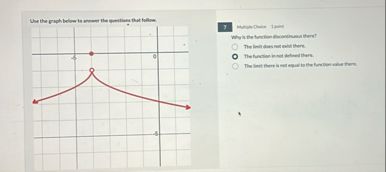 =
This is AI generated Response.
Asked by: Ratan
Created at: 2025-06-15 09:05:25
Asked by: Ratan
Created at: 2025-06-15 09:05:25
Final Answer:
Rendered
Raw Text
Did you like this answer?
Let's solve the problem step by step:
---
**Step 1: Analyze the graph at \( x = 0 \).**
- Looking at the graph, as \( x \) approaches 0 from both sides, the lines come together at the same \( y \)-value.
- However, there is a **hole** (open circle) at \( x = 0 \), which means the function is **not defined** at \( x = 0 \).
**Explanation:**
The **limit exists** at \( x = 0 \) because both sides approach the same value, but the function itself is **not defined** at that point.
---
**Step 2: Answer the question:**
The multiple-choice options are:
1. The limit does not exist there.
2. The function is not defined there.
3. The limit there is not equal to the function value there.
The correct answer is:
**The function is not defined there.**
**Explanation:**
The discontinuity is caused because there is no function value at \( x = 0 \), even though the limit exists.
---
**Final Answer:**
**The function is not defined there.**
📢 Instructions:
- Ask anything relatd to above question only.
- For new Question goto :