 VIPSolutions
give answer in 2 step with explanation at the end of each step and final answer at the end:2 Lrrvoma | oerats || wvworss | sesscaucer2 Teo AsxvouR TEACHER = ———— Larva | octets || wvwores | sesscavcer2 7eaos voun each isa um Er——
Question:
give answer in 2 step with explanation at the end of each step and final answer at the end: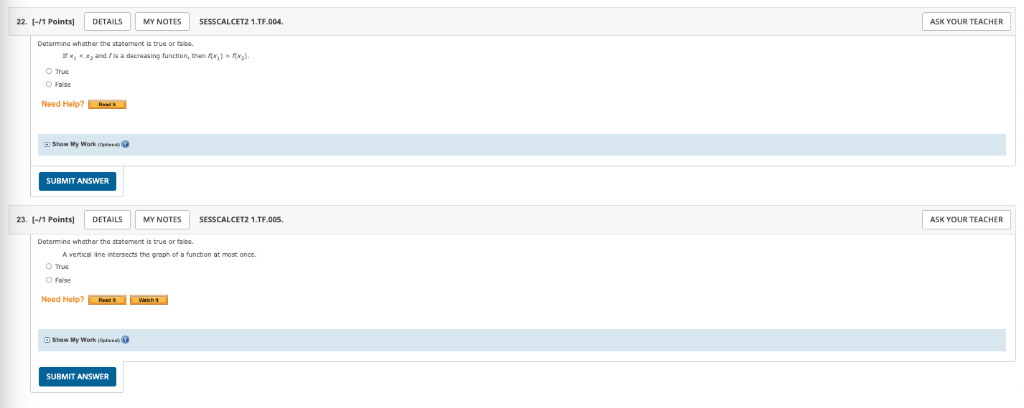 2 Lrrvoma | oerats || wvworss | sesscaucer2 Teo AsxvouR TEACHER
=
————
Larva | octets || wvwores | sesscavcer2 7eaos voun each
isa um
Er——
This is AI generated Response.
Asked by: Ratan
Created at: 2025-06-14 20:26:55
Asked by: Ratan
Created at: 2025-06-14 20:26:55
Final Answer:
Rendered
Raw Text
Did you like this answer?
Let's solve each question step by step with explanations:
---
### **Question 22**
**Statement:**
If \( x_1 < x_2 \) and \( f \) is a decreasing function, then \( f(x_1) > f(x_2) \).
#### **Step 1:**
Recall the definition of a decreasing function.
A function \( f \) is decreasing if for all \( x_1 < x_2 \), \( f(x_1) \geq f(x_2) \). For a *strictly* decreasing function, \( f(x_1) > f(x_2) \).
#### **Step 2:**
The statement does not specify "strictly decreasing," only "decreasing." For a decreasing (not strictly) function, it is possible that \( f(x_1) = f(x_2) \), not necessarily \( f(x_1) > f(x_2) \).
**Final Answer:**
**False**
---
### **Question 23**
**Statement:**
A vertical line intersects the graph of a function at most once.
#### **Step 1:**
Recall the definition of a function.
A function assigns exactly one output (y-value) for each input (x-value). Therefore, for any given \( x \), there is at most one corresponding \( y \).
#### **Step 2:**
A vertical line test: If any vertical line intersects the graph more than once, the graph is not a function. By definition, a function's graph cannot be intersected more than once by a vertical line.
**Final Answer:**
**True**
---
**Summary of Answers:**
- 22: **False**
- 23: **True**
📢 Instructions:
- Ask anything relatd to above question only.
- For new Question goto :